The GOP And “Biblical Israel”

Both Newt Gingrich and Rick Santorum believe in Greater Israel, the non-existence of a Palestinian people, the permanent annexation of the occupied territories, and a war of aggression against Iran because it wants some kind of nuclear deterrent to Israel's 300 or so nuclear warheads. And in a sign of this radical development, you can begin to see more arguments on the right for an explicitly religious fusion of Judaism and evangelical Christianity in creating a permanent fusion of the US and Israel as religiously defined nation-states.

This Barbara Lerner piece in National Review is really quite something. Two things stand out for me: It explicitly makes religious, Biblical arguments for Greater Israel, and it has no reference to what to do with all those Palestinians who are made de facto non-citizens in Greater Israel. But it seems pretty obvious that equal rights for non-Jews in all of Greater Israel would end the exclusively Jewish nature of the state. So they must either exist in enclaves of disenfranchisement – having less electoral clout in Israel than slaves did in the ante-bellum South – or be cleansed from the scene entirely.

Which is it? You will also notice there is scant attention paid to what this position – essentially isolating the US from everyone else on the planet and rendering a complete end to any relationship with the Arab or Muslim world – would do to the interests of the US. Because the interests of the US are not part of this equation. Religion is.

Mercifully, the commenters are aware just how extremist this piece is. My favorite one:

Red herrings about our country's religious heritage aside, there is absolutely nothing conservative about attempting to ground our adjudication of a modern territorial dispute in terms of Scripture.

The Culture Warrior

Santorum's crusade is clear:

Linda Hirshman attacks his backwards sexual ethics:

Rick Santorum’s candidacy, and the Republican Party that hungers for it, looks like a handful of the left-behind fighting a rear-guard action against modernity, which has passed them by. … Western history since the Enlightenment has been peppered with such revolts against the modern world. Usually they are a sign of desperation and find their way, unassisted, to the dustbin of history. On the rare occasion when they take hold, however, they can be extremely dangerous. 

Jen McCreight takes aim at the coverage of Santorum:

[C]an the media please stop referring to politicians like Santorum as running on a platform of "family values"? How is it "family values" to refuse gay people the right to form families? Represent his platform for what it is – homophobia. Don’t accept the labels these bigots want you to use.

What If The GOP Wins?

Washington Monthly is assembling essays on the question. Thomas Mann and Norman Ornstein expect Congress to basically own Romney:

A President Romney would be in a poor position upon taking office to change the course outlined in his campaign. He is already suspected as an infidel by many Republican activists. His fiscal policy would almost certainly be ambitious, one not unlike the budget resolution written by Representative Paul Ryan and passed by House Republicans. Indeed, this is the course Romney has taken with his professed economic plan, released in early November. If Romney tried to dilute his own proposal, he would be met at the beginning of his presidency with a full-scale revolt on his hands from his own party, both in and out of Congress.

Is The One-Child Policy On Its Way Out?

After spotting a new government poster in Beijing showcasing a smiling family with two kids, Evan Osnos speculates:

[T]he Party propagandists may be on to something. Two-child families may not be so far Kidsover the horizon after all, because of a growing consensus that economic pressures demand a change. “China’s shooting itself in the foot” with the one-child policy, Wang Feng, a director of the Brookings-Tsinghua Center for Public Policy in Beijing, told Bloomberg recently in a valuable piece on the big-picture demographics in the developing world. The policy is probably costing China at least half a percentage point off the annual growth rate, which will become more important as growth slows and a rapidly aging society saps the economic engine that has driven China’s rise for a generation. After growing at a steady clip for three decades, China’s working-age population has stalled, and the demographic dividends of that expanding workforce are running short. When do demographers expect the working-age worm to turn? 2013.

Quote For The Day

"[T]here is a widespread belief that Romney’s campaign, like a well-designed corporate strategy, is bound for success. But even if Romney emerges as the nominee, it matters how he gets there. Already, the religious right, represented by Rick Santorum, and Tea Party activists, represented by Ron Paul, have pushed Romney in unwanted directions. In New Hampshire, Republican and independent voters have a chance, through Huntsman, to show him a sturdier model. Jon Huntsman would be a better president. But if he fails, he could still make Romney a better candidate," – The Boston Globe, in its endorsement of Jon Huntsman.

This Meeting Is Over.

Convention center

Steven Malagda wants to know why cities insist on constructing – and expanding – convention centers and meeting facilities: 

The convention business has been waning for years. Back in 2007, before the current economic slowdown, a report from Destination Marketing Association International was already calling it a “buyer’s market.” It has only worsened since. In 2010, conventions and meetings drew just 86 million attendees, down from 126 million ten years earlier. Meantime, available convention space has steadily increased to 70 million square feet, up from 40 million 20 years ago.

(Photo of the Boston Convention Center by Flickr user electric.porcupine.)

Is The Sun Setting On Al Qaeda?

Fawaz Gerges believes so:

If the Arab awakenings of the past year manage to fill the gap of legitimate political authority, they will annihilate the last dregs of Al-Qaeda and like-minded local branches. Only then will Al-Qaeda, like Osama bin Laden, not only die, but, finally, be allowed to die.

Daveed Gartenstein-Ross sighs:

It’s not clear how awakenings in the Arab world can "annihilate" al Qaeda’s central leadership in Pakistan. How will the Arab uprisings annihilate al Shabaab in Somalia? And the chaos in Yemen has resulted in anything but an annihilation of AQAP. I have written previously about why the "Arab Spring" doesn’t inevitably sound the death knell for al Qaeda, and I won’t repeat those arguments here. Suffice it to say that it’s ironic that a piece asking us to critically assess the conventional wisdom to puncture fantasy in turn offers up its own set of seemingly unexamined myths.

The Humanities Aren’t Totally Useless After All

Education_Jobs

Paul Jay and Gerald Graff defend the market value of much-maligned disciplines:

It is true that humanities study, unlike technical training in, say, carpentry or bookkeeping, prepares students not for any specific occupation, but for an unpredictable variety of occupations. But as many before us have rightly pointed out, in an unpredictable marketplace this kind of versatility is actually an advantage.

As Associate Dean [Scott] Sprenger notes, "the usefulness of the humanities" paradoxically "derives precisely from their detachment from any immediate or particular utility. Experts tell us that the industry-specific knowledge of a typical vocational education is exhausted within a few years," if not "by the time students enter the workforce." It is no accident, he observes, "that a large percentage of people running Fortune 500 companies (one study says up to 40 percent) are liberal arts graduates; they advance more rapidly into mid- and senior-level management positions, and their earning power tends to rise more significantly than people with only technical training."

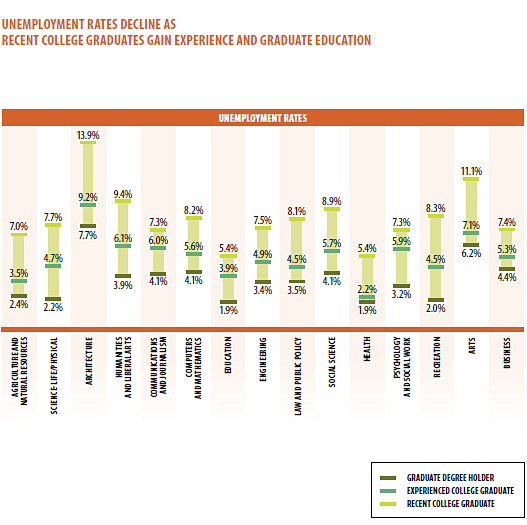
Catherine Rampell flags the above chart from a new study (pdf) and makes the case for a range of college degrees.

Are Movie Theaters Fading? Ctd

More readers keep the discussion going:

I actually find myself going to more movies now than I ever have for one sole reason: my waning attention span. I can't tell you how many times I've tried to put on a DVD or a downloaded movie only to pause it after 20 minutes because I'm so fidgety. I'll also usually find my iPad in my hands while I'm trying to watch, which isn't exactly the best way to immerse oneself in a story. However, when I go to the theater, I have no choice but to give the movie my undivided attention for two hours. I can't check email (or The Dish!) and I can't get up to putter around while the movie is on. The theater forces me to watch what's in front of me, and I subseqently find that I get far more enjoyment as I would at home.

Another writes:

I can only speak from my experience, but I manage a multi-screen art house (with a few mainstream movies thrown in here and there) in a large city. 2011 was actually our most successful year ever at the box office and in overall revenue (and 2010 was the previous high). We are definitely not seeing any long-term downturn. But I think the mainstream industry problem comes from two areas in particular:

a) The dumbing down of major mainstream product and turning them into video games to appeal to a younger audience has backfired. A movie resembles a video game is always going to pale in comparison to the interactivity of an actual video game. This is why all the kids that I know like going to the movies – but they LOVE playing video games.

b) Post Avatar – the rush by several of the mainstream chains to add additional surcharges (for IMAX, for 3-D, for additional screen size, etc.) has backfired and has threatened the main advantage that movies have had. People are going to always want to go out and movies have been and should always remain about the most inexpensive form of quality entertainment (especially compared to going to a performing arts or sporting event).

Another:

What really has helped break the back of movie theaters is computer graphics getting cheaper and easier.  It used to be that serials like Lost, Walking Dead, etc. were not possible except at great expense and as a major broadcast event for a limited run because special effects were so expensive.  Using computers to digitize what used to be man- and money-intensive scenes has opened up TV production studios to produce shows/movies that would have filled the low-A/good-B-film and hobbyist niches (hobbyist niche is like zombie-fan, murder-mystery-fans, etc).

Another reader counters previous ones who complained about other moviegoers:

If there is a segment of the market that is actually saying, "I would go to the movie, but I hate those damn kids with their smart phones!" I am certain it is minuscule. If you're truly bothered, here's a tip: see movies a few weeks after their release, when the crowds are smaller.

One more:

Your commentator who said "If you're older than say 35, the first movie you saw was likely at a theater" is off by about 30 years. Those over 65 or so probably saw their first movies in a theater. But movies started airing on TV almost as soon as there was commercial TV, so once the television became fairly ubiquitous – and that was in the '50s – television became the first home for movies for pretty much everyone.

Though VCRs didn't really appear until the late '70s.

The Daily Wrap

6a00d83451c45669e20162ff129826970d-550wi

Today on the Dish, Andrew blasted Santorum's anti-freedom agenda, labelled Romney the uber-awkward "John Kerry" of 2012, found a heavy anti-Paul bias at the WaPo, and defended the consequences of Paul's ideas on foreign policy. He noted Santorum's lucky timing, exposed the self-proclaimed moral paragon's long history of corruption, praised Obama's Iran policy and political strategy on the CFPB appointment, and unearthed more evidence that the President defied right-wing charicature. Romney looked likely to get hit both as a flip-flopper and extremist in the general, planned to make the deficit worse, and appeared dominant in New Hampshire (where Huntsman flailed).  Gingrich was a "festering white-head of loathing," Santorum may actually have won Iowa (a no-recount caucus) but looked to have some issues in Iowa, and Ron Paul was in it for the looooooooooooong haul. Moderate GOPers were SOL, the media had a clear interest in lying to you about New Hampshire and "Queen Esther" reared her head at CPAC.

Iran imitated Palin (ironically enough given that moniker), Assad's victims extended beyond his borders, and the international climate on climate change looked slightly better. Ryan Avent thought positively about the economy come election time, Reihan hoped for GOP party-switchers, George Will got hit for betraying conservatism in favor of consumerism, and readers  and readers kept discussing why terrorists suck at their jobs and whether movie theaters were on the decline. White girls said dumb things to black girls, naked male bodies were sexy off and on the screen, the drag TV show "Work It" was still awful, and the wives of high-profile marriage equality opponents differed quite publicly. Also, George Washington may have gotten high.

MHB here, Faces of the Day here, Correction of the Day here, Cool Ad here, AAA here, and VFYW here

Z.B. 

(Photo: Justin Sullivan/Getty Images.)