[T]here’s roughly a one-in-four chance that Santorum actually received the most votes. Romney’s margin of victory was 8 votes out of 122,255 cast, or 0.0065%. If you look at a number of recent recounts — Florida Presidential 2000, Ohio Presidential 2004, Washington Gubernatorial 2004, and four recounted Minnesota races in 2008 — the initial error margin in all but Ohio and one of the Minnesota races was greater than that.
Month: January 2012
Is Ron Paul Setting Back Non-Interventionism? Ctd
Greg Scoblete joins the debate:
[T]he real center of gravity of this discussion isn't on whether the public is aware or not aware of non-interventionism. What matters is whether the elite consensus that guides U.S. policy becomes more receptive to the idea. To the extent that Paul is exposing people to the idea (especially young people) and these people eventually enter into the machinery of U.S. foreign policy slightly more skeptical of international crusades, so much the better. But he may also be reinforcing in the minds of up-and-coming policymakers that only fringe candidates support the idea and for the sake of their political careers they'd better steer clear.
Larison counters:
I would say that just about any exposure is good exposure. There is always the danger that non-interventionists can be portrayed in a unflattering light, but to a large extent negative associations are already there, and they aren’t going to be eliminated by waiting for a different messenger to show up.
What Paul has done is introduce a new paradigm: that freedom matters more than power. He is now campaigning in a state whose motto is "Live Free Or Die", a concept so alien to the current GOP candidates it might as well be in Swahili. Newt Gingrich, to take one example, has doubled down on Dick Cheney's "one percent" doctrine, arguing that the US should assume that a Jihadist with a nuke in an American city is not just feasible, but potentially imminent – despite the fact that we have not had a single suicide bomber succeed in the US since 9/11 with even a bunch of fertilizer explosives. "Live Risk-Free Or Die" is the core GOP message on national security. "We will take care of you".
And this is an attractive illusion to so many, who grow up in a culture where every problem has a solution, and most problems require collective government solutions. If the left says "we will take care of you by entitlements" at home; the right says "we will take care of you by constant warfare" abroad. Paul – in stark contrast to both – is saying a famous "why?" to Robert Kennedy's "why not?" And part of his appeal is its complete inversion of our politics, left and right. I have no idea whether this will backfire or not. Most good ideas do, at first. But he has expanded the range of ideas in our national debate more radically than anyone since Reagan. And since I believe ideas have consequences, and that wider debates are likely to lead to better collective judgments, good for him.
George Washington’s Hemp Fields
A reader adds to this post:
Not only is Newt dumb, the dude has obviously never seen Dazed and Confused.
More history for Gingrich:
President George Washington wrote a letter that contained an oblique reference to what may have been hashish. "The artificial preparation of hemp, from Silesia, is really a curiosity." 38 Washington made specific written references to Indian hemp, or cannabis indica, and hoped to "have disseminated the seed to others. " 39 His August 7, 1765 diary entry, "began to separate the male from the female () plants," describes a harvesting technique favored to enhance the potency of smoking cannabis, among other reasons. 40 Hemp farmer Thomas Jefferson and paper maker Ben Franklin were ambassadors to France during the initial surge of the hashish vogue. Their celebrity status and progressive revolutionary image afforded them ample opportunities to try new experiences.
Conservatism Is Not Consumerism
Patrick Deneen is dismayed by George Will's giddy claim that the fracking boom is a victory for conservatism:
We do better to look to more unlikely sources, such as the British conservatism of Roger Scruton, and his forthcoming book Green Philosophy, discussed here by Rod Dreher. Perhaps there is a connection between consuming less, being more in place, and hence being responsible for one’s places and people, and – in turn – less growth in government, more self-reliance and self-governance. Perhaps the prospect of more gas will fuel not a resurgence in conservative values, but their further erosion. Perhaps it’s not the "progressives" who should worry us most; rather, it’s so-called "conservatives" like Will, who seem to be the biggest cheerleaders for fueling a future in which conservatism has almost everything to do with SUV sales and the right to increase childhood diabetes, and exceedingly little to do with conserving things worth saving.
Crunchycon Dreher elaborates:
Since when did conservatism come to associate itself with increasing abundance for its own sake, with no attention paid to the costs of our immoderation? Does Will see it as a victory for conservatism when a morbidly obese family piles food onto its plate at the cheap buffet? Was it a conservative triumph when Americans who didn’t have much savings got mortgages for big houses they couldn’t afford? That’s the logic of Will’s thinking in this column.
The View From Your Window

Bathsheba, Barbados, 12 pm
Are Movie Theaters Fading? Ctd
A reader continues the thread:
I'm wondering if why first-run movie theaters are so horrible isn't only due to the improvements in home theater; what if it's simply a question of age? If you're older than say 35, the first movie you saw was likely at a theater. If you're under 35, your first movie was probably viewed on a VCR in your home, where there was no one to object to your talking, where if you needed to take a break the film could be stopped for you, and if you missed a plot point or a line of dialogue, you were just a rewind button away from seeing it again.
Another writes:
I feel that it should be pointed out that it's not only kids and teenagers talking during movies these days. During a few recent movie outings, my girlfriend and I have been annoyed by older couples who also don't seem to understand the etiquette of watching a movie in a public theater. They'll either attempt to whisper guesses about what will happen to one another, or explain to their friend/spouse what just happened when the other doesn't understand. Then there are the elderly couples who have trouble hearing and ask for lines to be repeated.
Another joins the readers from Austin, Portland and Seattle:
My partner and I live in Greenwich Village, which is a movie lover's heaven. We live within walking distance of several megaplaxes and at least four independent cinemas. One of them is Film Forum, which shows a wild variety of movies, ranging from new releases to the most obsure vintage films. For example, last night I attended a screening of the 1924 silent epic Greed, and it was sold out. (The theater accommodates 250-300). Last week, a screening of The Cameraman, starring Buster Keaton, also sold out. I occasionally see a film on Turner Classic Movies, but, for us and for many other New Yorkers, the big screen still rules.
By the way, if you haven't seen it, don't miss the new Iranian film A Separation. It was acclaimed in its home country, but to my eyes, it lays bare the foundations of a society informed by a vision of justice that does nothing to help its people. It's also the most gripping drama I've seen all year.
Will The Economy Doom Obama?
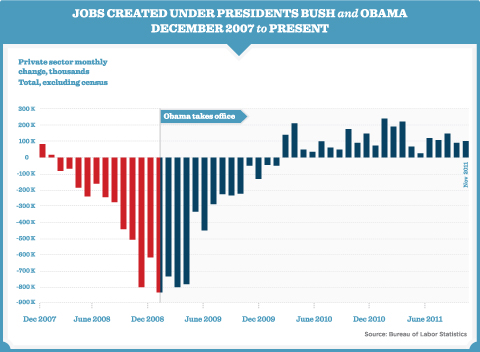
Ryan Avent imagines the president's record going forward:
A lot can happen over the next year, but for the moment the current recovery looks likely to continue. On Friday, the Bureau of Labour Statistics will report the latest employment data, for the month of December. The consensus forecast is for a gain of 170,000 private-sector jobs and a loss of 20,000 public-sector jobs, for a net gain of 150,000. (In the year to November, the economy added an average of 133,000 net jobs and 157,000 private-sector jobs per month, so this would represent a slight acceleration.) If we extrapolate those changes out through the election, then Mr Obama's opponent will only be able to claim net job losses during the Obama presidency of just 55,000. What's more, the net figure will entail government job losses of 833,000 combined with net private-sector job creation of 788,000. Given steady improvement in state and local finances, continued loss of 20,000 government jobs per month seems too high, so there is a decent chance that the Republican nominee will be unable to claim any net job loss during the Obama presidency at the time voters go to the polls.
(Chart from Obama's campaign blog)
Party Switchers
Reihan wants the GOP to welcome them. He follows up:
In my column, I reference Susana Martinez, the Republican governor of New Mexico, who was, until the 1990s, a Democrat. Were Martinez to develop a higher national profile, she could, in theory, unlock the key to wooing upwardly-mobile female Mexican American voters concerned about issues like education (her signature issue), wage growth, and crime and disorder.
One of my favorite examples of a potent party-switcher is Randy Altschuler, a successful young Jewish American entrepreneur who lost the narrowest congressional race of 2010 in the East End of Long Island. The key thing about Martinez and Altschuler is that neither of them seems to have repudiated their group affiliations. Martinez is quite comfortable with her regional and ethnic identity, and the same is true of Altschuler. Republicans in the Northeast must project that they aren’t conservative Southerners in disguise, but rather that they reflect the cultural style and the priorities of their region. For example, it should be entirely natural for Northeastern Republicans to favor public investment in mass transit, provided it is cost-effective, transparent, and open to competition.
Drag Gone Bad, Ctd
A reader writes:
Besides being unfunny, "Work It" is also not very original. "Bosom Buddies" in the '80s was very similar with the only difference being that they dressed as women because they couldn't find somewhere to live – the two lead characters moved into a women-only apartment building. Oh yeah, and it starred Tom Hanks.
Credit sequence above. Longer clip from the "Bosom Buddies" pilot here. Alyssa Rosenberg cheers "Work It"'s low ratings. She struggled to get through the first episode:
Work It‘s approach to revelation via gender-switching is particularly grating given that Up All Night is doing the same thing, with vastly more tenderness and perceptiveness. It’s particularly ugly to see Lee pretend to have been sexually harassed at his old job, telling his new potential boss at the pharmaceutical sales company where he goes to work that “The guys were always sassing me, or patting my fanny, or ogling my teats.” In pretending to understand female experience, he’s demonstrating his ignorance of it in a way that minimizes sexual harassment, making it cutesy and adorable.
Is The Climate On Climate Change Shifting?
Robert Stavins thinks the recent Durban negotiations have altered the way the world is thinking about addressing global warming:
The Durban Platform – by replacing the Berlin Mandate – has opened an important window. It is this. The national delegations from around the world now have a challenging task before them: to identify a new international climate policy architecture that is consistent with the process, pathway, and principles laid out in the Durban Platform, namely to find a way to include all key countries (such as the 20 largest national and regional economies that together account for upwards of 80% of global carbon dioxide emissions) in a structure that brings about meaningful emissions reductions on an appropriate timetable at acceptable cost.
David Bosco is a bit more dismissive. Brad Plumer goes back to basics:
In December, the global climate talks in Durban, South Africa, didn’t provide much optimism on the climate front. The world is still on pace to heat the planet 3.5°C by century’s end. Given what scientists are learning about the link between climate change and natural disasters, as well as about worrisome feedbacks like melting permafrost in the Arctic, that’s a risky prospect. The International Energy Agency expects that global emissions need to peak by 2017, or else we’ll have locked in enough fossil-fuel infrastructure to make a “dangerous” 2-degree Celsius rise in temperatures impossible to avoid. Tick, tick, tick…
 The Dish