Eating In Israel

Annalise Koltun shares his experiences with kosher and non-kosher Israeli cuisine. An aside on Israeli agriculture:

For most of its history, Israel’s produce was watered, weeded, and picked by Palestinian workers who crossed over each day from the West Bank or Gaza. Since the start of the Second Intifada in 2000, however, Israeli has closed its borders to most of these workers. And since few or no Israelis are willing to work in the hot sun for minimum wage, Israel now imports workers from Thailand, Vietnam, and the Philippines. There are hundreds of thousands of these foreigners in Israel; in 2010, the first victim of a Hamas rocket attack after the previous year’s Gaza War was a man named Manee Singueanphon, not Moshe Cohen.

Why Would Robots Be Evil?

Alyssa Rosenberg applauds the above short film for debunking the fears of the privileged class:

The shopkeeper is angry at a robot who is physically smaller than he is, who is annoying rather than intimidating. He commits an act of terrible violence against that much more vulnerable actor. And then he discovers that things he’s conditioned to want to protect and find adorable—kittens—are emotionally dependent on the robot, who has been stealing milk to feed them. It’s a narrative that questions the shopkeeper’s prejudices and assumptions, rather than suggesting he’s right to be angry and afraid of a new element in his environment.

E.D. Kain nods:

One reasons Blade Runner was so interesting and complex was the very reason Alyssa enjoyed the above short: it turned the fear of the powerful robot Other on its head, and granted them their humanity and their frailty, and ours.

(Video: No Robots from YungHan Chang)

Why Discourage Bilingualism?

Julie Sedivy reiterates the cognitive benefits of knowing two languages:

[A]n intriguing Israeli study led by Esther Adi-Japha found that the drawings of bilingual kindergarten-age kids were different from their monolingual peers. When asked to draw a picture of a flower that does not exist, monolingual children were fairly unadventurous, drawing perhaps a flower that was missing its leaves, or a flower with only one petal. Bilingual children, on the other hand, incorporated elements from completely different objects—producing for instance, a flower with a tail, or a flower with teeth. This kind of cross-category mixing in children’s drawings tends not to occur until kids are about eight years old, putting the bilingual kids on an accelerated timeline for this particular skill.

Heaven For The 1%

Eternalprogression

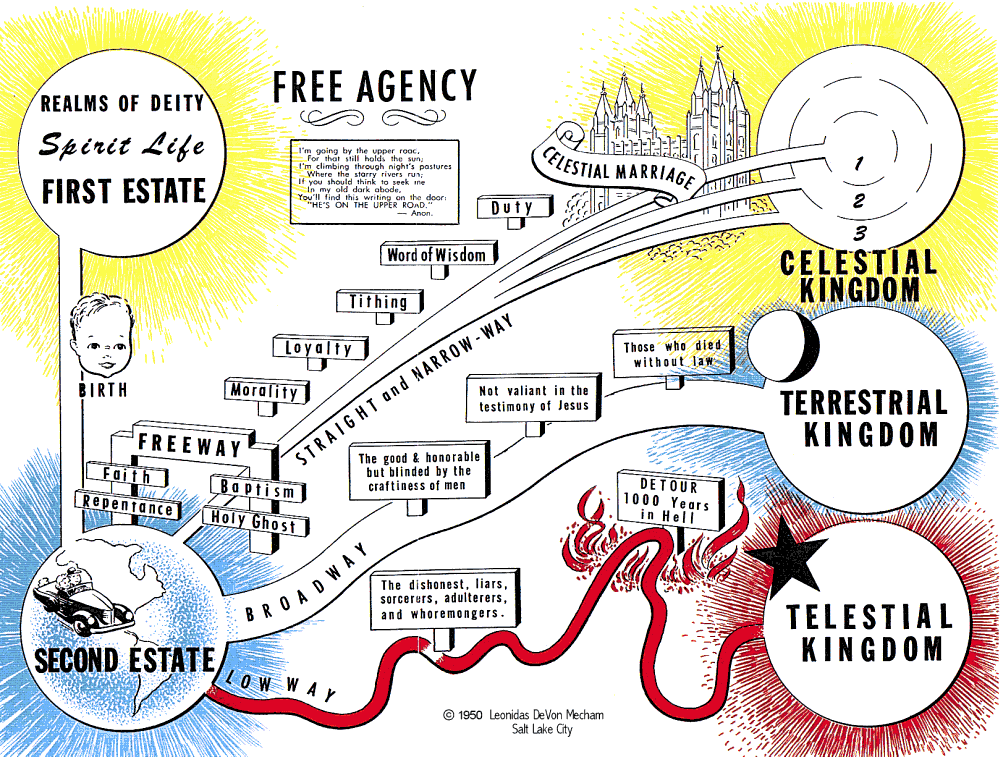
Mormons believe in three heavens and one hell. The celestial kingdom is the most desirable:

There are also different sub-degrees of glory within the celestial kingdom, and the highest degree can be reached only by couples who are married together in the temple, and in which the husband has joined what Mormons call the “Melchizedek priesthood." (Pretty much every devout male Mormon joins the priesthood by the time he’s married.) Those who attain the highest degree become gods in the afterlife, meaning that they can bear new children in heaven, and may even have their own planets.

(Artist Rendering of Eternal Progression via the Utah Lighthouse Ministry)

When We Can’t Forgive

When Greg Bottoms' older brother was 25, he tried to burn down his family's house when his family was inside. After fifteen years in a prison psychiatric treatment facility, the brother tried to contact the family:

I told the social worker I could not speak to him, nor could my mother, who is in her 60s now, living a peaceful life after many years of a damn difficult one. Call me cold, but our problem—his problem, but ours by extension—is intractable. I wish I could offer some kind of easy prescription here—something to do with politics and policy, with therapeutic philosophies or biochemical treatment protocols. But the mystery of mental anguish, of the mind on the outs with itself, of a version of hell made manifest in a suburban living room, is the one thing in my life that has brought me to the point where my only option seemed to be to pray. To reengage my brother would be suicidal. What choice do I have? The past comes flooding back. I cut him loose to survive.

The Theology Of Star Wars

Liel Leibovitz critiques it:

We revere Star Wars because to our minds—modern machines that equate religion with superstition and are willing to disregard imperfections in science but never in dogma—the movies represent transcendentalist humanism at its best, a perfect manifestation of that noxious label, “spiritual,” that people use to describe themselves when they’re too dull to believe in religion and too dim to understand science. This is why the Force has become the organizing metaphor of our time; there’s no better one for those who believe that if we only open our hearts and understand people are all the same and all good we’d be enlightened enough to lift rocks with a tilt of our heads.

Should Atheists Build Their Own Temple?

2601_atheists

Alain de Botton believes so:

You can build a temple to anything that's positive and good. That could mean: a temple to love, friendship, calm or perspective. Why should religious people have the most beautiful buildings in the land? It's time atheists had their own versions of the great churches and cathedrals. A beautiful building is an indispensable part of getting your message across. Books alone won't do it.

His design:

Measuring 46 meters in all, the tower represents the age of the earth, with each centimetre equating to 1 million years and with, at the tower’s base, a tiny band of gold a mere millimetre thick standing for mankind’s time on earth.The Temple is dedicated to the idea of perspective, which is something we’re prone to lose in the midst of our busy modern lives.

In an interview with Jim Houston, de Botton addressed the criticisms of the New Atheists. Watch his TED talk on what atheists can learn from religion here.

(Image of the planned temple via Londonist)

How Did The Inquisition Happen?

Cullen Murphy traces how intolerance and persecution took on an institutional life:

The inquisitors shared an outlook of moral certainty. In a world of moral certainty, the unthinkable becomes permissible. The sanctity of private conscience is no longer deemed inviolate. … It all sounds very medieval. But it’s not merely medieval. Scholars may debate whether there truly is such a thing as a “totalitarian” state, and what its characteristics are, but the desire to control the thoughts and behaviour of others – joined to a belief that God or history will render an approving judgement – underlies much of the sad narrative of the past hundred years: the police states, the dirty wars, the ethnic cleansing, the internments, the renditions, the Red Scares, the fatwas, the special prosecutors, the electronic surveillance, the encroachments accomplished in name of national security.

More on the Inquisition as predecessor to today's acceptance of torture here.

“Jesus > Religion”

Over the past few weeks, this pro-Jesus anti-religion video by Jefferson Bethke has racked up more than 17 million views:

Lisa Fullam captions:

I post this here because I suspect he represents a very widely held set of notions among Millennials. These are the young folks who not only don’t darken the doors of churches, but don’t see any reason for doing so. As they see it, the Christian churches’ concerns simply don’t mesh with their concerns. 

CBS interviewed Bethke earlier this week. Another young Christian created a response video defending the Catholic Church: