Why Did Romney Get A Pass?

Byron York is incredulous

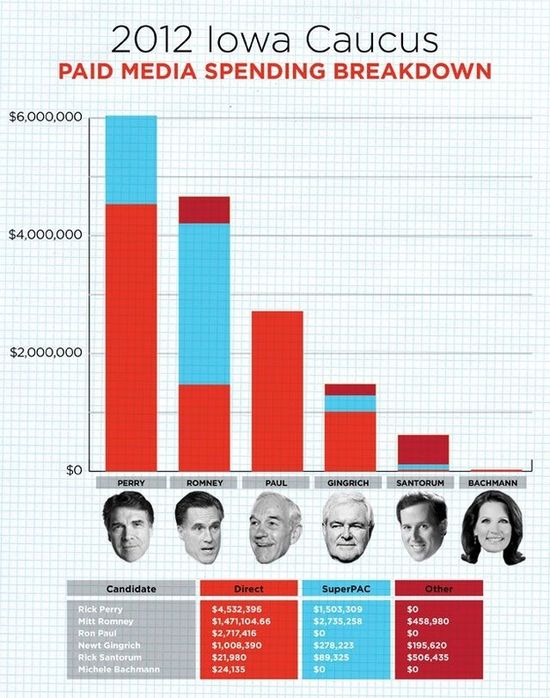
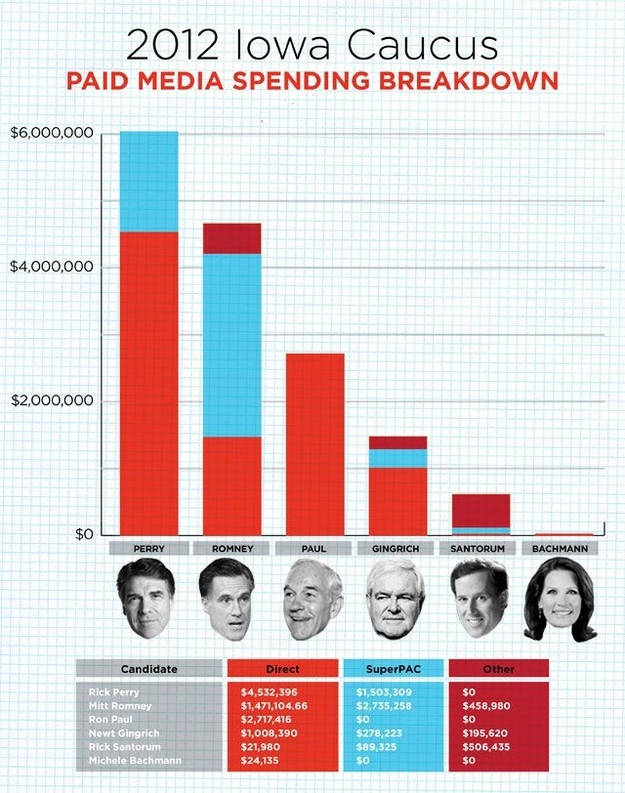
As Iowans go to their caucuses, Romney has remained remarkably unscathed. The campaign ad study found that only 20 percent of ads have targeted him, and even those mostly hit several candidates, with Romney being just one of a group. Romney has faced nothing like the full-bore, straight-on attacks that crippled Gingrich. Of course, some of Romney's adversaries just don't have the money to wage an air campaign. But some do. Rick Perry, for instance, has spent more on ads than any other contender in Iowa and also has a super-PAC raising money on his behalf. But Perry has spent his time fighting to be the anti-Romney, not fighting Romney himself.

Adam Sorensen proposes a theory:

Maybe, just maybe, everybody is hesitant to bloody Romney on the airwaves because they don’t want a raw relationship with the nominee. He’s looking that strong. … If the GOP primary is practice for a November bowl game against President Obama, Romney’s been given the red jersey. For the most part, no contact.
Did Negative Ads Sink Gingrich?

Gingrich_Negative

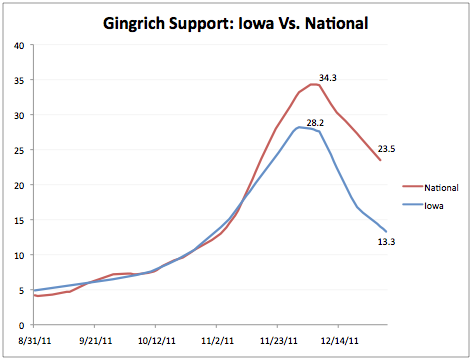
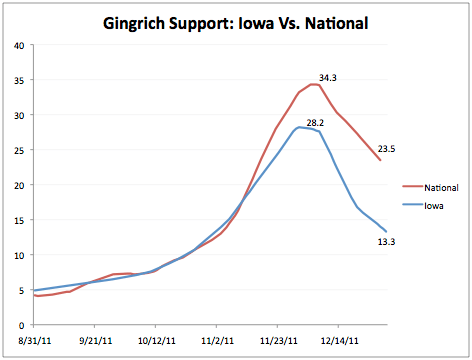
That's the conventional wisdom. Blumenthal weighs the evidence:

According to CMAG's Goldstein, none of the Republican candidates or their Super PACs aired advertising nationally, either on broadcast or cable television, so the national decline resulted from media coverage that echoed many of the same criticisms delivered in the paid ads in Iowa (and even some of the ads themselves).

Understanding Iowa

Ezra Klein will be watching more than the vote count:

[N]either the media nor party elites respond to Iowa in an easily predictable fashion. There's no simple convergence around the winner. Sometimes, as with Sen. Tom Harkin's 1992 win in Iowa, no one cares about Iowa whatsoever. In that case, the win didn't count as Harkin was from Iowa. Sometimes, a win in Iowa counts as an impressive victory, but not one with obviously national implications — that's essentially how Mike Huckabee's 2008 win was greeted. Sometimes, a win in Iowa vaults a candidate directly to frontrunner status, as happened to then-Sen. Barack Obama in 2008. Sometimes, it persuades the party to coalesce against a threat, as happened with Pat Robertson's second-place finish in 1988.

Nyhan wants journalists to recognize the role they play. Kevin Drum counters and claims that the media's importance has been diminished this cycle. Matt Steinglass is closer to Nyhan:

It's a weak field, and to some extent things are always like this during the primaries. But it is striking how the evolution in sympathies resembles the narrative arc of a season of an hour-format TV drama or reality show, where writers and producers are deliberately tweaking developments to sustain audience tension. Those wild swings in voter preference are clearly predicated on weak initial attachments to the candidates. But I think they also reflect the news-media industry's increasing competence at performing its core revenue-generating function of holding public attention by creating campaign narratives with frequent twists and turns and shifting audience perspective and empathy.

Face Of The Day

136361320

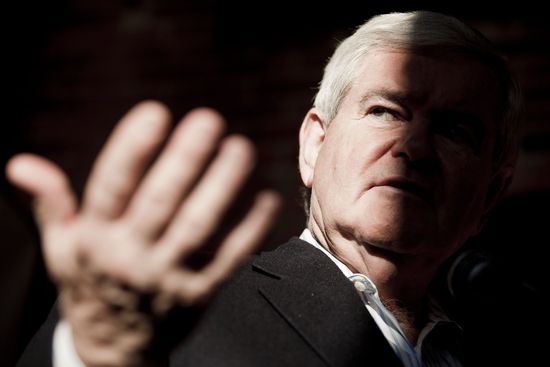
Republican presidential candidate, former Speaker of the House Newt Gingrich, speaks at a campaign stop to bolster support on the day of the Iowa Caucus, January 3, 2012, at Elly's Tea in Muscatine, Iowa. After a surge of support in early December, Gingrich saw a double digit-drop to 12 percent in last week's Des Moines Register poll, compared to front-runner Mitt Romney's 24 percent going in to the caucus. Photo by T.J. Kirkpatrick/Getty Images.

Is Libertarianism Fundamentally Racist? Ctd

TNC sharpens the argument about process and bad faith that I went after:

Racists–and those who exploit racism–are rarely about the business of openly declaring themselves as such, especially after their cause has been thumped, Before the Civil War, you could find all manner of Southerners exalting the "great moral truth of slavery." Afterwards, they claimed it was just "State's Rights." Before Reconstruction, the defeated Confederates employed explicit black codes that reduced African-Americans to slavery. After Redemption they moved to "vagrancy laws." "contracts" and "grandfather clauses."  In the 1960s George Wallace would loudly declare "segregation forever!" Now we say "the Civil Rights Act destroyed privacy." In the era of militia madness, Ron Paul defended his racist newsletters. In the era of Barack Obama, he didn't read them.

It certainly is possible that Ron Paul never read a publications produced in his own name, just as it's possible to sincerely believe that the Civil Rights Act destroyed personal liberties, and it's possible to sincerely believe that if you are going to vote, you should be able to read the names of the candidates, or that Lincoln destroyed the original values of the republic. But it's also true that those beliefs have long been used to shield more odious ones. Forgive me for being suspicious when I see them employed in combination.

Fine. Just call them suspicions. Not facts.

Drag Gone Bad

"Work It", a show about men dressing up as women to get jobs, premieres tonight. It looks excruciatingly unfunny:

Noelle Howey isn't laughing:

About one in four transgender Americans report losing a job because of their gender identity, according to a national transgender-discrimination survey released last February by the National Center for Transgender Equality and the National Gay and Lesbian Task Force. Transgender people report double the unemployment rate as the rest of the population. And even for those who keep their jobs, a stunning 90 percent of trans people say they have experienced disrespect, discrimination, and even violence on the job.

Michael Abernethy pans the show:

The real problem with Work It [is] that it can wring nothing funny out of this situation, only strained, dated gags. The show’s most egregious offense is that it is uninspired and unoriginal. Cross-dressing persons can be found in Greek comedies, the works of Shakespeare, and early silent films. Were Work It to offer something new to the debates and conversations about male and female gender roles, it might be worthy of our time. Instead, it will most likely be remembered for years to come, alongside My Mother, the Car and Who Wants to Marry a Millionaire, as one of TV’s truly bad ideas.

Egypt’s Army Problem

Issandr El Amrani unpacks it:

The turbulence that has hit Egypt since mid-November seems, at first glance, mostly a testament to the poor performance of the Supreme Council of the Armed Forces (SCAF) in handling the transition away from the rule of Husni Mubarak. Having assumed power on February 10, the SCAF moved quickly to attain the stamp of popular legitimacy through a March 19 referendum on constitutional amendments. Since then, however, the conclave of generals has stumbled over the flawed logic of its own plan for the transition, as well as ad hoc decision making and a high-handed, dismissive attitude toward the new politics of the country. The SCAF’s plan, in brief, was to engineer a restoration of civilian rule that shielded the army’s political and economic prerogatives from civilian oversight, and perhaps bolstered those roles, yielding a system not unlike the “deep state” that prevailed for decades in Turkey. Such was the system in Egypt, in fact, under Mubarak. As a return to civilian government looms, with Parliament set to reopen and presidential elections scheduled for no later than July 2012, the SCAF is no closer to securing such behind-the-scenes dominance for the military and is much further from winning popular consent to that arrangement.

Relatedly, Malou Innocent calls for the end of US aid to Egypt.

The Toxic Trail

George Packer reflects on the GOP campaign thus far:

It would be a mistake … to believe that, long after Iowa, once the horse race is over, and if he’s elected, Romney could suddenly flip a switch, clear the air of the toxicity left behind by the Republican field, and return to being a cautious centrist whose most reassuring quality is his lack of principles. His party wouldn’t let him; and, after all, how a candidate runs shapes how a President governs. In politics, once a sellout, always a sellout; once a thug, always a thug.

The South Carolina Factor, Ctd

Steven Taylor explains the importance of Iowa and New Hampshire:

[T]here is no example of an eventual nominees utterly failing in IA and NH (defined as third or worse in both) and then going on to success. Perry, Bachmann, and Gingrich all appear destined to achieve that level of failure in both contests.  As such, focusing on SC is a longshot strategy.

Yesterday, Jennifer Rubin likewise dismissed Perry's and Gingrich's plans to make a stand in South Carolina.