Is Maliki Committed To His Country?

GT_IRAQGUARD_120102

"Mohammed Al-Diyali," an Iraqi writing pseudonymously, despairs at Iraq's political future:

I'm actually not that convinced that Maliki and his friends really represent Iraqi Shiites in the first place. Maliki and the others like him spent most of their lives in Iran; they have the mindset of the dictatorship in Iran. The problem is not just whether our politicians are Shiites or Sunnis. The problem is whether they actually care about the country they're supposed to be representing. I don't see any sign that they do. They are all incredibly, brazenly corrupt. In this respect, Hashemi, the Sunni politician that Maliki is now trying to arrest, and Talabani, the Kurd leader, are just the same as Maliki and his kind. When I worked with Americans during the war, I spent a lot of time in the government quarter in the Green Zone, and I saw all of our leaders at work. They all tried to spend as little time in Iraq as possible. They often missed sessions of parliament. They all had homes outside the country where they preferred to spend their time. 

Joel Wing is a tad optimistic:

As for the government breakdown, I think Maliki is really pushing this to the limit. The Iraqi National Movement was very divided, with the ministers and other politicians holding office quite happy with what they had, while Iyad Allawi was on the outside left complaining about Maliki, while completely neglecting his job as a lawmaker. Now, Maliki's action has united the list. Almost all the other parties, the Kurdish Coalition, the Supreme Council, and White Iraqiya have all offered to mediate as well, which shows that they are not behind Maliki's stance. The Sadrists appear to be the only ones he can consistently rely upon. I think that places limits on the Prime Minister, but he seems to be committed to this confrontation. In the end, I think there will be some kind of negotiated settlement, but it will leave Maliki and Allawi's National Movement more bitter than ever, which will solidify the dysfunction.

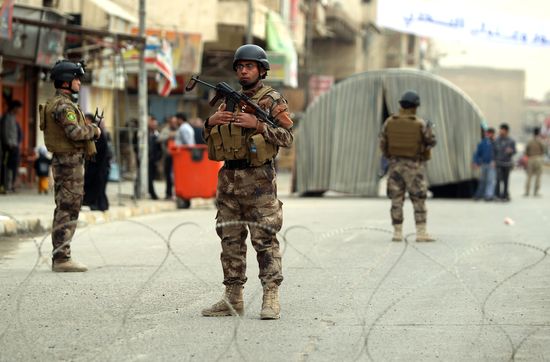
(Photo: Iraqi soldiers stand guard during a celebration marking the the departure of US troops from Iraq in Baghdad's Adhamiyah neighbourhood on December 30, 2011. By Ahmad al-Rubaye/AFP/Getty Images.)

Ethanol Subsidies RIP, Ctd

Joining her colleague Matt Steinglass, Erica Grieder lauds the quiet expiration of corn-ethanol subsidies. Tim Carney is less sanguine, pointing to the ethanol mandate, which still requires that 10% of fuel contain ethanol. Doug Mataconis explains

[T]he reason the industry isn’t complaining too much about the end of the tax credit isn’t because they have suddenly gotten religion and realized that they don’t need government help to push a product that nobody seems to want, it’s because they are now benefiting from the most powerful subsidy of all, mandated demand. It’s as if Congress decided that all fast food hamburgers sold in the United States must include a certain quantity of lettuce and then eliminated a tax credit to lettuce farmers. The industry wouldn’t complain because the new mandated demand subsidy is far more valuable to them, and far harder to repeal once it is enacted, than a tax credit.

Reihan zooms out:

Ethanol subsidies, alas, are not the not the most dangerous protection for incumbent firms in U.S. political economy. As a friend recently observed, the “beauty” of ethanol subsidies is that there is a finite amount of arable land, and so there is a theoretical limit to the extent to which firms could exploit ethanol subsidies. The same isn’t true of the implicit and explicit subsidies that have fueled risk-taking in the financial markets. 

How Much Should Parking Cost? Ctd

Parking_grid

Mike Konczal contrasts Shoup's vision of market-driven prices for parking with Chicago's privatized system:

Chicago sold off a 75 year lease for its parking meter revenues in a sweetheart deal for JP Morgan and faceless fronts of international capital with no public debate, bids or scrunity.  The plan has no emphasis on competition and market pricing either between spaces or between firms owning the resources – all public meters are owned by a single, private entity. … In the Chicago parking meter example, when there are block parties or art fairs that block meters the public has to compensate the private owners.  Private investors need to approve or get paid for there to be public gatherings on Chicago streets.  People find this inherently offensive, as well they should.

Quote For The Day

“Operation Iraqi Freedom failed for the same reason that a-thousand-and-one liberal schemes fail; they’re right in theory, but suffer too many unintended consequences in practice. So while liberal welfare schemes can end up creating more poverty, and liberal sex education results in more impregnated teenagers, liberal imperialism suffers from the same law – except that in war unintended consequences are magnified ten-fold (liberal warfare is also difficult because war can only be won by sacrificing liberal principles – it’s very hard to wage without the use of torture, terror and internment.)” – Ed West, Daily Telegraph.