A necessary NSFW rant:
Month: January 2012
Breaking: Jon Huntsman Is A Republican
Yesterday, Roger Simon ludicrously claimed that Huntsman "is probably in the wrong party." Mark Kleiman recoils:
Simon seems to be implying that Huntsman ought to be a Democrat. That’s an insane thing to say. It’s true that someone with Huntsman’s beliefs and values might wind up voting for Obama over Romney because Romney, and the party he heads, have become so dangerous and so despicable. But Huntsman, a natural-born plutocrat, is a friend of the plutocracy. He’s taken the Norquist no-taxes pledge. He likes the Ryan budget. In political terms, he’s an extremist, even though his personality seems closer to Obama’s than to those of his GOP rivals. But Obama’s temperate personality doesn’t make him a Republican, and Huntsman’s temperance doesn’t make him a Democrat, or even a RINO.
Ask Me Anything: Why Am I Still Defending Ron Paul?
Question? askandrew@thedailybeast.com Video archive here. My original endorsement of Paul here, my rethinking of the endorsement here, and my take yesterday on his associations here.
Print Your Own Million Dollar Bill
Well, it's one solution if you really need a new microwave.
Is Libertarianism Fundamentally Racist?
Chait says yes:
The most fevered opponents of civil rights in the 1950s and 1960s – and, for that matter, the most fervent defenders of slavery a century before – also usually made their case in in process terms rather than racist ones. They stood for the rights of the individual, or the rights of the states, against the federal Goliath. I am sure Paul’s motives derive from ideological fervor rather than a conscious desire to oppress minorities. But the relationship between the abstract principles of his worldview and the ugly racism with which it has so frequently been expressed is hardly coincidental.
If the connection is "hardly coincidental" then how are Ron Paul's motives not racist? Jon wants to be fair to libertarians and libertarian conservatives, but in his gut he knows we're all bigots. By Chait's reasoning, for example, I am profoundly homophobic. I oppose hate crime laws on the basis of freedom of thought and speech. In Virtually Normal, I even argue in principle against employment discrimination laws for gays. Does that mean I cheer on bigoted employers and gay-bashers?
Yes, says Chait:
[Libertarians] genuinely see racism as a belief system that expresses itself only in the form of coercive government power. In Paul’s world, state-enforced discrimination is the only kind of discrimination. A libertarian by definition opposes discrimination because libertarians oppose the state. He cannot imagine social power exerting itself through any other form.
I can. The social power of homophobia and hetero-sexism in a free culture is crushing. I oppose it; and recognize it. I have spent a great deal of my life pushing back culturally and intellectually and morally against it. But I do not want to compel it into submission. I want to persuade it into toleration. And that is the core difference between power exerted by the state and power exerted by non-state actors: the former is ultimately backed by physical force deployed by the government; the latter by public opinion, economic and social power, and the willingness of minorities to buy into the ideology of their oppressors or haters.
Because I believe in civil equality as guaranteed by the Constitution, I insist on absolute neutrality by the government, which is supposed to represent all citizens, but I would allow for private hostility, bigotry, hatred and even discrimination in civil society. Because our laws are so riddled with identity politics, I find it practically impossible to oppose employment discrimination laws for gays, when every other minority is included in them. But I stick by my principles in Virtually Normal, and I do not believe it makes me a gay-hater or enabler of gay hatred.
Process matters in a liberal society (though not, of course, in a leftist or theocon one). It is not a bad faith argument, even if you differ. And yet the accusation of bad faith creeps in:
[I]n the absence of government protection, white males, acting solely through their exercise of freedom of contract and association, have historically proven quite capable of erecting what any sane observer would recognize as actual impediments to the freedom of minorities and women.
Since I am a privileged white male, is my alleged dedication to the principles of liberty merely a mask for my desire to get and keep mine and screw the rest? That's Corey Robin's core argument about conservatives in general: in the end, all it is is the maintenance of power.
But what when this country is more multi-colored than white? Or when women outnumber men in the workplace? If I change my position then, and start using the government to ensure white male supremacy, Chait and Robin will have a point. But I won't. Since my principles do not make distinctions between citizens as members of variously oppressed groups, they endure through a future far more culturally and morally complex than the one we have now. Libertarianism anticipates this complicated future and understands that the state will have to become lighter not heavier if the social compact is to survive.
Noah Smith counters:
The modern American libertarian ideology does not deal with the issue of local bullies. In the world envisioned by Nozick, Hayek, Rand, and other foundational thinkers of the movement, there are only two levels to society – the government (the "big bully") and the individual. If your freedom is not being taken away by the biggest bully that exists, your freedom is not being taken away at all … this gigantic loophole has made modern American libertarianism the favorite philosophy of a vast array of local bullies, who want to keep the big bully (government) off their backs so they can bully to their hearts' content.
There is no question that this is the case. Bullies love freedom. But so do rebels and prophets, who would be silenced without it. And the right response to bullying is to stand up to it, while the government diligently ensures that the free market is not dominated by monopolies or rentier classes; and that core political liberties, such as freedom of speech, are protected everywhere.
Freedom means evil, as well as good, will flourish. And a conservative, properly understood, is someone who understands that evil is eternal, but that evil backed by a monopoly of physical force is the only one that can be restrained by a political order, without undermining the freedom it requires to breathe and grow and think for itself.
Fresh Santorum
Andrew Romano believes the Santorum will win tonight "one way or another":
[E]ven if Santorum doesn’t win the most votes, he will almost certainly “win” the Iowa caucuses. The reason? He’s the freshest story. For better or worse, media expectations really do matter come caucus time. Everyone anticipated that Romney will do well, including Romney, who boasted Monday evening in Marion that he’s “going to win this thing.” Same goes for Paul, who has the most robust organization in the state and has long polled in the double digits. But Santorum is new. Santorum is fresh.
And Santorum has not been covered to death. There’s a reason the guy is suddenly surrounded by 10-foot-wide semicircles of reporters and cameramen at every stop—a scrum that on Monday included CBS anchor Scott Pelley, New York Times executive editor Jill Abramson, Politico power broker Mike Allen, and hard-hitting ABC reporter Jake Tapper. By sneaking up and surprising the media, the former senator has ensured that he will get far more gee-whiz coverage after Iowa than either of his rivals, regardless of whether he technically defeats them on caucus night.
Romney’s “Appeasement” Canard
Ted Galen Carpenter takes on the bizarre allegations directed against Obama on foreign policy:
[W]hat is the president’s conduct that warrants allegations of appeasement? For the current crop of GOP presidential wannabes, merely exhibiting a willingness to conduct negotiations with adversaries is considered evidence of craven appeasement on the part of an American policy maker. And because Obama has attempted to open or advance dialogues with such adversaries, Republican activists excoriate him. But that is a very disturbing standard.
If the GOP candidates believe that it is improper even to talk to hostile foreign regimes, diplomacy largely ceases to exist as a meaningful foreign-policy tool. It is no challenge at all to negotiate with friendly, democratic governments. But we don’t have the luxury of dealing only with the New Zealands, Chiles and Estonias of the world. The real challenge for diplomacy is negotiating with, and getting desirable results from, prickly or odious regimes. Making demands for a laundry list of concessions from such adversaries, backed up by either unenforceable or ill-advised threats, is not a practical—much less a sensible—foreign policy. Yet that is where Romney, Gingrich and most of the party’s other presidential candidates apparently would take the United States if any of them entered the White House.
Gingrich Gets It Right
Of course Romney is a liar. Listen to his calculated lies about Obama. But this is rich:
"This is a man whose staff created the [Super]-PAC, his millionaire friends fund the PAC, he pretends he has nothing to do with the PAC – it's baloney. He's not telling the American people the truth. It's just like this pretense that he's a conservative. Here's a Massachusetts moderate who has tax-paid abortions in 'Romneycare,' puts Planned Parenthood in 'Romneycare,' raises hundreds of millions of dollars of taxes on businesses, appoints liberal judges to appease Democrats, and wants the rest of us to believe somehow he's magically a conservative.
"I just think he ought to be honest with the American people and try to win as the real Mitt Romney, not try to invent a poll-driven, consultant-guided version that goes around with talking points, and I think he ought to be candid. I don't think he's being candid and that will be a major issue."
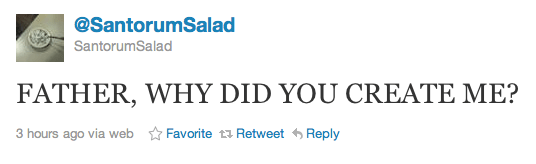
Meme Of The Day
Is There A Slippery Slope To Assisted Suicides? Ctd
A reader writes:
Oregon's little-discussed state assisted suicide plan has much the same pattern as the Netherlands. From the latest report (2010):
As of January 7, 2011, 96 prescriptions for lethal medications had been written under the provisions of the DWDA during 2010, compared to 95 during 2009 (Figure 1). Of the 96 patients for whom prescriptions were written during 2010, 59 died from ingesting the medications. In addition, six patients with prescriptions written during previous years ingested the medications and died during 2010 for a total of 65 known 2010 DWDA deaths at the time of this report. This corresponds to 20.9 DWDA deaths per 10,000 total deaths.
The linked report has a number of other useful findings. By the way, I personally knew one of the 100 or so Oregonians who will be in the 2011 report.
He was an 83-year-old man dying of lung cancer. His case was totally typical. As his health declined, he became more and more distraught at the idea of the manner of his death. He went to his family doctor to receive the lethal prescription to give himself the option. I was one of two people who signed a state form to verify that it was his decision and that he was not under emotional duress.
Like a little less than half the Oregonians who receive the medication, he didn't use it. He died July of natural causes, at home with his wife.
 The Dish