What Makes Someone A Libertarian?

Will Wilkinson rejects the label:

I’m more interested in arguing with standard liberals about the nature and scope of specially-protected rights and liberties within the settled context of the liberal-democratic nation-state than in arguing with standard libertarians about the justification of taxation, publicly-financed education, or welfare transfers. After all, there are many orders of magnitude more standard liberals than standard libertarians, and they possess many orders of magnitude more influence. We pick our fights, and I’d like to pick ones that stand a chance of making a real difference.

Timothy B. Lee counters.

What The Polls Can And Can’t Tell Us

Iowa_Poll_Of_Polls

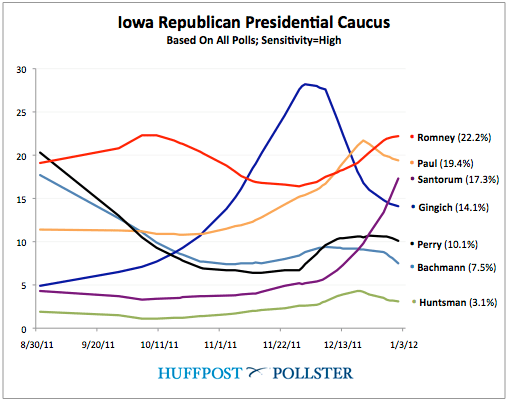
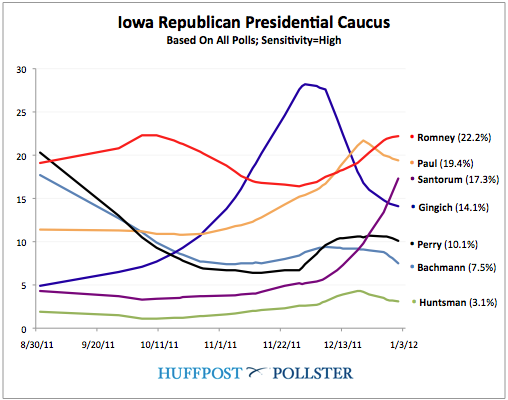
Blumenthal notes that Romney is leading in 8 of the 11 most recent Iowa polls and declares him the most likely to win tonight. A caveat: 

[T]hat math assumes two things that may not turn out to be true: First, that the polls are collectively free of statistical bias, and that any shortcomings in the way they identify the likely electorate are not skewing the snapshot in some meaningful way. Second, it assumes that any surges in support for a particular candidate are over and have not changed the standings over the final days of the campaign. The history of polls conducted before Iowa's caucuses says both assumptions are questionable.

Harry Joe Enten likewise bets on Romney:

Overall, polls and models aggregating these polls points to a Mitt Romney victory with Ron Paul in second and Rick Santorum in third. Among the four major models/averages (538Polls and VotesHuffPollster, and Real Clear Politics), the order of the top is the same. 

Nate Silver agrees that Romney is the favorite but cautions that there is room for error:

The critical thing to keep in mind is that a wide range of outcomes remain possible in Iowa even at this late hour. Our forecasts, which are derived from the polling but account for its historical accuracy or lack thereof, project for example that Mr. Romney is most likely to receive about 22 percent of the vote. However, the margin of error on Mr. Romney’s forecast (enough to cover 90 percent of all possible outcomes) is about plus or minus 10 points, meaning that Mr. Romney could plausibly finish with as much as 32 percent of the vote or as little as 12 percent.

The Enthusiasm Gap In Iowa

Philip Klein offers some perspective on reports of "packed rooms" and standing-room-only events in the Hawkeye State:

The truth is that the venues candidates are holding events at this year are much smaller than in 2008, back when some candidates were filling large ballrooms or even small arenas. When going into a Barack Obama event in 2008, it wouldn't be unusual have to get there early and still park a five or 10 minute walk away from the actual rally site, only to come into a massive venue where crowds in the thousands were going wild. Even on the Republican side, Mike Huckabee was filling larger venues. 

Yet yesterday, reporters, photographers and a few actual patrons were packed into a tiny diner at a Mitt Romney event in Atlantic, Iowa. True, later that evening, he attracted hundreds to a town hall-style building in Council Bluffs, but it was still a relatively small venue. On Saturday, Newt Gingrich squeezed people into a diner in Council Bluffs and a small corner of a Coca Cola bottling factory in Atlantic. At the same time, the audiences seem a lot more subdued than in 2008 — less shouting and sign waving.

Making Calendars Consistent, Ctd

The above video explains how our Gregorian calendar came to be. A reader writes:

Are these guys kidding? Look, I understand the benefits of their proposal, but someone should point out that all of our prior history would not be translatable into this new calendar paradigm. Every single birthday, occurrence, event, holiday would occur at different times relative to each other than has historically been the case. We'd lose something essential about the way that our cultures operate.

Another writes:

The idea of a consistent calendar seems to come up every few years (and always at the end of the year), but one of the great things about our current calendar is the year-to-year interplay between dates and days of the week.  For example, in 2011/2012, Christmas and New Years Day fell on a Sunday, which I find to be a bummer; Thursday seems to be the best day for these dates.  But that's sort of the point, isn't it?  Every year has a different feel to it because of where important dates lie within the week.   I think a static calendar would get pretty boring.

But look, if we must adopt a consistent calendar, there can be no other choice beside the Shire calendar, described by Tolkien in Appendix D of The Lord of the Rings. It is indeed consistent from year to year. But it also has a very special quality: it includes days that do not belong to any month (rather, they fall between months and are given names instead of dates). Further, the calendar has one or two days every year (eg Midyear's Day and in leap years, Overlithe) that not only lie outside the month, but that lie outside even the week.

Can you imagine a calendar encompassing days that lie completely outside the paradigms of month and weekday? It has this element of "suspension of time" that I find very appealing. The next week or month does not always begin immediately after the ending of previous one. There would be an unmistakable pause in what we perceive as the passing of time. Tolkien describes these days as "chief holidays and times of feasting", with Overlithe being "a day of special merrymaking". Sure enough. We would of course take the day off to reflect and to party. Could be exactly what the world needs.

The Derangement Of The Drone War

Joshua Foust gets scared:

Beyond the political consequences, the drone program also imposes severe bureaucratic costs. Within the U.S. Intelligence Community, various lethal targeting programs are heavily classified, compartmented, and SAPed — meaning, they are mostly closed off from each other. This is one reason why the CIA and JSOC maintain separate, non-overlapping kill lists in Yemen. It also means it is practically impossible for anyone, in any position including the top of the Office of the Director of National Intelligence, to exercise proper oversight over the program. In other words, we have created an unaccountable killing machine operating at an industrial scale, to borrow CNAS President John Nagl's phrasing.

Will Romney Beat His Personal Best In Iowa?

Jim Geraghty speculates

[I]n 2008, Mitt Romney won 25.19 percent of the vote in the Iowa caucuses. A big question will be whether he surpasses that this year. In the past four polls in Iowa, Romney finished with 23 percent, 19 percent, 24 percent, and 23 percent. By many standards, the 2008 field of Republican competitors in Iowa was stronger than this one. …  A core element of Romney’s argument is that he is the most electable Republican in the field. But if he can’t surpass his previous threshold in Iowa – or perhaps another threshold of his 30,021 votes from last cycle – one will wonder why the most-electable Romney can’t beat his previous finish against weaker competition.

The Daily Wrap

6a00d83451c45669e201675fdae44e970b-550wi

Today on the Dish, Andrew assessed Ron Paul's scrambling effect on America's left/right binary, heaved at extended exposure to Santorum, worried that the Christianist par excellence would blunt Paul's impact on the GOP, and was sure that he would almost certainly take America to war with Iran. We kept up on the latest Iowa polls (a state that matters, though South Carolina might not), foresaw some negativity from the Gingrich campaign, noted the end of ethanol pandering in Iowa,  and exposed the deep-seated desires of the political press corps. Romney seemed inevitable, Gingrich embarrased himself, Santorum appeared to hit trouble beyond Iowa, and the winner of the election would not end America. Joe Klein thought negative attack ads worked better this year than in the past, but some research suggested ads in general turn off some undecided voters.

Syria greeted the new year with protests, Andrew Exum considered how his background helped him get through war, and the TSA sucked. Bees taught us about democracy, the world isn't ending this year, and Roger Ebert sparked a discussion over whether movies were fading away. We defended British cuisine, tried to keep kids from getting fat, and mapped out what we know about taste.

Roger Scruton developed a green conservatism, McArdle called us out on infographics, and Reagan's actual policies confused Eric Cantor. Robin Hanson pushed the debate on working hours forward, the religious got autoerotic, an economist revamped parking, pot helped people through the Great Recession, and science explained both snow and "tit for tat." 

The Dish aired your responses to Andrew's year-end reflections and celebrated many new readers – who, along with our old readers, should enjoy some regular features. So without further ado, Quotes For The Day here and here, MHB here, Map of the Day here, AAA here, Faces of the Day here,  and VYFW here.

Z.B.

Understanding Tit For Tat

Professor Daniel Wolpert explains why fighting children will often say that the other hit them harder:

You underestimate a force when you generate it, so as one child hits another, they predict the sensory movement consequences and subtract it off, thinking they’ve hit the other less hard than they have. Whereas the recipient doesn’t make the prediction so feels the full blow. So if they retaliate with the same force, it will appear to the first child to have been escalated.

Adults do it too:

This led to a simple but effective experiment being conducted called ‘tit for tat’, in which two adults sit opposite each other with their fingers on either side of a force transducer. They were asked to replicate the force demonstrated by each other when pushing against the others finger. Instead of remaining constant, a 70 percent escalation of force is recorded on each go. It seems that we really don’t know our own strength.

Sanctified Sex Toys

The adult industry courts the religious:

With the voice and disposition of a summer-camp director, Joy Wilson founded Book 22 a decade ago, when she had trouble "getting her body to respond" to her husband after their second child, and her online search for remedies yielded scandalous imagery that offended more than it helped. The pioneering site, named after the Biblical book also known as the Song of Solomon, now faces growing competition from rival vendors including Hooking Up HolyIntimacy of Eden, and Covenant Spice. And the industry grew exponentially this fall with the launch of the Orthodox Jewish shop Kosher Sex Toys, and last year with the Muslim vendor El Asira

J. Bryan Lowder claps:

I am definitely glad that these sites exist. Good sex is clearly important for a healthy romantic relationship, and if religious types (especially orgasm-desiring women) need a holier box around their vibrator in order to make it palatable, I say praise the lord.

Local Lutheran minister Bob Snowdon is giddy.