Map Of The Day

Screen shot 2011-12-30 at 9.34.09 AM

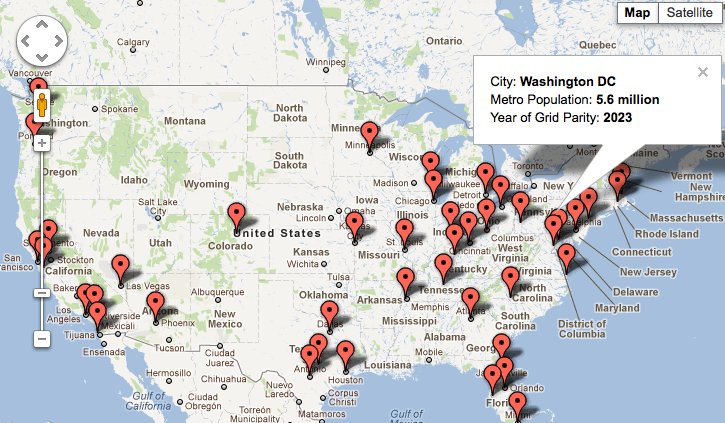
A snapshot of John Farrell's animated map of the years in which solar energy will be cheaper than grid electricity in major American cities. Farrell predicts that San Diego will be the first city to reach solar parity, in 2013. How he did the math:

The cost of solar in 2011 is $4.00 per Watt installed.

Grid electricity price is the average residential retail rate reported by PVWatts for the core city of the metropolitan area.

The cost of solar decreases by 7% per year.

The grid electricity price increases by 2% per year.

(Hat tip: Mark Frauenfelder)

How Much Should Parking Cost?

Dave Gardetta considers the work of Donald Shoup, a Yale-trained economist who envisions a fascinating new market:

This spring the [L.A. Department of Transportation] plans to introduce an $18.5 million smart wireless meter system based on Shoup’s theories. Called ExpressPark, the 6,000-meter array will be installed on [LA's] downtown streets and lots, along with sensors buried in the pavement of every parking spot to detect the presence of cars and price accordingly, from as little as 50 cents an hour to $6. Street parking, like pork bellies, will be open to market forces. As blocks fill, prices will rise; when occupancy drops, so will rates. In an area like downtown ideal for Shoup’s progressive pricing, people will park based on how much they’re willing to pay versus how far they are willing to walk to a destination.

Will Santorum Get Mopped Up?

That's Beinart's bet:

[P]recisely because Santorum has gotten so little scrutiny, it’s likely that his support will sink after he endures the barrage—from both Romney and the media—that will surely follow a strong showing in Iowa. Were Gingrich or Perry to run strong in Iowa, it would prove the resilience of their support. But if, as expected, Santorum beats them, it may just be because he hasn’t faced the assault that all the other major candidates have. And there’s a lot to assault. Voters don’t usually nominate presidential candidates who lose their Senate seats by 18 points.

Faces Of The Day

GT_MARCUS-PRAYING_120102

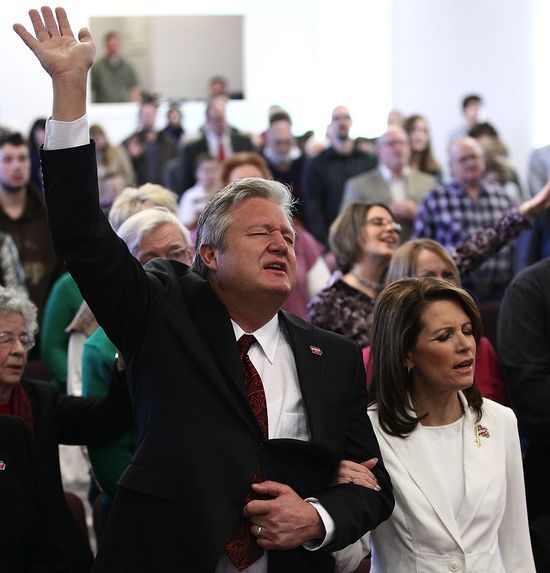
Republican presidential candidate Rep. Michele Bachmann (R-MN) and her husband Marcus sing and pray while attending services at the Jubilee Family Church on January 1, 2012 in Oskaloosa, Iowa. Bachmann also delivered personal testimony during the service, as GOP presidential contenders are crisscrossing Iowa in the final stretch of campaigning before the January 3rd caucus. By Win McNamee/Getty Images.

Ethanol Subsidies RIP

Matt Steinglass celebrates:

The rise of the tea-party movement forced conservative politicians to take principled opposition to subsidies far more seriously. The budget-cutting frenzy in Washington made the subsidies a target. And the strange high-beta situation of Midwestern farmers, who are enjoying high corn prices and rising land prices while the rest of the country is seeing stagnant income and declining real-estate values, has muted their fervour for subsidies too.

The speed with which this has happened puts me in mind of the country's startling attitude shift on gay marriage. I have absolutely no idea how things like this come to pass, and I don't think anyone could hope to predict them. But I think it serves as a somewhat hopeful close to a mostly horrible year to observe that in politics, solutions to problems often seem to be completely impossible, until all of a sudden they're not.

The Flavor Network

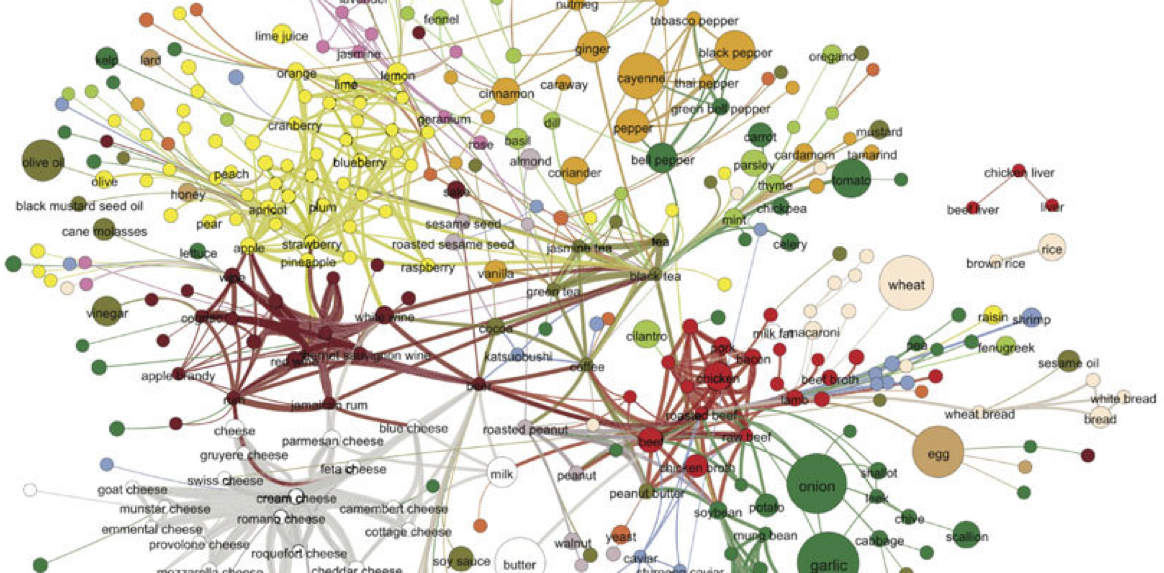
Screen shot 2011-12-29 at 4.03.16 PM

Yong-Yeol Ahn, Sebastian E. Ahnert, James P. Bagrow and Albert-László Barabási mapped the flavor compounds shared by culinary ingredients:

A hypothesis, which over the past decade has received attention among some chefs and food scientists, states that ingredients sharing flavor compounds are more likely to taste well together than ingredients that do not. This food pairing hypothesis has been used to search for novel ingredient combinations and has prompted, for example, some contemporary restaurants to combine white chocolate and caviar, as they share trimethylamine and other flavor compounds, or chocolate and blue cheese that share at least 73 flavor compounds.

Their conclusion is that "while North American and Western European dishes tend to combine ingredients that share flavor compounds, East Asian cuisine avoids them." Hat tip to Nathan Yau, who notes that "Mushrooms and liver are on the edges, out on their lonesome." The whole map can be viewed here.

Can You Ignore The Early States?

Not really:

Santorum may or may not wind up coming close to the nomination, but if he finishes in the top three in Iowa (as currently looks very likely), he's going to get a bump elsewhere. What about Huntsman, however? He's totally off the radar this week. He's been totally off the radar for the last month. He won't get a mention tomorrow night when TV and the rest of the press cover Iowa. He's unlikely to be subject to very much media attention over the next few days, either. And so it wouldn't be at all surprising if someone who has done little in New Hampshire so far overtakes him with a post-Iowa surge.

Are Movie Theaters Fading? Ctd

A reader writes:

My wife and I (late 40s, kids out of college) haven't been to the "big chain" theaters for at least five years now – it's the teenagers talking, laughing, cell phone calls, etc.  We've been spoiled by the pristine conditions at home.

The exception is the "over 21" theaters we have in Portland, Oregon.  They run movies that are just about to come out on DVD for a very low price, have great pizza, and a beer or glass of wine.  No one under 21 allowed, and the 21-29 crowd seems very reasonable.  We just saw the movie "Drive", ate two giant slices of pizza, drank two hefeweizen beers, for $20 (yes, really) at the Laurelhurst theater.  No distractions, great place to set our drinks and pizza, it was awesome as usual.

First-run mega-theaters: let the kids have 'em.  I'll never go back.

A reader in Austin is on the same page:

When I read your post, one movie chain stood out: The Alamo Drafthouse, which started in Austin, Texas. You may remember this chain when its no-talking PSA [seen above] made national news (and you linked to it back then). Ebert hits on some critical points which can also be attributed to the Alamo's success.

Obviously, they're very strict about texting and talking during the movie, but they're also not out to get you. They rely on the audience members to flag violators to the wait staff by writing it down on an order card. This keeps the process fairly anonymous. After the usually funny PSA, they show a screen which basically says, "No, seriously. No talking. Keep your phone silent and dark. We really, really mean it." I've personally witnessed in other theaters people answering their phones, screaming kids, and parents having conversations with their kids throughout the movie, and for that reason alone I now only watch movies at the Alamo.

They also have fun events all the time. Master Pancake (their version of Mystery Science Theater 3000) sells out frequently. They have sing-a-longs, quote-a-longs, and more. But what everyone loves is that they offer food and drink (yes, including alcohol). Admittedly, their food has gotten on the expensive side, but most of it is good. They try new menu items. They show you how a movie theater can offer you more than cartoonishly large popcorn buckets and soda.

Update from another reader:

I'm sure someone's already mentioned Cinebarre, north of Seattle.  My husband and I (late 50s) won't go to the movies anywhere else.  Just as strict on talking and texting. Burgers, pizza, beer and NO yapping teenagers or crying babies.  Clean, comfortable – a little spendy, but first-run films in a pleasant atmosphere is so worth it!
The TSA: Still Useless

Charles C. Mann visited airports with security expert Bruce Schneier to prove they're not getting any better:

Terrorists will try to hit the United States again, Schneier says. One has to assume this. Terrorists can so easily switch from target to target and weapon to weapon that focusing on preventing any one type of attack is foolish. Even if the T.S.A. were somehow to make airports impregnable, this would simply divert terrorists to other, less heavily defended targets—shopping malls, movie theaters, churches, stadiums, museums. The terrorist’s goal isn’t to attack an airplane specifically; it’s to sow terror generally. "You spend billions of dollars on the airports and force the terrorists to spend an extra $30 on gas to drive to a hotel or casino and attack it," Schneier says. "Congratulations!"