The British Diet Is Healthier Than You Think

716px-William_Hogarth_063

Anita Guerrini looks to the history books:

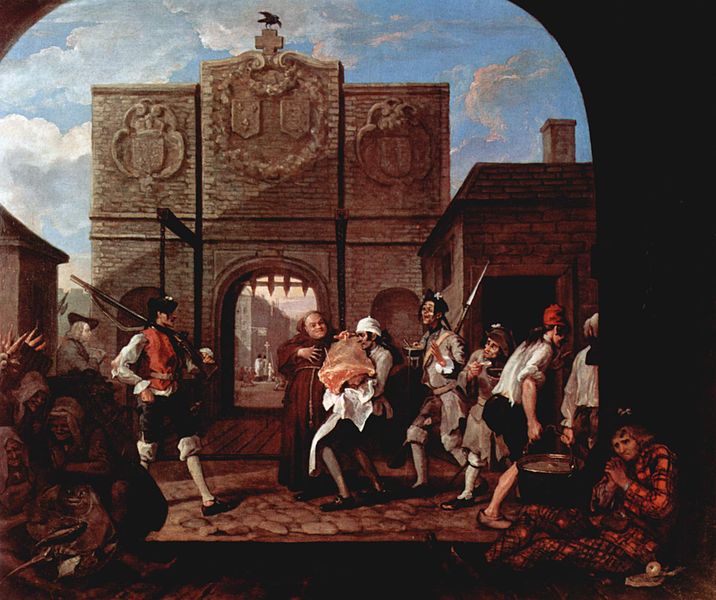
Britain currently has the highest percentage of vegetarians in Europe, about five per cent of the population. How did this happen in the land of the beefeater? William Hogarth’s 1748 painting O the Roast Beef of Old England, or the Gate of Calais contrasted the beef-eating English to the famished French (and their Jacobite Scots allies) sipping their meagre potage, or nibbling on raw onions. But carnivores and vegetarians, as well as that recent innovation, the ‘locavore’, who eats only local food, all have a long history in Britain. …

[S]ome religious sectarians and radicals in the wake of the English Civil Wars proposed a vegetarian diet among other attributes of an imitation of Christ and a new, more egalitarian England. […Roger] Crab’s 1655 pamphlet, The English Hermite, repeated the common belief that Adam was a vegetarian and further denounced meat-eating as conducive to violence because of its enflaming effects on the blood. In addition it was more costly than living on vegetables alone. The fact that Crab very nearly starved to death on his regimen was omitted.

(Image: William Hogarth’s 1748 painting O the Roast Beef of Old England, or the Gate of Calais via Wikimedia Commons)

Greening The Right

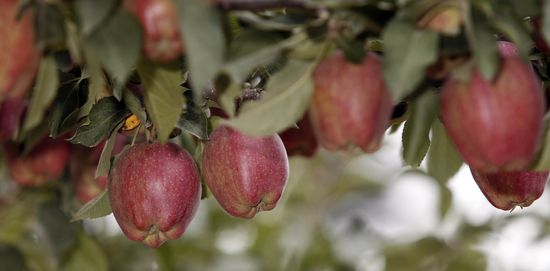
APPLESJeffTGreen:Getty

Twenty-seven years after my own modest pamphlet, "Greening The Tories," a far more distinguished philosopher grapples with the question of conservatism and conservation: Roger Scruton. Bryan Appleyard summarizes Scruton's case in Green Philosophy: How To Think Seriously About the Planet:

He believes in capitalism — he calls it the "free economy" — but it is an idea that needs constant vigilance to prevent capitalists transferring their costs and risks to others. "A free economy can be abused and it can only be justified on the assumption that costs are returned to the person that produces them." The banks very successfully ceased to become capitalists by externalising their risks — and, Scruton says, so do supermarkets and the aircraft and motor industries through a patchwork of hidden subsidies that mean the taxpayer takes up their costs. In the case of the environment, carbon emitters should pay for every gram; only then will they take their pollutions seriously. But wouldn’t a carbon tax require an international treaty of precisely the kind he says will not work?

"Not necessarily. If you take the example of plastic trash — China exports millions of tons of plastic to America in the form of toys. If America put a carbon tax on it, that would vastly increase the cost of those toys and that would make the Chinese make the toys out of wood, something biodegradable."

In a more critical review, Jonathan Rée gets to the heart of how conservatism can and should be pro-conservation:

He knows that conservatism has got itself a bad name by flirting with unbridled capitalism and promoting the idea that there's no motive like the profit motive. But that's never been Scruton's version, and for the past few years he has been conducting a grand exercise in rebranding. He still divides the world into shrewd conservatives and leftist buffoons, but in the new terminology his sort of people are now "oikophiles" (from the Greek "oiko" for house, which is the derivation of "eco"), while the rest of us are benighted "oikophobes".

The English have a word for it too: home-lovers, as opposed to home-haters. … I got through Green Philosophy sitting by an open fire in the old stone cottage where I have lived most of my life, and I can understand why oikophiles such as me might be well-attuned to environmental issues. We like to think of ourselves not as lords and masters of our private patch, but trustees of a heritage that we hope to pass on to successors who will cherish it as we do.
Ron Paul’s Long Game

Buzzfeed Politics outlines it:

Paul is following the roadmap set by Barack Obama's 2008 strategy: Start early, learn the rules, and use superior organization and devoted young supporters to dominate the arcane but crucial party procedures in states your rivals are ignoring — states where caucuses and conventions that elect the delegates who will ultimately choose the Republican candidate. 

Bottom line:

Ron Paul will almost certainly not be his party’s nominee. But he will almost certainly force Mitt Romney or another frontrunner to battle him for delegates, and to engage a candidate to his right. Paul could even, in a long and close race, wind up a kingmaker. It's a scenario most in the party eye warily.

Here's hoping. But Santorum, the coalescence of the Christianists behind him, and the harsh spotlight on the old newsletters suggest to me that the chance of a real breakthrough for Paul's ideas has diminished.

What Makes For A Good Soldier?

In reviewing a new book on the experience of war, Andrew Exum reveals why his own service didn't leave him with psychological scars:

Why have I not suffered from being in war? I can only hazard guesses. I was born and raised in the mountains and valleys of East Tennessee.

My family has owned the same farm in northern Hamilton County for two centuries, and one of my ancestors led North Carolina’s militia during the American Revolution. East Tennesseans are, generally speaking, kind and God-fearing mountain people. During the Civil War, though, we waged partisan, guerrilla warfare against both outsiders and ourselves with a brutality that horrified Union and Confederate commanders alike. Set against one another, we killed our cousins and erstwhile friends with both cunning and terrifying violence. We are, in other words, the Americans perhaps best suited, psychologically speaking, for combat in the mountains of Afghanistan. The only differences, perhaps, between the Taliban of Afghanistan and the Presbyterians of East Tennessee is that the former are both far poorer marksmen and more tolerant toward the Roman Catholic Church.

A Three-Way Race In Iowa

RCP_Iowa

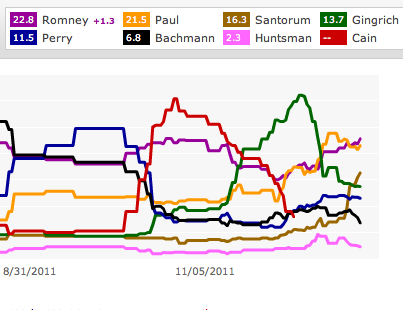
A highlight from PPP's latest poll:

Other than Santorum's rise the other big story of this week is Paul's fall. He was at 24% earlier in the week but has dropped to 20%. That decline in support coincides with a precipitous drop in his favorability numbers. On our last poll he was at +13 (53/40), but that's gone down 21 points on the margin to -8 (43/51). For all that Paul still has a very decent chance at winning on Tuesday- it just depends on whether his unusual coalition of young voters and non-Republicans really comes out to caucus. 

Nate Silver's electoral model now shows Paul, Romney, and Santorum neck and neck:

It is likely that at least one or two more polls will be released on Monday or even on Tuesday morning, which could provide slightly more clarity. It is indisputable, however, that there are at least three plausible winners of the caucuses. As J. Ann Selzer noted after she conducted The Des Moines Register’s poll, slightly different but entirely reasonable assumptions about turnout could tip the advantage to Mr. Romney, Mr. Paul or Mr. Santorum, as could the choices made by undecided voters.

Charles Franklin's estimates have Romney ahead:

If Romney does finish 1st, I would expect everyone else to go to South Carolina, except for Paul and Huntsman. Latest Suffolk poll shows huge Romney lead in NH. You can’t stop him in NH so give it to him and move to his most challenging state of the first four.

(Screenshot from RCP's Iowa poll of polls.)

Why Do We Prohibit Long Hours? Ctd

Robin Hanson continues to rail against work-hour limits:

While economists don’t see a plausible efficiency rationale for work hour limits that exclude high status work, we do see a quite plausible non-efficiency rationale: people like both to show their concern about the “downtrodden,” and their dislike and defiance of big corporations. And they can signal both these things by blaming the plight of the low status on their employers, and then claiming to help by regulating employer choices about work details, such as work hours and safety.

Note that this can function as a signal of caring about low status workers even if it actually hurts them – signal observers need only think that these signalers believe that it helps. 

Earlier discussion here and here.

The Science Of Snow

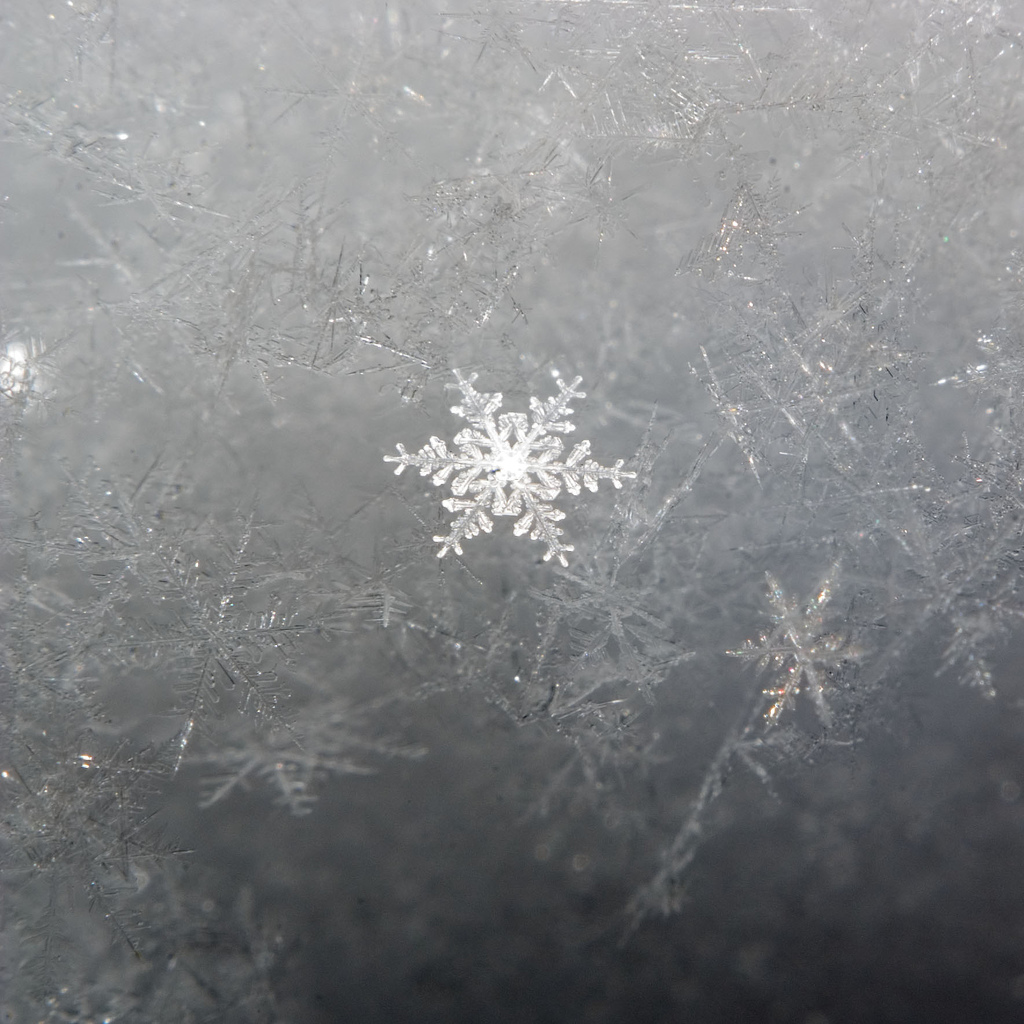
361650027_c849075719_b

Jennifer Ouellette examines our understanding of the snowflake:

The higher the humidity, the more complex the shape, and if the humidity is especially high, they can even form into long needles or large thin plates. Scientists aren’t entirely sure why, but they suspect it has to do with the complex underlying physics of how water vapor molecules are slowly incorporated into the growing ice crystal — what Descartes termed the "ordinary order of Nature." There's still a lot of mystery in that ordinariness.

Cheryl Murphy explains why freshly fallen snow looks white:

This is because sunlight traveling to and through the airy snow is made up of all of the colors in the visible spectrum of light. This light is scattered and reflected through the many snow crystals and flakes. The hexagonal bases of snow crystals act like thousands of prisms lying on the ground, refracting and reflecting all of the colors of the visible light. In most cases, no wavelengths or colors of light are absorbed by the snow and nearly all of the light is reflected back towards our eyes which interpret all of these reflected wavelengths together as the color white.

(Photo by Jaspar Nance)

Are Movie Theaters Fading?

Roger Ebert fears so. One reason besides the ballooning price of tickets and snacks:

Competition from other forms of delivery. Movies streaming over the internet are no longer a sci-fi fantasy. TV screens are growing larger and cheaper. Consumers are finding devices that easily play internet movies through TV sets. Netflix alone accounts for 30% of all internet traffic in the evening. That represents millions of moviegoers. They're simply not in a theater. This could be seen as an argument about why newspapers and their readers need movie critics more than ever; the number of choices can be baffling.

The Hive Mind In Democracy

8723400_f873de6d24_b

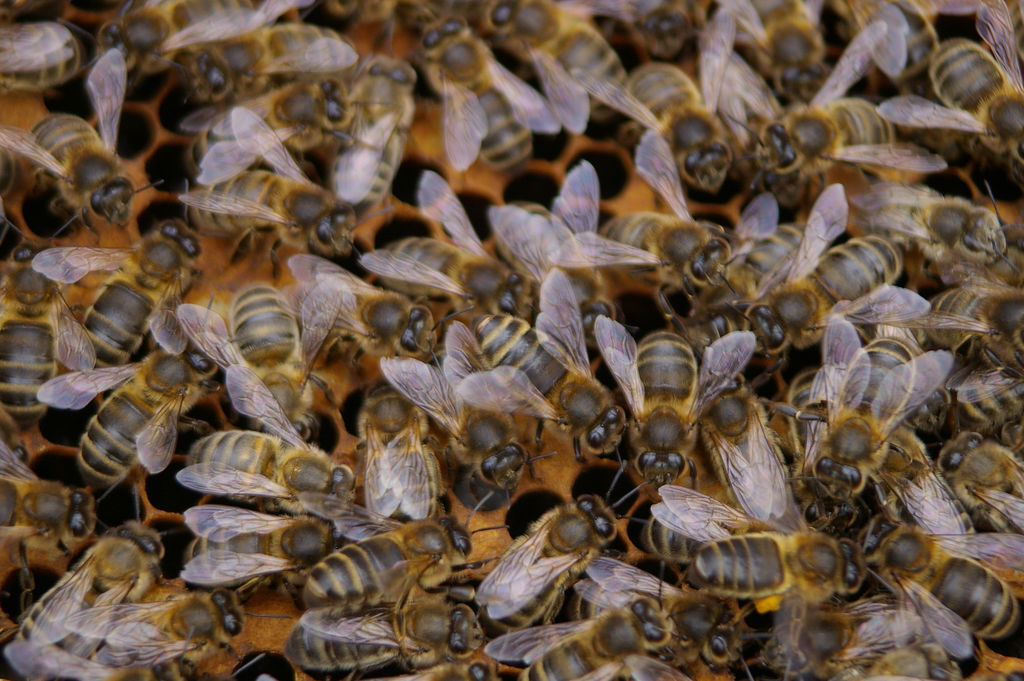
David Dobbs quotes from Thomas Seeley’s Honeybee Democracy

We will see that the 1.5 kilograms (3 pounds) of bees in a honeybee swarm, just like the 1.5 kilograms (3 pounds) of neurons in a human brain, achieve their collective wisdom by organizing themselves in such a way that even though each individual has limited information and limited intelligence, the group as a whole makes first-rate collective.

His assessment of Seeley's lessons for group decision-making:

  1. Create groups with mutual respect and shared interest
  2. Minimize the leader’s influence on the group thinking
  3. Seek diverse solutions
  4. Aggregate the group’s knowledge through debate
  5. Use quorum responses for speed, cohesion, and accuracy

These work fairly well in small-town meetings, not so well at larger democratic scales, as we’ll see vividly demonstrated over the next year or so — at the larger scale, we can’t get past step 1, and disrespect for the other party seems increasingly a fundamental requirement for candidacy, at least among the GOP. … Honeybee Democracy provides not just a look at a particularly rich life of inquiry but some nice, unforced parallels between the workings of honeybee colonies, small human societies, and our great big human brains: Certain group dynamics, it seems, are scalable and fractal.

(Photo by Max Westby)

Who Are The Undecided Voters?

Many of them are apathetic:

A large chunk of people decide late because they just don’t care about politics and tune it out for as long as they can. Tulane’s Brian Brox and the University of Arkansas-Little Rock’s Joseph Giammo examined the attributes of late deciders in presidential general elections and found that a large chunk of them resembled the "stereotypical apathetic citizen." They tended to be less partisan and politically active than early deciders, treated the candidates as interchangeable, and weren’t inclined to care who won.

One surprising twist: Brox and Giammo found that these "low-interest late deciders" seemed to recoil at information sent their way. The more Republican ads they saw, the less likely they were to vote Republican; Democratic ads pushed them toward the GOP. "These voters may actually be likely to become irritated with the efforts of candidates to attract their votes," Brox and Giammo write, "since we know that they have little interest in the campaign in the first place."