Chris Rock, on Newt Gingrich, back in the Clinton days:
Month: January 2012
Did Romney Pack The House?
The crowd did cheer the individual mandate last night. Jonah Goldberg wonders:
There were definitely moments when Romney deserved the applause and cheers he got. But he also got applause and cheers for lines that have elicited no such response in the previous 8,000 debates. If Romney did pack the room with ringers, it was smart if also devious. Gingrich exposed a key vulnerability to his debate superpowers: he feeds off the energy from the audience. If Romney and his team figured that out and tampered with his energy source, that’s smart politics. It’s not like the President of the United States never has to speak to audiences that don’t cheer attacks on Saul Alinsky.
Frum adds:
The complaint reminds what a highly strung mechanism the Gingrich psyche is. If a condition as mildly adverse as a less-than-enthusiastic audience can so disable Gingrich's performance, you do have to wonder what real adversity would do to him. Actually, you don't have to wonder. We learned in the 1990s. Real adversity utterly disorients and defeats him.
Jon Ward has more. Relatedly, Romney surrogates are now systematically "infiltrating" Gingrich campaign events. Yesterday Romney asked supporters to "storm" the debate.
GDP Reax

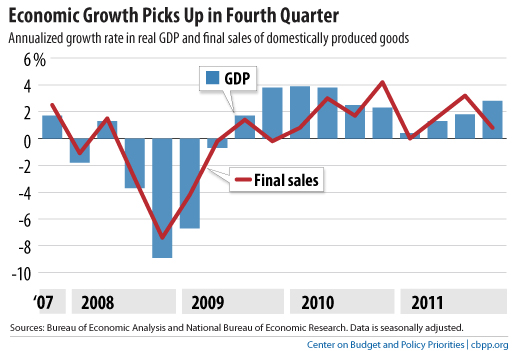
Chad Stone was disappointed by the GDP report:
Critically, the jump during the third quarter in final sales of goods and services— a better measure of underlying demand than GDP —didn’t continue in the fourth quarter … [see chart above] . More than half of the growth in GDP in the fourth quarter came from inventory accumulation — that is, unsold goods piling up on the shelves.
Karl Smith counters:
There is … a bit of handwringing over the fact that inventories contributed so much to GDP growth. But, what does this tell you. Most of this is autos. During the summer there was a major slowdown in parts from Japan. So Hondas and Toyotas started getting lean on lots. Now, they are coming back. That’s inventory adjustment. But, it tells us little about the underlying economy.
Yglesias thinks this kind of growth isn't enough:
GDP grew at a 2.8 percent annualized rate in the fourth quarter, up from 1.8 percent in the third quarter. That's a perfectly respectable number for an economy at full employment to put up, but it's not the kind of "catch-up" growth rate that gives you recovery from a recession.
Scott Hoyt warns:
It is clearly premature to conclude that the economy is off and running. The outlook appeared to be improving at this time last year, only to be derailed by an unexpected surge in commodity prices and fallout from the Japanese earthquake. It would not take much to repeat the pattern this year, since business and consumer sentiment remains brittle from the effects of the Great Recession and events in Washington.
Mark Thoma blames austerity:
[P]remature austerity — cutting spending before the economy is ready for it — is taking a toll on the recovery. The fall in government spending reduced fourth quarter growth by .93 percent — if government spending had remained constant GDP growth would have been 3.7 percent rather than 2.8 percent. This is the opposite of what the government should be doing to support the recovery. We need a temporary increase in government spending to increase demand and employment through, for example, building infrastructure. That would help to get us out of the deep hole we are in, but instead the government seems to be trying to make it harder to escape.
Brad Plumer reminds everyone that these numbers aren't set in stone:
The current GDP numbers are just a first-pass estimate. These numbers will get revised at least twice in the months ahead. Sometimes they get revised very significantly (for instance, it took three years for the Bureau of Economic Analysis to figure out that the recession in the winter of 2008-2009 was much, much, much worse than anyone knew).
And Jared Bernstein hopes the economy increases its momentum:
[H]ave we hit escape velocity from the clutches of the Great Recession? I’d say no, not yet. We’re headed in the right direction, we’ve got some mo, but growth is too slow and there’s still too much fragility and slack in the system.
The View From Your Window

Saginaw, Michigan, 1.41 pm
Did Santorum Once Support A Healthcare Mandate?
PolitiFact verified several days ago that Santorum's claim that Gingrich has supported some version of the mandate for 20 years was "mostly true." But it didn't think to ask whether Santorum, too, has supported the individual mandate in the past. And as it happens, he has. He supported it in 1994, according to this April 7, 1994 article in the Allentown, Pa. Morning Call, and this May 2, 1994 article in the same newspaper. It's possible that the newspaper would have gotten this wrong once, but in the heat of a primary campaign it's highly unlikely Santorum's campaign would have allowed it to get this wrong twice.
Paul Personally Approved His Newsletters
The WaPo reports:
[P]eople close to Paul's operations said he was deeply involved in the company that produced the newsletters, Ron Paul & Associates, and closely monitored its operations, signing off on articles and speaking to staff members virtually every day. "It was his newsletter, and it was under his name, so he always got to see the final product. .?.?. He would proof it,'' said Renae Hathway, a former secretary in Paul's company and a supporter of the Texas congressman.
TNC pounces:
If you believe that a character who would conspire to profit off of white supremacy, anti-gay bigotry, and anti-Semitism is the best vehicle for convincing the country to end the drug war, to end our romance with interventionism, to encourage serious scrutiny of state violence, at every level, then you should be honest enough to defend that proposition.
What you should not do is claim that Ron Paul "legislated" for Martin Luther King Day, or claim to have intricate knowledge of Ron Paul's heart, and thus by the harsh accumulation of evidence, be made to look ridiculous.
I cannot and will not defend the newsletters. And Paul's apparent lies about his involvement make the matter worse. And I don't think Paul is the "best vehicle" for advancing the ideas TNC cites. He's a very flawed vehicle, like most politicians and human beings. And I corrected immediately the record on the MLK holiday.
But when Paul has said what he has said in these debates, when he has walked into the lion's den of a GOP primary and attacked the criminal justice system for racial bias, lacerated the war on drugs, and cut to the core of the delusions behind American global aggression, he deserves to be judged on his recent history as well as his increasingly distant past. His message that more liberty makes diversity more possible is a vital one.
Would TNC have excoriated Robert F Kennedy in 1968 as someone who could not possibly channel progressive ideas because he was once a hatchetman for Joe McCarthy?
I acknowledge this newsletter incident is ugly, indefensible and, above all, cynical. I don't think it is all that matters in the remarkable late career of congressman Paul. And that hunting for heretics rather than celebrating converts is a losing political strategy.
Bob Dole, Newt, And That Bucket
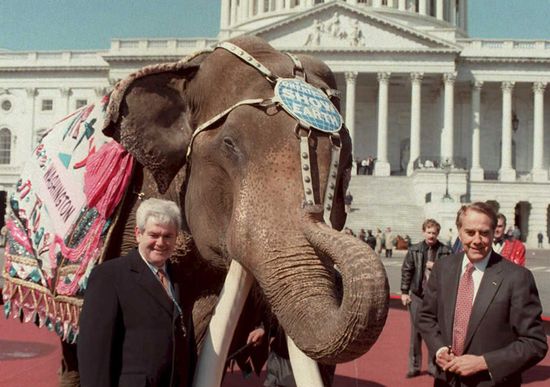
Defending Gingrich against Dole's dry humor, Yuval Levin clarifies the "empty bucket" situation:
It’s true that Newt Gingrich used to go around with an empty ice bucket in 1996. It was a symbol of his efforts to cut congressional perks and costs. For decades prior to 1995, every congressional office would receive a daily delivery of ice from a central freezer on the Capitol grounds. It was a holdover from the days before easy refrigeration, and it made for a nice demonstration of the sort of silly and costly perks that members of Congress received. When he became Speaker, Gingrich ended the practice and (in large part because that meant eliminating several staff positions) saved some $400,000 a year. Gingrich liked to use the ice bucket as a metaphor for Democratic governance: expensive, wasteful, and out-of-date. Whatever you think of the metaphor, it was something Gingrich talked about constantly, including on many occasions in the presence of Bob Dole.
(Photo: Newt Gingrich, Speaker of the US House of Representatives, and Robert Dole, Senate Majority Leader pose with an elephant outside the Capitol building in Washington on April 5, 1995. The elephant is part of the Ringling Brothers Barnum and Bailey Circus. By Richard Ellis/AFP/Getty Images.)
Newt’s Core Strength: The South
We should be wary of calling this race over yet, despite Romney's knee-capping of Newt last night. It looks as if Romney may will win in Florida after that debate and with a big ad advantage – but I'll be looking to see how well he does in the panhandle most of all. One stat leaps out from the new NBC/WSJ poll [PDF]:
Gingrich leads Romney in a four-way matchup, including Santorum and Paul, with “very conservatives” (47 percent to 17 percent), Tea Party supporters (46 percent to 21 percent), and in the South (45 percent to 21 percent). Those numbers gets even bigger in a two-way matchup. For example, in the South, one-on-one with Romney, Gingrich leads 65 percent to 28 percent.
The poll was started after the SC victory and before the Florida debates, so that may skew things in this volatile race. But that kind of advantage with Southern voters, if they do not agree to rally around the Romney establishment, means Super Tuesday becomes much more important.
My own suspicion is that many Southern Christianists will vote for the not-Mormon. I suspect Newt has a better chance of getting that role than Santorum.
Yglesias Award Nominee
"'Israel Firster' has a nasty anti-Semitic pedigree, one that many Jews will intuitively understand without knowing its specific history. It turns out white supremacist Willis Carto was reportedly the first to use it, and David Duke popularized it through his propaganda network. And yet [M.J.] Rosenberg and others actually claim they’re using it to stimulate “debate,” rather than effectively mirroring the tactics of some of the people they criticize.
Throughout my career, I’ve been associated with the Jewish left—I was to the left of the New Republic staff when I worked there, moved on to Talking Points Memo, hosted my blog at Firedoglake for years, and so on. I’ve criticized the American Jewish right’s myopic, destructive, tribal conception of what it means to love Israel. But it doesn’t deserve to have its Americanness and patriotism questioned. By all means, get into it with people who interpret every disagreement Washington has with Tel Aviv as hostility to the Jewish state. But if you can’t do it without sounding like Pat Buchanan, who has nothing but antipathy and contempt for Jews, then you’ve lost the debate," – Spencer Ackerman, Tablet.
Romney’s Not-So-Blind Fannie-Freddie Investments
A reader writes:
Following the GOP debates, one salient fact jumps out at me: Mitt Romney lies frequently, easily, and shamelessly. This isn’t Reagan’s evasions or Clinton’s careful parsing or Bush’s leaving the lies to his underlings; this is bold-faced making up outrageous crap about his opponents and saying it loudly and directly and repeatedly. Why the hell isn’t this the big story the media talks about? Surely the fact that Mitt Romney is a lying sack of shit is more important than Newt’s affairs or Ron Paul’s old pamphlets.
Money quote from the September 2011 Boston Globe article cited in the above video:
On his financial disclosure statement filed last month, Romney reported owning between $250,001 and $500,000 in a mutual fund that invests in debt notes of Fannie Mae, Freddie Mac, among other government entities. Over the previous year, he had reported earning between $15,001 and $50,000 in interest from those investments.
And unlike most of Romney’s financial holdings, which are held in a blind trust that is overseen by a trustee and not known to Romney, this particular investment was among those that would have been known to Romney.
 The Dish