The Economist is upbeat about the country's reconstruction:
Clashes are, for the moment, little more than unpleasant, but isolated, incidents. Shops and cafés open late in city centres and, at least in the urban coastal areas, people are still largely positive about their lot.
Amnesty warns of widespread torture in the country's prisons, although the authorities appear to be responding to international pressure on the isssue. Greenwald zooms out:
Obviously, the Gadaffi and Saddam regimes were horrible human rights abusers. But the point is that one cannot celebrate a human rights success based merely on the invasion and overthrow of a bad regime; it is necessary to know what one has replaced them with. Ironically, those who are the loudest advocates for these wars and then prematurely celebrate the outcome (and themselves) bear significant responsibility for these subsequent abuses: by telling the world that the invasion was a success, it causes the aftermath — the most important part — to be neglected. There is nothing noble about invading and bombing a country into regime change if what one ushers in is mass instability along with tyranny and abuse by a different regime: typically one that is much more sympathetic to the invading regime-changers.
(Photo: Libyan men stand at the destroyed gates the 28May Brigade military base which was damaged during earlier fighting in the oasis town of Bani Walid, on January 25, 2012. By Mahmud Turkia/AFP/Getty Images.)
Digby challenges my belief that Obama could ever work with the GOP – even on tax reform or deficit reduction:
[W]hat's Andrew Sullivan's excuse? He's been involved in American politics for decades. Surely he saw that the modern conservative movement has become a retrograde, obscurantist, political faction that has every intention of acting out its dystopian agenda without any thought to its opposition. Indeed, politically mowing down their opposition is what animates them …The great rapprochement — like the Grand Bargain — was a pipe dream, and it was one that many, many Democratic voters enthusiastically bought into.
But my point is that it was important to establish that as fact in the voters' minds before a liberal president could go on the offensive. Digby is viewing the GOP the way the GOP views Iran. Strike now! We know they'll never cooperate. So why bother even going through the motions? But Obama's long game requires first the out-stretched hand, then the wanton obstructionism, then the framing of the issue to Obama's advantage, then coalition building, then the end game.
This is not weakness. It is strength. And Obama has in reserve both the military option with Iran and the possibility of a brutal but empowering re-election victory against the GOP. My point is that even if the GOP were never going to cooperate an inch, better to demonstrate that and own the center, than assume that and govern out on a limb on the left.
Maybe this strategy will fail. But my point is: that is yet to be proven. What does seem to me proven is that polarization on the left is not a solution to polarization on the right. And if the country does get that polarized on both sides, the right has more voters in a center-right country. And if the strategy doesn't fail, the pragmatic reforms Obama has pressed will be much more durable because of the way in which he got us there.
There's no telling what horrible things could befall Romney in the coming months. Maybe some damning tax revelations will leak out. Maybe a former Bain executive will turn up and admit that he and Romney used to smoke cigars filled with $100 bills as they laughed maniacally about the companies they'd looted. Maybe Romney will be caught on camera insisting that corporations are more personlike than fetuses. You can never know. If a major gaffe should damage Romney, it's not going to help Gingrich unless he's still in the race.
Newt predicts that the primary will go on for another six or eight months, "unless Romney drops out earlier."
Zionism’s goal was a sovereign, independent Jewish state in the historic land of Israel, as a means to the moral and spiritual rebirth of the Jewish nation. If the occupation is destroying Israel’s fundamental character, dismantling the state, and corrupting the people, as Gorenberg contends, then Zionists above all should want to end it, as swiftly and comprehensively as possible, and not try to hold out for the most favorable terms—to say nothing of holding out for the approval and acceptance of those for whom the Jewish state can at best be seen as an unfortunate fact of life. After all, it was always absurd to think that anyone but the Jewish people would ever truly endorse the aims of Zionism, because Zionism was a specifically Jewish national project. That project is properly judged a success or failure by what kind of nation it built, and how. Which is how Gorenberg judges it. And, to his dismay but not despair, he finds it wanting.
Just as interesting is the fury of the response to these facts in America:
Based on what [Gorenberg] has said about the reception when he has gone to synagogues and other venues to talk about his book, much of the opposition from within the Jewish community refuses to be confronted with painful facts, determined to shout down and shut out the messenger with the unwelcome message.
Sounds familiar, doesn't it? One of the commenters – an anti-Zionist – adds to the tortured question raised by the "Israel-Firster" debate:
Gorenberg is on to something very important in acknowledging that Israel forfeited the chance to achieve the stated Zionist goal of becoming a normal country when it held on to the territories after 1967. But even this would only be possible with the further step that Gorenberg clearly opposes, to reframe its national identity as “Israeli” rather than “Jewish”. In other words, to restrict its nationalism to its own people and cease to regard itself as the possession of a transnational “Jewish people” and the leader of a revolution of national consciousness among Jews wherever they may live. As the brilliant and heroic Shlomo Sand writes in The Invention Of The Jewish People, the refusal of the State of Israel to acknowledge the existence of an Israeli nation and renounce its claims to represent a larger “Jewish nation” risks bringing on the destruction of the actually existing Israeli nation, culture, and society.
Noah responds here with several fascinating counter-points.
Along the same lines, Steve McCann resents GOP elites foisting Romney upon the party:
Perhaps Newt Gingrich or Rick Santorum or Ron Paul are not the right candidates to face Barack Obama, but that decision should be up to the voters. While it maybe the role of the conservative pundit class to proffer their opinions of the various candidates, it is not the role of the overall Establishment to so marginalize candidates that there appears to be only one viable alternative.
The United States and the European Union are ratcheting up economic sanctions in the hope that they will push Iran’s President, Mahmoud Ahmadinejad, to re-start serious nuclear negotiations after a year’s hiatus. The E.U.’s twenty-seven member countries, which buy about a fifth of Iran’s oil exports, agreed last week to forgo all Iranian crude by July. Ahmadinejad said soon afterward that he would indeed be willing to talk again. The strategy, led by Obama, appears to be achieving its aim of raising the pressure on the ayatollahs to an unprecedented level. The value of Iran’s currency has fallen sharply. The diplomatic campaign would be stronger if it contained a definite plan to assuage Iran’s fears that the West and Israel ultimately seek regime change in Tehran—fears that presumably inform Iran’s search for a nuclear deterrent.
Joshua Pollack outlines what successful diplomacy would look like.
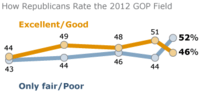
According to Pew, Republicans are increasingly unsatisfied with their choices. Another bad sign for the GOP:
About half of independent voters (53%) rate Obama positively in understanding the problems of average Americans; only 38% and 37% of independents, respectively, give Romney and Gingrich positive ratings. Democratic voters overwhelmingly say that Obama understands the problems of average people (84%). Smaller majorities of GOP voters give Romney (61%) and Gingrich (60%) positive ratings.
Kevin Drum notes that brutal primaries increase voter dissatisfaction:
[T]his is the point at which I'd normally remind everyone that it's only January … and there's plenty of time for everyone to cool down before summer. And I think that's exactly what's going to happen. Still, there's that little niggling voice in my head saying "Newt, Newt, Newt….." Will Newt Gingrich, even after he's obviously lost, continue his scorched-earth campaign against Romney? Will Sheldon Adelson fund this doomed effort? I'd guess no. But it's a soft, unconvincing no. He just might, after all.
Matt Collin ponders a new study [pdf] about post-circumcision sexual behavior in Kenya:
At first glance, this sounds like good news: those who said they believed that circumcision was effective reduced their risky behaviour – the exact opposite of what one would expect from a Peltzman-type relationship. Wilson et al. chalk this up to a sort-of income effect: now that their baseline risk of contracting HIV is lower (therefore raising potential life expectancy), subjects who have been circumcised decide to invest more in life quality, avoiding dangerous behaviours.
But wait – this nugget of good news is actually obscuring something else: those who didn’t believe that circumcision worked increased risky sexual behaviour – they were less likely to use a condom during intercourse and had more sexual partners. … The increase in risk among the non-believers is disconcerting, even if in net terms there is no increase in risky behaviour. While the believers, who are in the majority, offset the non-believers, we don’t know what the aggregate effects on HIV outside of the sample would be.
A new study sheds light on what happens to your brain on psilocybin, the key compound in magic mushrooms:
"Psychedelics are thought of as ‘mind-expanding’ drugs, so it has commonly been assumed that they work by increasing brain activity,” says [David Nutt, a neuropsychopharmacologist]. "Surprisingly, we found that psilocybin actually caused activity to decrease in areas that have the densest connections with other areas."
Under the influence of mushrooms, overall brain activity drops, particularly in certain regions that are densely connected to sensory areas of the brain. When functioning normally, these connective "hubs" appear to help constrain the way we see, hear and experience the world, grounding us in reality. They are also the key nodes of a brain network linked to self-consciousness and depression. Psilocybin cuts activity in these nodes and severs their connection to other brain areas, allowing the senses to run free.
The findings bode well for the the therapeutic potential of psilocybin:
Two regions that showed the greatest decline in activity were the medial prefrontal cortex (mPFC) and the posterior cingulate cortex (PCC). The mPFC is an area that, when dysfunctional, is linked with rumination and obsessive thinking. "Probably the most reliable finding in depression is that the mPFC is overactive," says Carhart-Harris. … "[Psilocybin] shuts off this ruminating area and allows the mind to work more freely," he says. “That’s a strong indication of the potential of psilocybin as a treatment for depression."
Aldous Huxley remains, I think, the most powerful exponent of what this is about. It is about, in his words, the revelation that "the universe is All Right".
And all shall be well and All manner of thing shall be well By the purification of the motive In the ground of our beseeching.
If you believe, as I do, that we are at root children of God, trapped, as Pascal put it, between being angels and beasts, then there will be moments in our lives when we are closer to being angels and closer to being beasts. In my view, our beastliness, as it were, is a function of our contingency as evolving primates, having to tackle a terrifying world of death, disease, war, hatred, and fear with intelligence and self-control and self-defense. This is the world of the first half of Hobbes' Leviathan.
But we are also more than that, as Jesus taught us. We are children of God. Our alienation is because something deep within us yearns to come home, a home we do not remember, but we know exists. What psilocybin seems to do is remove the veil from seeing and accepting this wondrous, difficult truth. It does not add something to our consciousness that isn't already there. It simply calms the noise around it so we can hear what is already within us. Hence the parallels between brains in deep meditation and brains on psilocybin.
Of course, we need the veil to survive in our physical, practical lives. As Huxley notes above, we couldn't walk across the street without it. If we were always aware of the staggering beauty of Creation and the overwhelming force of God's love for us, we would be like Jesus – homeless, jobless, possession-less, beyond family or tribe. And that is where the saints are and where we are lucky occasionally, by grace, to find ourselves. Mystics have sometimes strained against their physical limits to see the truth. Jesus starved and meditated for 40 days in the desert. Others, like Julian of Norwich or St Teresa of Avila, had experiences of such intensity they live on in our consciousness even now.
To glimpse this even once – by chemical ingestion – opens up the truth as to who and what we are. It is not a substitute for living that truth, or searching for it every day, or prayer, or the sacraments, or caritas. But it is a sacramental glimpse. And however far into the darkening forest you walk, you never forget the mountaintop.

 problems of average Americans; only 38% and 37% of independents, respectively, give Romney and Gingrich positive ratings. Democratic voters overwhelmingly say that Obama understands the problems of average people (84%). Smaller majorities of GOP voters give Romney (61%) and Gingrich (60%) positive ratings.
 The Dish