Fighting The “Class Warfare” Argument

Greg Sargent notes that Obama is honing his message as one of making hard choices in a tight budgetary environment. It's strong:

Greg:

He spelled out that if we don’t ask the wealthy for a bit more, either the deficit will go up, or the burden of doing all the sacrificing to bring it down will fall on those who are least equipped to bear it. He also framed a clear choice between keeping tax breaks for the wealthy and investing in “everything else,” a twist on the 99 percent versus one percent argument that didn’t sound personal at all and came across as eminently sensible and even undeniable. In this narrative, we face a stark choice: Either keep tax cuts for the rich, or invest adequately in the future viability of the whole country.

The best line: "Bill Gates doesn't envy the rich!" after Obama noted that he and Gates agree on this. The worst line: "We don't need any more tax breaks!" I agree – so why did he propose a whole slew of them in his SOTU? Filler, I suppose.

Romney, Obama And Europe

One of the more 1990s features of Romney's very 1990s campaign is his attempt to describe Obama as a European rather than an American. He means by this the notion of Europe as a beleaguered, depressed welfare state (although some moderator might ask him about Germany's 5.5 percent unemployment rate, and why that's such a dreadful model).

The irony is that in 2012, in the real world outside of Mitt's pander-world, much of Europe is being run by center-right governments, who are being dictated to by the center right government in Berlin. And what are 2012's European policies with respect to the economy? Why, they're much closer to Romney and the Republicans than Obama and the Democrats.

Germany is insisting on austerity and budget cutting even during a recession, just as the GOP wants. The result is a Europe on the very brink of a serious debt trap, in which cutting debt depresses the economy which depresses revenues which increases the debt some more. Greece and Italy are obviously the prime examples.

But perhaps the more gripping analogy is with Britain, where my Tory friends embarked on a very serious austerity program in the middle of 2010, in the hopes of liquidating the debt quickly, staying on the right side of the bond markets, and allowing new private sector investment to bring back growth. Sure, the US has an advantage of a global reserve currency, and Britain needs to prevent a collapse in the pound if the markets perceive fiscal drift. So Osborne has less lee-way than Obama. But still, the contrast is striking.

In the US – following the Keynesian model – the economy is recovering, however slowly and has been adding jobs for two years. In Britain, following Tea Party policy (with some tax increases as well) the recession is now officially longer than the Great Depression in the 1930s, and still drifting down:
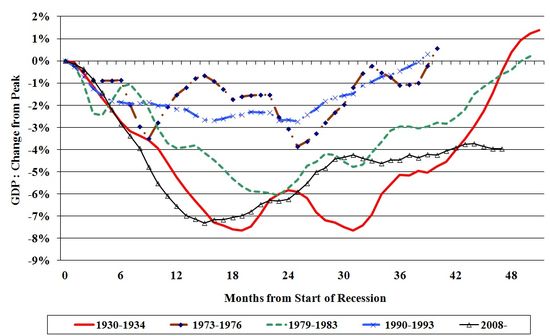
Gdp chart jan 2012

Brad DeLong argues:

With a ten-year nominal interest rate in Britain of 2.098% per year, if low long-term Treasury interest rates were the key to recovery, Britain would be in a boom. If there was ever a place where expansionary austerity would work well–where private investment and exports would stand up as government purchases stood down–if its advocates’ view of the world was reality rather than fantasy, it would be Britain today.

But it is not working. And the lesson is general.

If it is not working in Britain, how well can it possibly work elsewhere in countries that are less open, that don’t have the exchange-rate channel to boost exports, that don’t have the degree of long-term confidence that investors and businesses have in Britain?

Krugman piles on. For me, the true test of conservatism is empiricism. It doesn't look as if the Ron Paul medicine is currently working very well (although some of that blame must surely lie with the massive debt that Blair and Brown, like Bush, piled up in the last decade). Nonetheless: this is the data. Britain has flatlined or declined in the last six months. The US has grown.

So here's an obvious retort to Romney and his Obama-Is-A-European schtick. Obama should simply say that it is Romney who now wants to impose European-style austerity, and it isn't working. Obama, meanwhile, has chosen an American exceptionalism strategy, which is leading to growth. By relying on that renowned British homosexual, JM Keynes.

What Is Romney’s Real Tax Rate?

He claims it's closer to 45 or 50 percent:

John Berlau and Trey Kovacs of the WSJ make the same argument:

One reason investment income is taxed at a lower rate than wage and salary income is because it is a double tax—profits are taxed once under the statutory 35% corporate tax rate and then again when they are paid out to individuals as dividends.

Daniel Shaviro counters:

Berlau and Kovacs are entirely right to suggest that the corporate level tax matters to the analysis. I frequently noted this point in the carried interest debate a couple of years back. But they are of course wrong (in classic WSJ fashion) to simply assume that corporations are actually paying tax on 35% of their income. 

Jared Bernstein sides with Shaviro:

Based on Romney’s tax returns, it’s impossible to tell whether the capital gains he realized through these companies reflect corporate taxes at all (interestingly, Romney’s trustee actually made this point to the WSJ, which chose to ignore it).

Finally, remember this: [private equity firms (PEs)] are masters of debt financing, and debt financing carries an effective tax rate of -6% because business interest can be deducted from your tax bill.  For the highly leveraged PE crowd, debt financing is a tax shelter for other liabilities they face, including any corporate income that might slip through the cracks…if I were the WSJ here, I’d crow that Romney’s tax rate is actually 9% (15-6)!

Mitt Is Outspending Newt By Almost 3 -1 In Florida

It's $15.4 million versus $6 million. Which makes tonight's debate all the more important. I think Newt is going to throw some rhetorical bombs tonight. It's high noon. I don't think it's that big a hyperbole to say that this debate and this primary could determine the entire election. If Newt wins, the GOP implodes.

I'll be live-blogging, of course. For the eighteenth time.

Clash Of The Populists

Matthew Dowd compares Gingrich's populism to Obama's:

Gingrich’s message seems to be one much more aligned with cultural populism than economic populism. This cultural populism doesn’t speak to income inequality and tax rate unfairness. It is much more about a forceful argument against cultural elites such as  the media and Hollywood who, Gingrich says, are, at best, out of touch with true American values (including religion and faith) and, at worst, are undermining these values.  It is a values-based argument much more about U.S. culture than about economic unfairness.

And, so, we have a president who has for now chosen to run as an economic populist against economic elites (as he sees Romney), and the rising candidacy of Gingrich, who is running as a cultural populist against cultural elites in this country. … Gingrich’s emerging as the Republican nominee would be a historic, never-before-held battle all around populism. A true clash of the Titans, economic populist vs. cultural populist.

And in that fight, cultural populism has always won in modern times. But this year may be the exception. It may prove that even Bob Shrum can be right if you live long enough.

The Original Brokeback?

Kevin Sessums discovers the first same-sex kiss in the movies – in 1927:

During this week when The Artist was nominated for the Best Picture Oscar, let's honor the only silent movie ever to win the award when Wings won it in 1927. It is the story of the VERY close friendship between two World War I flyboys played by Buddy Rogers and Richard Arlen. (Rogers was Mary Pickford's 3rd husband and 12 years younger than she when they married.) The relationship between the characters played by Rogers and Arlen in the film is very "Brokeback Mountain." They are even referred to as "powder puff boys" by their commanding officer at one point.

They are both supposedly in love with Clara Bow in the film, who, during filming, began a love affair it is said with a newcomer in the cast, Gary Cooper. Neither of them shows as much love for her, however, as they do for each other.

No, this doesn't mean they are gay; they may just be in deep platonic love, deepened by the bonds of war. But notice how today, such a kiss would not be shown in such a context. In some ways, greater awareness of homosexuality has led to a temporary decline in homosociality for straights. I think that's beginning to change back again. I sure hope so. The gay rights movement is not only about allowing people to be gay with dignity; at root, it's about allowing people to be themselves with dignity. Which includes genuine, non-gay, love between men.

Why Don’t Evangelicals Like Mormons?

A theory:

The real issue for many evangelicals is Mormonism’s remarkable success and rapid expansion. It is estimated to have missionaries in 162 countries and a global membership of some 14 million; it is also, from its base in the American West, making inroads into Hispanic communities. Put simply, the Baptists and Methodists, while still ahead of the Mormons numerically, are feeling the heat of competition from Joseph Smith’s tireless progeny.

And if a Mormon is elected president, it would be a remarkable triumph of legitimization for the LDS Church. Given how it was once treated in America, it would be a historic watershed. And that added legitimacy and prestige may well be a core factor in evangelicals' apparent lack of enthusiasm for Mitt.

But I want to repeat that, in case anyone misunderstands me, that in my view, one great thing if Romney were to be elected would be the erasure of one more bigoted barrier to anyone running the country. I think it would be great for America to have a Mormon president in the same way (but not to the same extent) as it is great to have a biracial president and would be to have a female president. Diversity matters to me in terms of opportunity, if not results.