Can Gingrich Be Stopped?

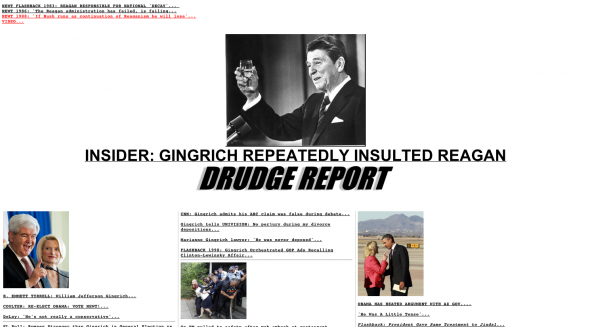
Drudge-report

As the conservative establishment rushes to kill Newt's candidacy, Michael Brendan Dougherty is taken aback:

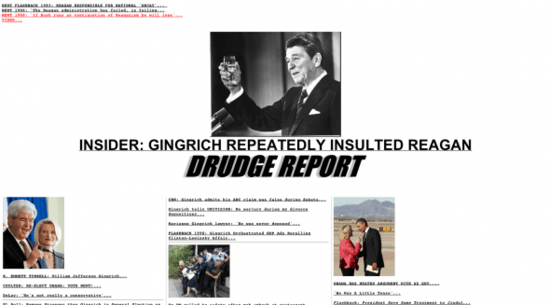
[T]his front-page of Drudge looks like debate-prep for both Mitt Romney and the CNN moderators tonight.  It's also the last debate for almost a month. It could form the most important impression on voters in Florida and all the caucus contests from now until the Arizona primary in late February. 

Paul Waldman downplays the influence of the right-wing media: 

If Newt falls, it'll be because he brings himself down, because his own craziness and incompetence render him unable to overcome Mitt Romney's money and methodical organization. The Florida primary isn't going to turn on a piece in the National Review. So DC Republicans can squawk all they want about what a disaster a Gingrich nomination would be, but like the rest of us, they're mostly going to have to sit back and wait for Newt to destroy himself, probably in the most dramatic way possible. But if I were them I'd be reasonably confident that he will sooner or later. After all, this is Newt Gingrich we're talking about.

2012 Will Be The Most Negative Campaign In History

Joe Hagan previews the general election:

Whereas in 2008 there were about 25 opposition researchers, the engine of any negative campaign, working for Obama’s campaign, the pro-Obama super-PACs, Priorities USA Action and American Bridge 21st Century, together add another 50. Even more will be added on the right, with American Crossroads, the super-PAC co-founded by the negative-campaigning guru Karl Rove, and the Koch brothers’ Americans for Prosperity all staffed up and sharpening their arrows, ready to ally with whomever the nominee is and his respective super-PAC. That means that instead of two campaigns running against each other, there will be six or more, a virtual arms race of donor money, most of it anonymous, with overall television advertising spending expected to reach $3 billion in 2012. The tsunami of slime will overtake the public sphere for months.

Hollywood’s Condescension On Race

Clooney primarily spells it out:

Allison Samuels parses the roundtable: 

In Hollywood, where even legendary filmmaker George Lucas had to fight and ultimately use his own money to get an all-black film (Red Tails) made, black actresses still struggle to find quality work. When they do, they are rarely cast as ideals of beauty or objects of desire. On the odd occasion that they are, only a certain look will do. …

[Viola] Davis’s work has been consistently stellar throughout her career, yet her most celebrated role to date may just be that of a maid to a white family during the ’60s in the Deep South. Some viewed The Help as another stereotypical representation of black life, but Davis still found a way to shine in her work. Diverse and well-defined parts such as the ones Theron enjoys—a ruthless killer in one film, a dying woman in love in another—aren’t offered to Davis, nor are well-paid endorsement deals with Christian Dior. In the world Davis lives in, you take a role like the one of Aibileen in The Help because you’ve long given up on the notion that more balanced, nuanced parts about women who look like you are on the horizon. 

If Newt Gets The Nomination, Thank The Supreme Court

Chait argues that Citizens United allowed the Gingrich campaign to flourish:

Money is the primary mechanism that parties use to herd voters toward the choices the elites would prefer them to make. The nomination of George W. Bush offers a classic example. Bush and his network had organized so many Republicans to donate so much money that the contest was essentially over well before a vote had been cast. The Bush fund-raising network didn’t involve a handful of billionaires in a room. It required thousands of fairly affluent people working together. 

In contrast, Gingrich's Super PAC, funded largely by one very wealthy supporter, is keeping him competitive moneywise.

Newt’s Boogeyman

Enhanced-buzz-wide-5425-1327443486-23

British blogger Richard Adams reads up on Saul Alinsky:

[He] was what passes for a left-wing radical in American politics, agitating for better living conditions for the poor in the slums of Chicago and New York – that has been filtered through the likes of right-wing talkshow hosts such as Glenn Beck and Mark Levin. … Rather than the far-left figure that Gingrich and others would paint him, Alinsky appears in his writings – including Rules for Radicals, published in 1971 – to be more concerned with the nuts and bolts of grassroots organisation in effecting change. "Dogma is the enemy of human freedom," Alinsky once observed, and said he never considered joining the Communist party.

Dan Savage draws a parallel:

Alinsky's advice to young radicals—"go home, organize, build power [and] you be the delegates"—is the strategy adopted by American religious right and social conservatives in the 1980s.

They're organized, they're the delegates, they pack the school boards, they pack the city councils and state legislatures. The right's adoption of Alinsky's strategy was a success for the right and a disaster for the country. But you gotta give 'em credit: the right got out there and they organized and they built power. And how did they do that? Well, they did it with… wait for it… community organizers!

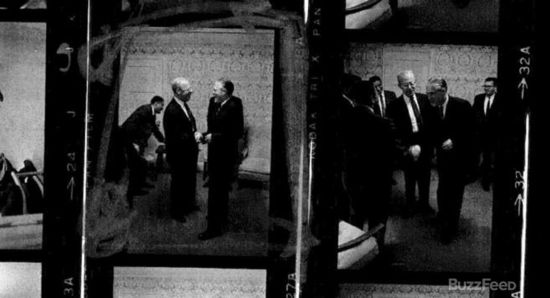
Andrew Kaczynski dug up the above image:

In the wake of the devastating Detroit riots of the summer of 1967, Michigan Gov. George Romney — a liberal Republican — met the radical organizer Saul Alinsky to discuss the grievances of the urban black poor. … "I think you ought to listen to Alinsky," Romney told his white allies, according to T. George Harris's 1968 book, "Romney's Way."

The Democrats vs Tax Reform

A reader writes:

As I've commented before, one puzzling aspect of your blog recently is the seeming total lack of acknowledgement of the existence of the Democrat party, sans Obama. Do they play no role whatsoever in the machinations in D.C. ?

So, let's discusss them for a moment. How eagerly would they likely be to support the wholesale tax reform that we both want ? Has any Democrat ever offered a bill to reform the code in a substantive fashion ? If so, it was done when nobody was paying attention. Truth is, the Congressional Dems and their benefactors have no more interest in root and branch, tax reform than the GOP does. If resistance in Congress is a primary reason that Obama hasn't proposed it (which I highly doubt; he's never wanted it either), resistance 'within his own party and among its paymasters' is as big a hurdle as kneejerk, GOP intransigence.

I agree. Especially on the kind of deal Obama could actually get on tax reform with the Republicans: one that is revenue-neutral. The Dems and Obama have pinned their tax reform to revenue increases. Now I understand that logic as leverage in a Grand Bargain. And I understand that the GOP's insane resistance to any net revenue increase is the main reason this has not happened yet. But still: yes, of course Obama's failure to deliver except rhetorically has been constrained by his own party. He wasn't going to back severe cuts in entitlements without a chance to get something actually done on taxes and revenues. But, unlike my reader, I do think he'd favor serious tax reform if he were completely unconstrained.

Which means to say: it may take a re-election for Obama to trump Pelosi. But if he is re-elected there's a decent chance she will too.

Paterno’s Legacy – And Ours, Ctd

19

A reader writes:

Why do so many people feel the need to ask, "In light of the scandal, how do we remember Joe Paterno?" Why can’t we remember him and his life exactly as it happened? One heinous act does not undo all the good he did in his life, much like a major kindness does not undo a life of evil. Joe Paterno was an excellent football coach whom many considered to be a paragon of morality, good will, dedication and service. But he also made mistakes, most notably he failed to act on information concerning the safety of children and in all likelihood enabled the further abuse of children. But most importantly he was a human, and like all of us he is neither black nor white, but some shade of grey. The need to classify him into a category of "good" or "evil" seems like folly to me.

Another writes:

I debated whether or not to share this, but as everyone has been sharing their "JoePa stories" lately, I thought it'd be appropriate to share mine.

Despite attending Penn State University, I never had the opportunity to meet JoePa. I heard stories of friends that had – most memorably two friends who, while out riding their bikes, saw him driving home from practice on the eve of the 2005 Ohio State game. They decided to follow him all the way into his garage so that they could shake his hand and wish him luck. Instead of being weirded out (which would have been pretty understandable) he was very gracious and thanked them for the support.

Last month, I was visiting Penn State for a number of different reasons. While I was there, I wanted to show my support for Joe in light of his cancer diagnosis and how he had been mistreated by the University and the press (based on incomplete information and misinformation) in the last month. I decided to leave him a note expressing my support along with a blue and white bouquet of flowers. I felt awkward approaching the Paternos' home. I had heard stories of students and alumni that had walked right up, rung the doorbell, and been welcomed in by Joe and Sue – in some cases, even being fed by Sue – but having never met the Paternos, I didn't have the nerve. I left the note and bouquet on their doorstep and walked away.

Three days later, I received a text from my Mom: "Does Joe Pa live on McKee St? If so, you got a card from him."

I think my jaw must have dropped about five feet. I was absolutely stunned that Joe and Sue would take the time to send me a card. Later, when I read the card, I was even more humbled by what it contained. Joe and Sue thanked me for the flowers and the note and said that Joe was drawing strength in his battle with cancer from all the support he had received from Penn Staters. They said that it was "good to be reminded of what we were trying to accomplish at Penn State." They said that after they finished "getting Joe healthy," they would work to remind people of the values that Joe had tried to impart during his time at Penn State. The card was signed, "Very fondly, Joe and Sue Paterno"

But here is the most amazing thing about all of this and what shocks me even to this day: I DIDN'T LEAVE ANY CONTACT INFORMATION WITH MY NOTE. I had signed the note with my name, and mentioned my graduation year, but had been very intentional about not leaving an address, email address, phone number – anything. This means that Sue (I have to think it was her, given Joe's health at the time), despite receiving hundreds of letters from alumni per day, took the time to look me up in the alumni directory (which still contained my parents' address at the time) and send me a card. The Paternos had never met me before; I'm not a huge donor to the school; I'm not someone important who can do anything for them; I'm just another alum. And they went way out of their way to send me a thank you card THE VERY NEXT DAY.

Recently, Penn Staters have been characterized as football-crazed idiots for supporting JoePa despite the allegations made against him in the press. I can tell you that Penn Staters' love for JoePa has almost nothing to do with football. Penn Staters are the Paternos' life work and legacy. Joe never missed an opportunity to remind us that success is only valuable when it comes with honor, and that all of us – football players or not – were at college primarily to gain an education, broaden our horizons, and become better people. It is not an overstatement to say that a part of who I am today is directly because of Joe Paterno and his love for Penn State.

And Penn State loves him back. Thank you, Coach.

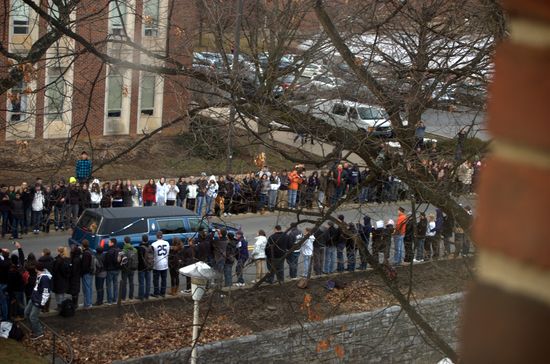
Another sends the above photo:

Though a long-time reader, and a big fan of VFYW, I've never been one to take a picture from my window – until today, that is.  I stood up from my experiment in which I was taking pictures of growing plants and, using the same camera, snapped this of Joe Paterno's funeral procession driving past.

State College, Pennsylvania, 4.40 pm.
Kill Hollywood?

That's the objective of Paul Graham's drive to fund alternative entertainment startups:

There will be several answers, ranging from new ways to produce and distribute shows, through new media (e.g. games) that look a lot like shows but are more interactive, to things (e.g. social sites and apps) that have little in common with movies and TV except competing with them for finite audience attention. Some of the best ideas may initially look like they're serving the movie and TV industries. Microsoft seemed like a technology supplier to IBM before eating their lunch, and Google did the same thing to Yahoo.

Alyssa Rosenberg thinks he's dreaming:

I don’t know that there’s good evidence that there will be a direct tradeoff between movie spending and other forms of entertaining. Video game sales are outstripping movie tickets, but it’s not like movie ticket sales have declined in relation to the rise of video games: in fact, both industries have experienced a similar downturn in the recession. And certainly, video game creators have an interest in Hollywood surviving as a way to spin off games into movies that help extend and make more durable existing franchises. There may be new forms of entertainment in 50 years, but I’m not sure it’s going to entirely replace movies or television, both of which have proven to be durable art forms even as our ways of consuming them change, posing both distribution and storytelling challenges. I don’t doubt that we’ll get new and exciting forms of entertainment. But I don’t think we’ll have to kill Hollywood to get them.