Well, It Sure Worked

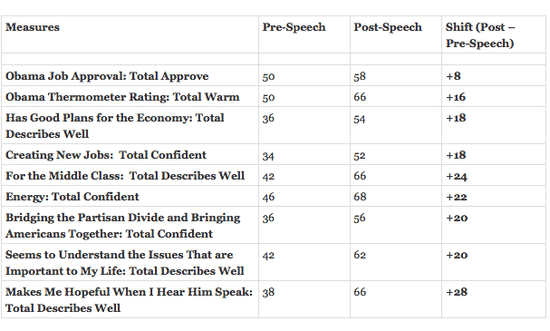
Some pretty stunning results for a SOTU, even though they usually get high marks. A reader adds:

Today at work the response has been surprisingly positive.  I live in Central PA, otherwise known as Pennsyltucky. What’s surprising is the reaction from those who have been steadfastly opposed to Obama and everything he stands for.  Both an evangelical Christian, who is primarily concerned with the social agenda, and a secular conservative, who is primarily concerned about his guns and his taxes being given to the lazy, enjoyed the speech and even said, “I could possibly see myself voting for him”.

I guess this goes in the "meep meep, motherfuckers" category. And I'm Wile E. Coyote this time.

Update: the poll linked above is from 2011, not 2012. The Dish wasn't the only blog to make this mistake. There doesn't seem to be much polling on the SOTU yet, but Steve Benen points to some focus groups that loved the speech.

After Some Sleep

It does help, after these frenzied few weeks. I think my reaction to the SOTU reflects a skewed perspective – much different than most people tuning in, who were the speech's core audience. A big part of the speech was reminding Americans of the facts about Obama's record – as opposed to the massive lies and distortions we keep hearing in the GOP debates. That's new to many; and it's Obama-crowd impressive. But since I wrote that argument and have been defending it for more than a week, I didn't hear that part, or heard it and dismissed it as old news. It may be old news to me, but it isn't old news to most Americans. So I was focused on policy specifics, which were indeed underwhelming, as others have noted, with a few possible exceptions (the task force targeting Wall Street corruption; the mass mortgage refi proposal).
And the focus entirely on getting the wealthy and successful pay more – outside the context of comprehensive tax reform – rubs me the wrong way. It puts Obama in the position of liberal crusader against the wealthy, rather than centrist reformer of the system. Yes, I know he can't reform the system with this GOP. But since they favor tax reform, that proposal would have put them on the spot. By all means, make it revenue-neutral and then in a second term raise the rates a little, if revenue continues to be a problem. I just think Obama needs a big centrist cause in the campaign as well as a few big liberal ones.

But we have entered a purely political season. And Obama is being purely political here – in a way he pledged not to be in 2008. It may be a master-stroke – since he sure has painted the GOP into a corner on fairness, and his arguments here have broad traction. And if he destroys the GOP this year – and he probably will if Gingrich is the nominee – then it may all come together. But it will mean a much more liberal Obama, which is why this centrist supporter gets a little queasy.

Still, the GOP asked for it. By denying him any cooperation, they have ceded policy to him. And if he wins, they will be on the ropes for a while. And that's how Obama could truly become the liberal Reagan I spotted in 2007. Because he will not only shift the landscape toward more government intervention, he will have reformed the opposition party to reflect that change.

And who should really get a big part of the credit for turning America to the left? The Republicans who made Obama more liberal than he ever wanted to be. Congrats, guys. You may really be making history.

(Photo: Bill O'Leary/WaPo/Getty.)
Gingrich Goes For The Cuban Vote

Newt pummels Mitt's immigration proposal on Univision:

Tina Korbe makes an obvious point:

[I]t’s interesting to observe the way the emphases of the candidates change according to their audiences. Gingrich definitely wants the vote of Miami’s large Cuban population, don’t you think?

Adam Serwer looks at how the two candidates are currently faring:

Gingrich's relatively moderate approach to immigration when compared to Romney hasn't moved the needle much in his direction as far as Latino Republicans in Florida are concerned. Latinos still back Romney over Gingrich 35 percent to 20 percent, although 21 percent are undecided, according to ABC News' Matthew Jaffe. Romney's appearance on Univision this afternoon could have a significant impact on how that 21 percent ultimately breaks. 

Weigel focuses on Newt's economic attack:

Gingrich has spent two weeks attacking Mitt Romney's career as a public equity captain and a co-founder of Bain Capital. He's dropping the subtlety now, and making an argument that plucks the middle class voter's heartstring: That rich jerk doesn't even work for a living. 

God Shouldn’t Only Bless America

Ryan Avent hated the xenophobia and zero-sum thinking in Obama's speech:

People who live outside of America are people just like Americans, and we should all rejoice in their rising prosperity, the more so when it occurs through additions to the stock of human knowledge that will benefit people everywhere. If an American president can't communicate that simple idea to his citizenry, out of fear that he'll be drummed out of office on a wave of nationalistic outrage, then he doesn't deserve to be president and his country doesn't deserve to win a damned thing, least of all the right to call itself "exceptional", a beacon of hope and freedom. A zero-sum world is a world without hope, and if Mr Obama is convinced that's what we're in then I don't see much need for him to stick around.

Reading The Florida Tea Leaves

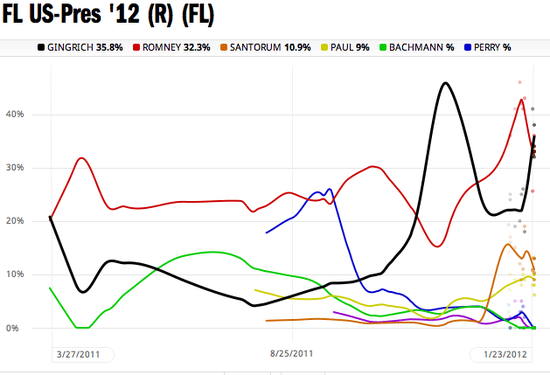
Florida

Nate Silver sizes up the Gingrich-Romney race:

Our forecast model currently gives Mr. Gingrich a 75 percent chance of winning the state. That seems like too confident a prediction, frankly. On the other hand, Mr. Gingrich does appear to have a modest lead in the polls — and the nonpolling factors do not clearly favor one or the other candidate, in my view. So I would call Mr. Gingrich the favorite for now — but not a clear favorite.

(Chart from TPM)

Adding Complexity To The Tax Code

Howard Gleckman analyzes Obama's proposals to further complicate taxes. His bottom line:

I suppose it is inevitable that a president beginning his fourth year in office and facing a deeply divided Congress would go small-bore. After all, there will be no fundamental tax reform in the current environment and even proposing such a step would only open him to criticism from the usual suspects in housing, non-profits, finance and other industries that are very happy with the system as it is.

Still, it is a shame that, instead, Obama would make things worse.

In my view, he needed one big domestic initiative in his first term to balance healthcare among Obamacons and Obama-Indies. Tax reform was an obvious choice, and he was given cover by Bowles Simpson. Would it have happened? Almost certainly not. Will many of Obama's countless little tax breaks pass? Almost certainly not. The point of tax reform was to stake out a position and remind us that he's not a standard-issue liberal.

He punted. And punted. And punted. His response? The argument that he put out a proposal last September that he didn't highlight and that no one read. Sometimes, his pragmatism is almost pathological.

But there's something else here. Sweeping tax reform removes much government meddling in the private economy. Since Obama seems now to want industrial policy directed from Washington, tax reform would hurt. But my main interpretation is that he couldn't bear being trashed by all the various special interests involved. And the data supports a populist re-election strategy.

I understand that. But let us be clear: more tax breaks is not change. It is much more of the same things that Americans are sick of.

The Daniels Response, Ctd

A reader writes:

You liked Daniels' speech, but how can you trust anything he says?  He said the Iraq War was going to cost $50-80 billion.  There's a point where a person should lose all credibility forever, and the Bush budget director is example case #1.

Another writes:

During Daniels' 29 months at the Office of Management and Budget, the projected federal budget surplus of $236 billion declined to a $400 billion deficit.  This is your budget cutter.  Why does he get a pass on this?

Another:

Daniels opened by saying, "The President did not cause the economic and fiscal crises, [but] he cannot claim that the last three years have made things anything but worse." Really? He's made the crisis worse? Your Newsweek essay says this charge is "simply—empirically—wrong." How can you applaud Daniels for repeating a line of attack that is so disconnected from reality?

Another differs from the majority:

I'm completely with you on the Daniels speech.  I'm a lifelong centrist Republican, who's been having doubts over the last decade or so about whether there is any longer a place for me in the party.  But Daniels the first Republican speech I'd heard in a long time that actually excited me.  As David Brooks said last night, I shed a tear that he did not run.  What a welcome contrast to the current lot of bozos running for the nomination.

A lengthy Daniels dissent:

You wrote about the SOTU response that "It was what a sane Republican critique of this presidency would be." I strongly disagree. This speech was heavily laced with the usual canards Republicans use to raise doubts about this president. For example, he faulted the president on energy policy for resisting domestic oil development. As you well know, the president has opened vast areas of previously protected land for oil development, a policy he announced an expansion of tonight. He made a valid point about the Keystone XL pipeline. However, there were serious concerns about this project, which was under review by the administration. Congressional Republicans forced his hand before the review could run its course. Of course he decided against it. I would place more blame on the House of Representatives than the White House for the death of that project.

Daniels also pressed the lie that the president has made no serious efforts to reduce the deficit. Democrats and Republicans may disagree on the best way to reduce the deficit, however President Obama has put forward some of the most ambitious proposals to reduce the deficit to receive any significant support. During the debt limit debate, he was willing to go farther on spending alone than the Republicans were requesting. Never mind their unwillingness to raise taxes on anyone besides the average worker.

Then Daniels has the absolute nerve to blame the divisiveness of modern politics on our president. Our president, whom is routinely called a socialist, a communist, a Kenyan anti-colonialist, is the cause of the division. Our president, who has consistently tried to find common ground on taxes, on energy, on healthcare, and on any number of other issues, only to watch the opposition walk away from their previous positions, is the cause of the division. Our president, whose main role in the ongoing class war has been to point out how the unscrupulous among the rich have been waging this war for decades and winning, is the cause of the division.

I can understand the desire to find a sane voice among the officials of the Republican party. I'm a registered independent and share that desire. I agree with you about Ron Paul's contributions to the debate; disagree with Jon Hunstman on policy, while I recognize that he tries to craft sane policy that accomplishes worthy goals, merely questioning his priorities; and I lament Gary Johnson's having been excluded from the Republican presidential race. I was hopeful before this speech to hear what you evidently believed you heard, but I did not.

The problem with the modern Republican party is not merely a matter of tone. Chris Christie has convincingly challenged many Republican orthodoxies while maintaining the fiery tone that so appeals to many Republicans. He has done this by dealing firmly with the reality of the policies he deals with, instead of the insane otherworldly echo-chamber that defines mainstream Republican thought. He consistently impresses me in a way that Mitch Daniels, at least tonight, did not.

Watch the 12-minute response for yourself here.

Obama’s Stump Speech To The Nation

GT_SOTU_Speech

Most bloggers saw Obama's SOTU speech as a campaign speech. Jonathan Chait cheers the president on:

It was the speech of a man who realizes that he has only one thing left to do, and that is to win reelection. The Obama of 2009-2010 was a pure pragmatic wonk, and his inattention to politics hurt his standing. Through sheer bloody obstruction, Republicans forced him to the only available alternative, which was to use his office solely as a political platform. His agenda is dead, but his public standing has benefited. Perhaps one day Republicans will wish they had been a little more flexible, and had kept the old, wonky, bargaining Obama rather than the slashing populist who’s cutting their throats.

Ross Douthat believes that the "address made plain" that "President Obama has decided to run for re-election as a full-throated liberal populist":

There were rhetorical nods to deficit reduction, sensible regulatory reform and the Lincolnian idea that “government should do for people only what they cannot do better by themselves, and no more.” But the substance of the speech could be summed up in one word: More. More spending on education. More spending on infrastructure. More money for green energy projects. More assistance for homeowners who are underwater on their mortgages. More tax breaks for manufacturers – for high-tech manufacturers, for manufacturers who relocate to poor areas, for manufacturers who retrain workers, for manufacturers who don’t outsource jobs, for manufacturers who upgrade their buildings … O.K., I lost count. And all of it to be paid for, inevitably, by more taxes on the wealthy.

Mark Kleiman ate it up:

What can the Red Team say in response, except “Ouch!”? American isn’t great? Osama isn’t dead? Vulture capitalists ought to pay lower tax rates than workers?

David Frum differs:

In the absence of recovery, the president is offering social reform: a more redistributive tax system to finance more government benefits. That's the first argument. The second argument was an argument that Congress' failure to deliver on prior reform proposals reflected institutional failure in need of correction. These two arguments—higher taxes for more benefits; reform of Congress to expedite social reform—are the president's big offers to the country for November.

Stan Collender wishes the president had proposed shared sacrifice:

[T]he SOTU turned out to be even more of a campaign speech than I had expected (If you have any doubt about that just listen with your eyes closed to the over-the-top soaring rhetoric at the end and ask yourself if it doesn't sound like the president was accepting his party's nomination.) and campaign speeches don't promise to impose pain (Ask Walter Mondale). That meant that the budget, deficit, and national debt were out and proposals that make you feel good about the future were in.

Brian Beutler understood the speech as a "point by point Romney refutation":

It read in a way as a series of critiques of the GOP’s most prominent rhetorical attacks on Democratic priorities, and as a piecemeal rebuttal of the talking points his most likely general election opponent Mitt Romney has levied against him in a bid to shore up support among Republican base voters.

And Kevin Drum was underwhelmed:

I'm a Democrat and a fan of the president, but even I found this speech formulaic, devoid of interesting ideas, and built almost solely for applause lines. Presumably this means that it's going to poll through the roof. Joe and Jane Sixpack will love it. And with that, Campaign 2012 has officially gotten underway.

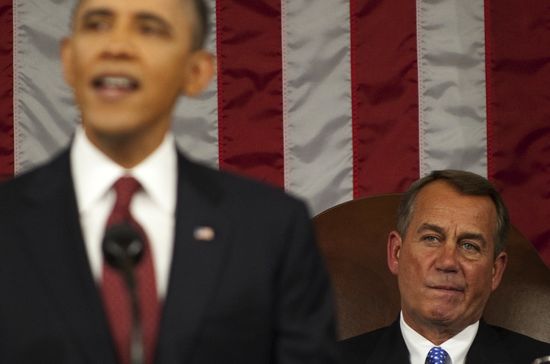
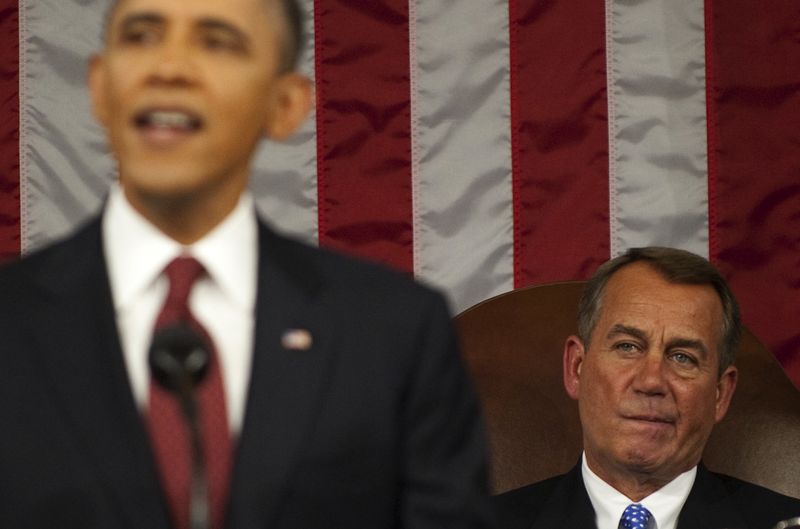
(Photo: U.S. House Speaker John Boehner (R-OH) listens as President Barack Obama delivers the State of the Union address before a joint session of Congress on Capitol Hill January 24, 2012 in Washington, DC. By Saul Loeb-Pool/Getty Images)

Swing Voters Loved It

Screen shot 2012-01-25 at 11.21.31 AM
That's Stan Greenberg's finding from watching 50 of them in a focus group respond to the speech. The Osowatomie strategy seems to be pushing the GOP into a smaller and smaller corner:

The dials spiked when the President made his strong populist pitch for the “Buffet Rule,” with Democrats exceeding 80 on our 0-to-100 scale and both independents and Republicans moving above 70.  There was no polarization here, as voters across the political spectrum gave Obama high marks.  And Obama’s framing of the economic challenges facing the country through the lens of post-World War II America was particularly effective.  He also received high marks for his proposal to change the tax code to encourage “insourcing” instead of “outsourcing,” his call to change our “unemployment system” to a “re-employment system” and his appeal to make it easier for entrepreneurs and small business to grow and create jobs.