Where Do Donations Go?

Donations

Dana Goldstein investigates:

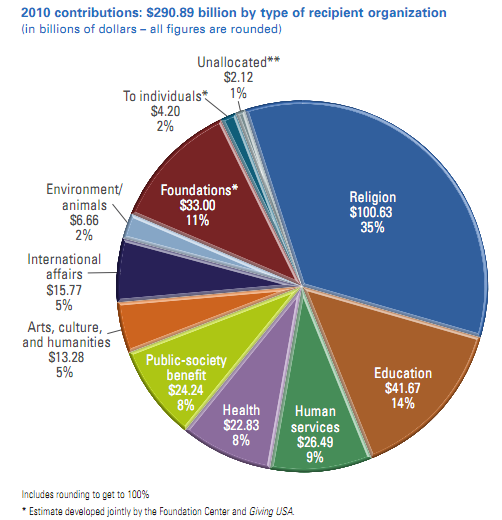
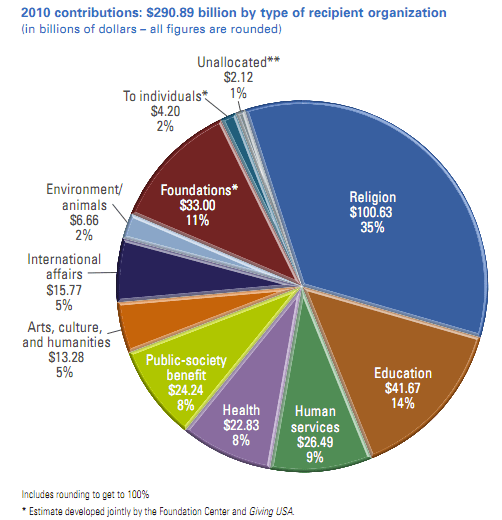
In their decision to prioritize religious giving, the Romneys are typical of American donors. When I was working at The Daily Beast in the wake of the 2010 Haiti earthquake, we decided to take a close look at how disasters impact American charitable giving. We were surprised at the results of our research: According to the Center on Philanthropy at Indiana University, only about one-third of all American charity–from individuals, foundations, and corporations–directly serves the poor, either within the United States or abroad. Year after year, religious organizations, typically local church groups, take home the biggest slice of American charity, even in the wake of major humanitarian crises. 

Is Christie Afraid To Veto Marriage Equality?

New Jersey reportedly has enough votes to pass a marriage equality bill. Christie, who has promised to veto the bill, declared today that he wants a referendum instead:

"I think this is not an issue that should rest solely in my hands, or the hands of the Senate President or the Speaker or the other 118 members of the Legislature," he said. "Let's let the people of New Jersey decide what is right for the state."

I do not see why in a representative democracy, a legislature should not be able to change the law in this way. For ever, we were told that we shouldn't use the courts and go to the legislatures. We did. We won. Now they move the goalposts again, as in California, to put the issue to a referendum. Why this issue as a referendum and not others? Dan Amira suspects Christie is trying to avoid using his veto pen because a majority of New Jersey voters support equality. I suspect he's protecting his viability as a candidate for the current Republican party (and the nomination of a gay African-American to the state supreme court was a great bit of distraction). But a referendum won't come easy:

Three-fifths of each chamber in the legislature must first approve a constitutional amendment if it's to appear on the ballot this November. That means convincing some anti-gay-marriage legislators to risk the legalization of gay marriage via popular vote, when they know the bill would otherwise die on Christie's desk. This plan may save Christie's hide, but what's in it for them?

Flexible With Reality

Vicious Grace - Jim

Fantasy author Jim Hines tried to pose like the characters on the cover of his novels and others in the same genre. His takeaway:

I spent the rest of last night with pain running through most of my back. Even the pose in The Shape of Desire, which first struck me as rather low-key, is difficult to imitate and feels really forced. Trying to launch my chest and buttocks in two different directions a la Vicious Grace? Just ow.

Alyssa Rosenberg comments:

If images like these are supposed to be what we find attractive, then maybe what we find attractive isn’t really human.

The Meaning Of Sheesh

It turns out I shouldn't have blogged that I was even briefed about the SOTU. I thought I just had to keep the contents to myself. One thing you learn pretty quickly about this White House: transparency is a theory, not a reality. Just watch it tonight, as I will (I don't have the text), and make your own mind up, as I will, in real time. 

As I said, I think tax reform should be at the center of the president's re-election push. The Romney tax business is an almost perfect backdrop. And tax reform – as I wrote above – helps Obama not only do the right thing, but also regain stature with independents, whom he desperately needs. That's my yardstick this year for this SOTU, as it was last: is he serious about long-term debt as well as short-term recovery? He totally dropped the ball last year, and I gave him hell. If he does it again, I think it reveals that he really isn't prepared to tackle tax reform or long-term debt in any serious way – and blame it all on the GOP. I mean: how can you enforce the Buffett rule without tax reform?

But the president strongly disagrees with this interpretation. Here's his defense of punting on Bowles-Simpson, made aggressively in his recent interview with Fareed. It's worth reading in full:

The basic premise of Simpson-Bowles was, we have to take a balanced approach in which we have spending cuts and we have revenues, increased revenues, in order to close our deficits and deal with our debt. And although I did not agree with every particular that was proposed in Simpson-Bowles — which, by the way, if you asked most of the folks who were on Simpson-Bowles, did they agree with every provision in there?, they’d say no as well.

What I did do is to take that framework and present a balanced plan of entitlement changes, discretionary cuts, defense cuts, health care cuts as well as revenues and said, We’re ready to make a deal. And I presented that three times to Congress. So the core of Simpson-Bowles, the idea of a balanced deficit-reduction plan, I have consistently argued for, presented to the American people, presented to Congress.

There wasn’t any magic in Simpson-Bowles. They didn’t have some special sauce or formula that avoided us making these tough choices. They’re the same choices that I’ve said I’m prepared to make. And the only reason it hasn’t happened is the Republicans were unwilling to do anything on revenue. Zero. Zip. Nada.

The revenues that we were seeking were far less than what was in Simpson-Bowles. We’ve done more discretionary cuts than was called for in Simpson-Bowles. The things that supposedly would be harder for my side to embrace we’ve said we’d be willing to do. The whole half of Simpson-Bowles that was hard ideologically for the Republicans to embrace they’ve said they’re not going to do any of them.

So this notion that the reason that it hasn’t happened is we didn’t embrace Simpson-Bowles is just nonsense. And by the way, if you talk to some of these same business leaders who say, Well, he shouldn’t have walked away from Simpson-Bowles, and you said, Well, are you prepared to kick capital gains and dividends taxation up to ordinary income, which is what Simpson-Bowles called for, they would gag. There’s not one of those business leaders who would accept a bet. They’d say, Well, we embrace Simpson-Bowles except for that part that would cause us to pay a lot more.

And in terms of the defense cuts that were called for in Simpson-Bowles, they were far deeper than even what would have been required if the sequester goes through, and so would have not been a responsible pathway for us to reduce our deficit spending. Now, that’s not the fault of Simpson-Bowles. What they were trying to do was provide us a basic framework, and we took that framework, and we have pushed it forward.

What he ignores is that if he had openly embraced Bowles-Simpson, his own commission, and forced the GOP to oppose him, he could have changed the dynamic. Because there is some magic in a Republican and Democrat and their colleagues offering a candid way out of our fiscal hole. And there is more magic in a president backing them. Instead we hear him saying that the GOP ran away from it, so why should he embrace it? That kind of logic was one I thought we voted against when we backed Obama in 2008. It's so so so Washington.

As it is, Obama really doesn't want the steep defense cuts that Republican Alan Simpson wants. And in a sane world, conservatives would be attacking him for this overweening bloat. But my real suspicion is that Obama does not believe he can defeat the special interests that would attack Bowles-Simpson. Look at how he cites business leaders whining about taxing income and dividends at the same level. He doesn't want to take them on. But why not? Fighting for a level playing field in taxation is a good thing – as policy and politics.

In Obama's defense, he says he proposed a similar budget last September, and it's true that it is not far off Simpson-Bowles. It's also true that Obama may want to do it, but thinks it's hopeless till after the election. It's also true that Republican resistance to any increase in revenues makes Bowles-Simpson a dead letter. But why not reveal that by backing the proposal and calling their bluff? Instead of ignoring it, proposing a document in September that no one even noticed, and then drifting on.

Let's hope that tonight is a bang, not a whimper. And let's see if tax simplification or reform are anywhere on the agenda.

Hamas’ “Moderation” Gambit

Nathan Brown doubts Hamas' signals that it might be taking a more moderate stance:

[T]hough Hamas’s recent steps are significant, they do not represent any clear commitment to a different path; each one has left an escape hatch gaping open. But Hamas’s leaders have begun to involve their movement in a series of processes over which they do not have complete control, and the incorporation of Hamas into regional diplomacy is a logical and desirable (though still risky) outcome. 

Walter Russell Mead assesses the growing schism between Gaza and Tehran.

The Election Will Determine Romney’s Tax Rate

Cap_Gains_Tax_Rate

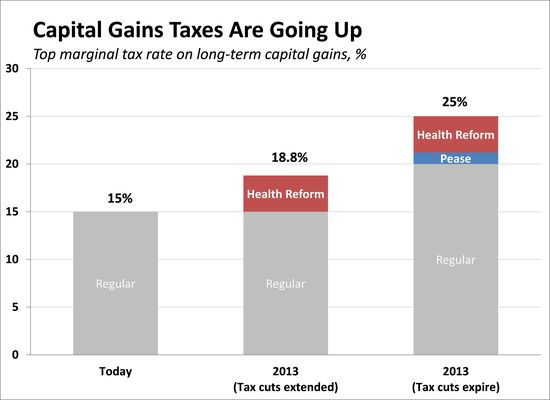
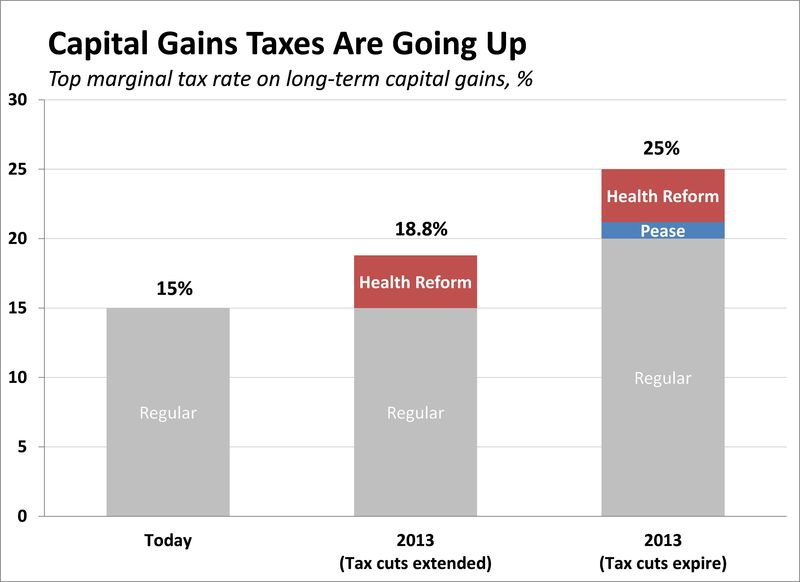
Donald Marron points out that capital gains taxes are scheduled to increase:

The only way that the top capital gains tax rate remains at 15% will be if the tax cuts are extended for high-income taxpayers and the new health reform tax gets repealed. That’s a key distinction in the election: President Barack Obama opposes those steps, while the GOP presidential candidates favor them (and some candidates would cut the capital gains tax rate even further).

Yglesias Award Nominee

"The reality is that, like it or not, 'Islamist-oriented' governments are about to become the new normal in a region dominated for decades by secular autocrats and pro-American generals. So the crude bias about Muslim movements that is baked into the worldview of many U.S. conservatives — that they are inevitably fundamentalist, anti-democratic, anti-Israel and anti-American, if not explicitly 'terrorist' — has become a serious liability. If heeded, it will make it impossible for this administration and future ones to navigate the region’s new politics and preserve crucial alliances," – Jackson Diehl, WaPo.

The GOP Is Bound To A Bloated Budget

James Traub spotlights the party's huge disconnect on foreign policy and defense spending: 

The Republican elite remains committed to a hawkish, big-spending policy and will keep hammering Obama as a peacenik, the way Republicans have done to Democrats for the last 40 years. It won't resonate the way it used to, however, because too many ordinary conservatives have lost the faith. Paul arouses plenty of antipathy with his attacks on U.S. foreign policy, but he also gets a great deal of applause — more than Romney ever gets when he calls for more ships and planes. Polls consistently find that Americans are prepared to accept serious cuts in defense spending.

The CBPP calculates the cuts Romney would have to make to non-defense budgets in order to keep fiscal promises.