An old meme remains popular:
Month: January 2012
Correction Of The Day
"An earlier version of this article incorrectly stated whom Newt Gingrich is said to have asked for an "open marriage." It was an ex-wife, not his current wife," – the NYT, trying to keep track.
Before The SOTU
I just got briefed a little, in a rare moment of outreach from the White House communications team. Everything is embargoed, so no details. And being briefed about the contents is not the same as listening Obama deliver the case. But sheesh. Get some caffeine ready.
Quote For The Day
"Do you think I’ve ever had an abortion?" – Barney Frank, advocate for pot decriminalization, responding to an interviewer who didn't seem to believe that Barney doesn't smoke pot himself.
Would They Call Adam Smith A Socialist Today?
George Scialabba explains that the free-market philosopher "at least had a moral imagination, unlike most of those who now claim his legacy." A brief rundown from his 2011 review of Nicholas Phillipson's Adam Smith: An Enlightened Life:
Like Hume, Smith was firmly on the side of the workers, a robust partisan of full employment and high wages.
What improves the circumstances of the greater part can never be regarded as an inconveniency to the whole. No society can surely be flourishing and happy, of which the far greater part of the members are poor and miserable. It is but equity, besides, that they who feed, clothe, and lodge the whole body of the people, should have such a share of the produce of their own labour as to be themselves well fed, clothed, and lodged.
And another sarcasm against early capitalist apologetics, which applies equally well to later ones:
That a little more plenty than ordinary may render some workmen idle, cannot well be doubted; but that it should have that effect upon the greater part, or that men in general should work better when they are ill fed than when they are well fed, when they are disheartened than when they are in good spirits, when they are frequently sick than when they are in good health, seems not very probable.
Smith straightforwardly supported the principle underlying progressive taxation:
The subjects of every state ought to contribute towards the support of the government, as nearly as possible, in proportion to their respective abilities; that is, in proportion to the revenue which they respectively enjoy under the protection of the state.
Nor was Smith a proponent of the minimal state. Government has the duty of "erecting and maintaining those public institutions and those public works which may be in the highest degree advantageous to a great society," but which "are of such a nature that the profit could never repay the expense to any individual or small number of individuals."
Adam Smith on the self-deception of politicians here.
Is The SOTU Useless?
James Joyner thinks so:
I find the pseudo-monarchial trappings of the speech increasingly repellent. We’re in the midst of an election campaign to decide whether Barack Obama gets to keep his office another four years and yet, for 90 minutes or so, we’re supposed to pretend that he’s our king. The entirety of both Houses of Congress, the Supreme Court, the Joint Chiefs, and the Cabinet–minus, of course, some token unelected apparatchik kept in a safe location somewhere to reconstitute the government in the event a Japanese airliner rams the Capitol– is supposed to clap like trained monkeys while the Campaigner in Chief delivers a partisan stump speech thinly disguised as a plea for national unity.
The View From Your Window

Old Hickory, Tennessee, 12 pm
Is Romney Right About The Navy?
Politifact rated Romney's claim that the Navy was at its smallest since 1917 "Pants on Fire." Tom Bruschino, one of the experts Politifact contacted, counters:
On the Navy question, Romney appears to be accurate[ly] using the standard Navy metric, which is number of active ships. In 2003, the US Navy dropped below 300 active ships, and is currently at about 285. The last time the number was below 300 at the end of the year was 1916, when it was at 245.
Ackerman and Schachtman explain why this technical accuracy isn't at all meaningful:
This is the sort of thing that’s literally true but meaningless in context. Counting ships is less important than counting types of ships, because they offer different seapower options. In 1917, the Navy did not have any aircraft carriers. It did not have silent, nuclear-powered (let alone nuclear-armed) spying submarines. It did not have — for all their many, many problems — modular minehunters that can operate close to enemy shores. And on and on.
In fact, as Politico’s Chuck Hoskinson has pointed out, Obama’s very Navy chiefs have unveiled a shipbuilding plan that goes from the current 288-ship fleet to 325 by early next decade. “Romney’s point falls flat as a political attack,” Hoskinson wrote last week, “because he’s suggesting the administration should do what it already had planned to do.”
Mitt’s Electability Argument Takes A Beating
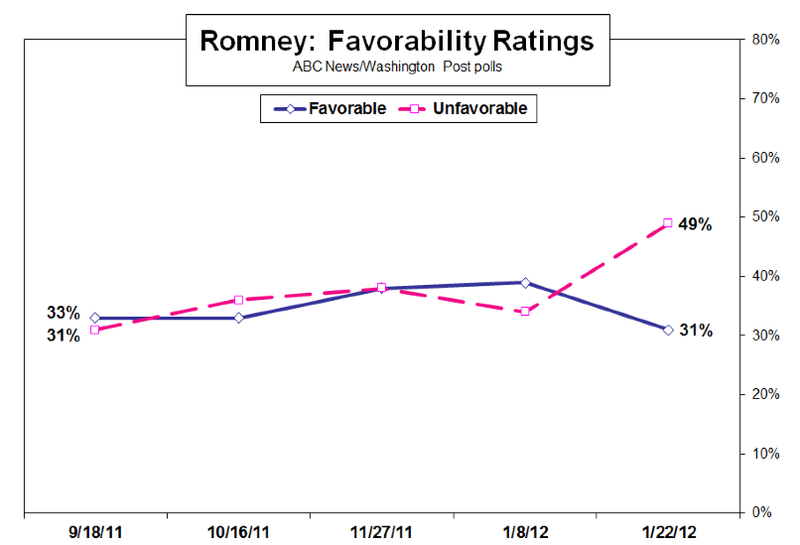
The latest WaPo/ABC News poll finds that Romney's unfavorables have spiked:
Among independents, Romney’s unfavorable rating now tops 50 percent — albeit by a single point — a first in Post-ABC polling back to 2006. Just two weeks ago, more independents had favorable than unfavorable views of Romney; now, it’s 2 to 1 negative.
Chait thinks this poll damages Romney's primary argument for his candidacy, that he is the most electable candidate:
The Obama campaign would almost certainly still prefer to run against Gingrich. But the electability gap between the two leading contenders is dwindling. No wonder more and more conservatives are frantically casting about for a new candidate to jump in and save the day.
(Chart from the poll release (pdf))
Birth Control And Religious Liberty, Ctd
A reader writes:
It's funny that you linked to the story regarding the Catholic Church's position on the birth control under the health care insurance rules. My wife, daughter and I went to mass on Long Island on Saturday night at 5PM, a mass that tends to be an older crowd though some families are mixed in. Our pastor was the celebrant and his sermon amounted to him yelling for 15 minutes about abortion, the administration's anti-religious attacks, and contraception. He was particularly upset about the contraception rules – yelling about taking money out of his insurance premiums to subsidy the pill – to the point that he took the Lord's name in vain as he walked in front of the altar. When he was screaming about the money, the only thought that went through my mind was the amount of money I've put into the collection box that was used by the Church to cover up pedophile priest cases.
Another makes a broader point:
Is something protected under the religious clauses of the 1st Amendment simply because a church states it? If the Catholic Church's stance on contraception is protected and the Obama administration's decision is violating their freedom, how far does it go? What if the Church all of the sudden reversed itself and said it's no longer its belief that it should help the poor? Let's say they started to believe that being poor was a purely individual choice that only reflected individual weakness and they didn't want to perpetuate dependency on others by helping people who chose not to help themselves. Would religious organizations such as the religiously affiliated hospitals in question in Turner's article then be exempt from treating people who don't have insurance or couldn't pay for their care out of pocket? Would the federal requirement that all hospitals have to treat emergencies then become unconstitutional on the same grounds that Turner's article argues the contraceptive requirement is?
 The Dish