A Book Tour Gone Wrong?

GT_GINGRICHBOOKSIGN_120123

That's how Marin Cogan sees Gingrich's campaign:

[T]he sense that this book tour (the aircraft carrier event [the night before his victory on Saturday] was also a book signing) had spun out of control, that he would go home if he didn't truly believe he was the only candidate that could defeat Barack Obama, and was therefore obligated to do this, was pervasive. 

Friedersdorf likewise looks at Gingrich's place in the media ecosystem:

Of course a base that gets much of its information from Fox News has a higher-than-justified opinion of Gingrich, a contributor to the cable-news network until he launched his presidential bid. Of course folks who get much of their information from talk radio are inclined to assess the conservatism of public figures based on fiery rhetoric more than the substance of their record: haven't they been trained to do so by charismatic hosts who daily exalt in zinging liberals and demonizing leftists as if it is the most important metric of a trustworthy ally? 

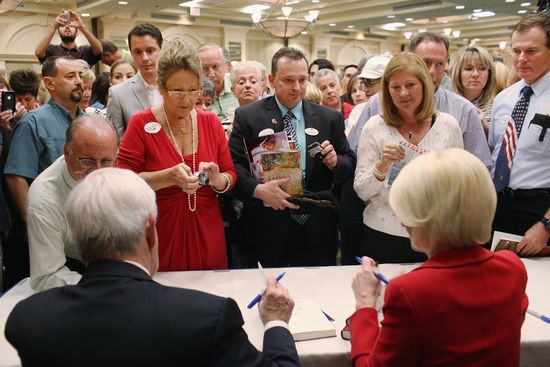
(Photo: Republican presidential hopeful and former Speaker of the House Newt Gingrich and his wife Callista sign books after speaking at a Hilton Hotel on November 25, 2011 in Naples, Florida. Gingrich, who has rose in recent polls following strong debate performances, had been written off earlier this year. Photo by Spencer Platt/Getty Images.)

Newt’s Grandiose Ideas For Fundamentally Reshaping The Country On A Fundamental Level

Screen shot 2012-01-24 at 1.15.36 PM

Ramesh Ponnuru's understated jab at them:

Gingrich has more original ideas than most of us. But for a president, what’s much more important is the ability to tell the good ones from the bad — an ability called judgment.

Ezra Klein makes the same point:

When Gingrich was speaker of the House, Bob Dole was the Senate majority leader. And so Dole spent a lot of time listening to the speaker’s proposals. “Gingrich’s staff has these five file cabinets, four big ones and this little tiny one,” he told The New York Times. “Number one is ‘Newt’s ideas.’ Number two, ‘Newt’s ideas.’ Number three, number four, ‘Newt’s ideas.’ The little one is ‘Newt’s Good Ideas.’”

Follow all the mildly amazing ideas here.

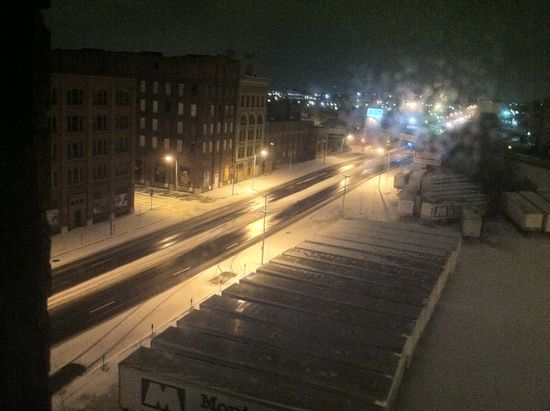
The View From Your Window Contest: Winner #86

Vfyw_1-21

A reader writes:

Based off of the well-concealed trucking logo, the weather report for Thursday, the architecture and the layout of the city, my best guess is that you're on Broadway Street in Missoula, Montana. 

Another writes:

I’d like to be able to say “we don’t need no stinkin’ clues” – and I will continue to protest that you have such low expectations of your readers – but I don’t think I have got it this week, even with your help.  The buildings feel very much like the Yesler / Pioneer Square area in Seattle and that would fit with the pile of containers over by the nearby port.  But that giant viaduct highway (Alaskan Way?) divides the port from the downtown buildings and I don’t think Seattle has those single pole parking meters anymore either.  So I’m at a loss on a specific location, and probably have the wrong city too.  But it did snow in Seattle last Thursday (trapping my inlaws here in Alaska for another couple of days) so I’ll stick with this guess.

Another:

This is killing me. I lack the crazy place-hunting ability of the people that usually win these, but Seattle was drenched in snow which started to melt Thursday night. And the area looks like the converted industrial SoDo neighborhood, which I've biked through hundreds of times. I just can't find these buildings anywhere – somewhere near I-5 I guess?

Another:

I'm actually late leaving on a trip, so I don't have time to get into this photo as much as I want to. However, living in the Pacific Northwest that looks very much like my Thursday night. The city and architecture are too big to be anything but Seattle, Vancouver, Tacoma or possibly Olympia. I know Vancouver pretty well and that particular truck yard does not look familiar paired with those buildings. It could easily be Georgetown in Seattle with that architecture, but the city lights behind don't look right for Georgetown's lowland location. So I'm going with Tacoma.

Another:

My guess is Sioux Falls, South Dakota. It would be in the Warehouse District, which is along East 6th Street between Minnesota Avenue to the west and Webber Avenue to the east, with the Big Sioux River a stone's throw away:

Soofalls

The semi trailers in the lot are for Montgomery's Furniture, which is the big furniture chain of eastern SoDak with big storage HQ in Sioux Falls. The area is crawling with railroad over/underpasses, one of which is shown down the road. I checked with the National Weather Service climate records for Sioux Falls and that location received several inches of snow over previously bare ground, hence the "first snowfall of the season" aspect to the scene.

Of course this could be completely wrong, so there.

Another:

Incredibly this week’s view is also reminiscent of the Harmony Mills image: Lots of snow and a truck with a logo prominently in the foreground.  This time I couldn’t find the trucking company or the tractor-trailer logo.  What I did find on Google, though, is that people really love to post images of jack-knifed tractor-trailers.

We’re in a desolate industrial zone on the edge of an urban area.  In addition to the tractor-trailer parking lot, one mid 20th century building across the street appears boarded up and the one on the left looks abandoned as well. There’s also an overpass that looks like it could be for freight trains. I’m imagining the person who sent in the view had a flight cancelled and then got stuck at a seedy hotel on the wrong side of the tracks.

This might be the bleakest VFYW ever.  Checking the NOAA.gov maps for last Thursday night shows a broad swath of snow across the northern US and southern Canada.  The Pacific Northwest isn’t bleak enough.  Neither are Minnesota, Wisconsin or the Dakotas.  And Canada, across the board, is too nice. I’m guessing the photo is taken somewhere along the axis of bleakness that runs from Buffalo through Cleveland to Detroit and then Gary, Indiana.  I'll go with Detroit?

Next week, someplace exotic or festive, please.

Another:

First off, I love the VFYW contest. But I don't usually have the time to stalk Google Maps to make decent guesses. But this one was easy for me: it was taken in downtown Columbus, Ohio. The photo itself is a view of the Arena District. It looks like it was taken from the Nationwide Insurance building, looking out onto a constructions site that will soon be a new office building for the company. It's funny seeing that image. I used to work in that very building and recently left my job at Nationwide and moved to Portland, Oregon. That snow makes me remember one of the reasons I decided to move west.

Correct state, wrong city. Another:

Something about that picture just screams downtown Cleveland to me, but I'm not sure about those "M" trailers. It looks like Lakeside Avenue facing west and the Warehouse District. I used to park right around there but my current office is a few blocks to the east so I'm not sure what construction may be taking place in that area. The highway is in the right place – that would be I-90 West. The weather is right. It snowed hard from about 3 til 6 on Thursday, then let up.

Another nails the correct city:

Dayton, Ohio! This picture shows the Montgomery Paper semi parking area, looking east along E. 3rd St. from one of the loft apartments on the south side of the street. It is just a block and a half from where I work!

Another local:

My family is from Dayton, and I was a reporter for the Dayton Daily News for a few years (and then the Cleveland Plain Dealer) before eventually finding my way to law school. It is the Montgomery Paper Co. trucks that give this one away. If you're ever in Dayton, you see these trucks a lot.

Another was more technical:

I guessed that the word on the container in the rear starting with "Mon" & ending with "ry" was "Montgomery", and the other word beginning with "Pa" was "Paper". Googling "Montgomery Paper" gives the address: 28 Wayne Avenue, Dayton, Ohio. Google-mapping that address shows buildings similar to the picture.

Another tried a different tack:

I made out the "Montgomery" on the trucks first and thought the next word began with either "Pa" or "Fa." Thanks to Google's auto-complete function, I was able to come up with Montgomery Paper. Google Maps then brought me right to Dayton and East 3rd Street. There's a big sign on the building, but I had to go around the corner to see a clearer version. I then googled the phone number and "lofts" and "dayton."

The only other VFYW I got so quickly was in Camden, New Jersey. Guess I have an affinity for Rust Belt towns.

Another:

I'm living in Texas now, but I miss the Dayton area, even though it's fallen on hard times lately.  A century ago, it was the Silicon Valley of the US, the hub of innovation and invention: the cash register, the automobile's electric starter, and so much more. I used to joke that Dayton was the most famous of US cities Americans seem to vaguely think they've heard of once.  Many famous celebrities left just as soon as they found out where they were (Martin Sheen, Rob Lowe, Dave Chappelle, Phil Donahue …) Indeed, its a little known fact the Wright brothers invented the airplane just so they could fly away.

Yes, I joke, but it's the knowing humor of someone who longs for home and misses it deeply, despite the tough patch it's going through.  Dayton is a great place to be from.

Another gets more specific with the location:

The view from the window is Third Street in Dayton, Ohio; specifically E. Third Street next to a lot that Montgomery Paper uses to store their tractor-trailers.  I would hazard to guess that the picture taker was standing in an apartment/loft at The Cannery.  On the street level you will find the K-12 Art Gallery, Therapy Cafe, Basically British Tea House and Square One Hair Salon.  Directly across the street you will find St. John United Church of Christ.

Another notes:

The Cannery at Webster Station in historic downtown Dayton is listed in the National Register of Historic Places.  Here is a link to an informative video about the area history and development project. This is a wonderful example of urban revitalization.

The winner this week was the only reader to guess the correct floor at The Cannery:

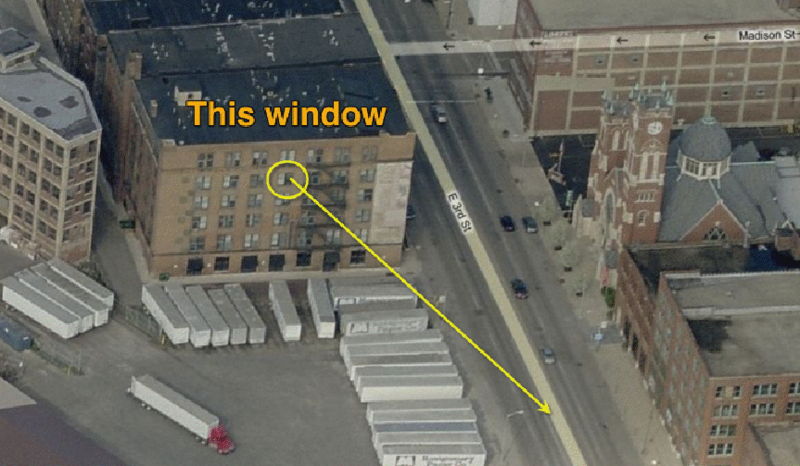
I found Dayton pretty quickly thanks to the Montgomery Paper Co. clue on the trucks, but nailing down the street address has been tough. Here's my best guess at the window, on the sixth floor:
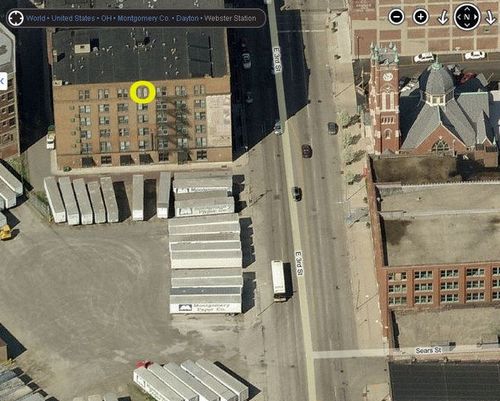
Dayton,  OH VFYW 2012-01-23

I did discover that across the street at St. John's United Church of Christ, the Dayton Gay Men's Chorus presented "Celebrate" on December 3rd. So, if the street address here is wrong, it's still a good entry for The End of Gay Culture meme.

Congrats, we'll get a book out to you shortly. Exact details from the submitter:

This picture was taken from my sixth floor loft in downtown Dayton, OH on Thursday evening. The address is 500 East Third Street and I am looking east down East Third Street above the Montgomery Paper tractor trailer parking lot.

One final email, from an especially tech-savvy reader:

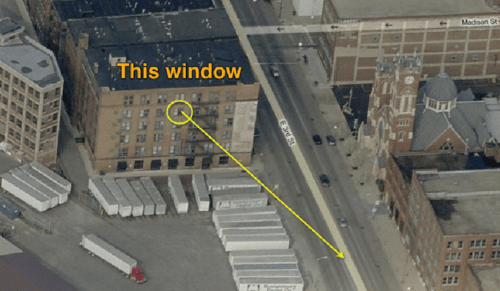
The location is Dayton Ohio, on 3rd Street in the neighborhood of St John's Church of Christ. The trucks all belong to the Montgomery Freight Company (Dayton is in Montgomery County, Ohio). Sears St is the cross street on the left side of the picture, and the church is just out of the frame to the left. The photograph was taken on an upper floor of the industrial building at roughly 600 3rd street. Judging by the lack of a fire escape in the photo, the position of the trucks, and the angle of the windows in the buildings on the north side of 3rd street, I'm going to assert that the window is the one circled in the picture below:
Viewer

This week was probably the easiest contest ever. Here's how you solve it, at least on a Mac:

1: Click on the photo from The Dish
2: In the new window that appears, right click on the picture and select "Open Image in New Tab"
3: Look closely at the URL in the new tab. Remove the characters "-800wi" from the end of it, and reload the tab.
4: Download the higher resolution picture to your desktop.
5: Open the image in Preview.
6: From the Tools menu, select "Show Inspector"
7: The little window that pops up has a button that says "GPS" on it. Click there.
8: The window will change to a tiny map of the world, with a button at the bottom that says "Locate.." Click there.
9: The browser will open with the coordinates of where the image was taken (on an iPhone 4, at 8:53PM on the 19th) in Google Maps. Notice that the altitude and image direction are also specified. 

Fish. Barrel. But fun. I've been trying this trick for weeks now and this is the first time it's worked!

(Archive)
Romney, Inc: First Blood

In a piece worth reading in full, Jonathan Last raises some good questions. First, Romney's work on the speaker's circuit is actually quite remarkable. In 2010, Romney accepted $35,771 from a non-profit tutoring and mentoring organization in Florida. He was also paid $29,750 to give a speech via satellite to a "Get Motivated Seminar" in Utah. Last: 

He does seem to have shown up to speak for Clark Consulting. Clark is a boutique operation: They consult for large financial institutions who are evaluating their business-owned life insurance programs. For this engagement, Romney was paid $66,000. The oddness of this booking was mirrored in two other speeches he gave. One was to Goldentree Asset Management, a New York hedge fund (they paid $68,000); the other was Barclay’s Wealth, an American division of Barclay’s Bank which does financial planning for high net-worth individuals and institutions (they paid $42,500). It’s not immediately obvious what a man actively campaigning for the presidency would have to say to any of these groups. Though it is easy to see why they would want to get in a room with him. None of it is improper, of course. Just unusual for a man worth $250 million who is presumably not in need of a spare $60,000.

He also scrutinizes Romney's advertised record as a job creator. For instance, do Staples' 89,000 employees really have Romney to thank? According to Last, who tells the impressive story of Staples founders Tom Stemberg and Leo Kahn, Bain was "neither the first investor in Staples, nor the largest":

[U]ltimately, it seems a little strange to credit Romney with being much more than a smart early investor. That’s not nothing. Investment and capital are a very large part of entrepreneurial success—which is why investors reap large rewards when a business pans out. But still. A group of investors ponied up the $2.7 million needed to buy a group of restaurants from Richard and Maurice McDonald. Banker Ken Langone led a group of 40 investors to raise $2 million to start the Home Depot. And Mike Markkula gave Apple Computers the $250,000 it needed when it incorporated in 1977. We don’t credit the jobs created by McDonald’s, Home Depot, and Apple to the money men. We credit them to Ray Kroc, Bernard Marcus, Arthur Blank, Steve Jobs, and Steve Wozniak. Because those men had the ideas, ran the operations, and assumed most of the risk. It’s unclear why we should regard Romney’s role with Staples any differently.

Paterno’s Legacy – And Ours

GT_PATERNO_120123

Ari Kohen reflects:

When I read about Joe Paterno’s passing this weekend — on two separate occasions, strangely — I found it impossible to separate the coaching legend of so many decades from the sexual abuse scandal of recent memory. For good or ill, one event or choice can fundamentally alter public perception of a person’s life and legacy.

Indeed, this is a central element of the book project on classical heroism that I just finished. The image of ourselves that we want to present to the world isn’t necessarily the one that will actually be presented or accepted, especially if there is some sort of anomalous behavior that doesn’t fit with that image. At bottom, there are only so many decisions we can make in a short lifetime, which is why each decision we make matters a great deal.

(Photo: Students and those in the community embrace one another as they hold a candlelight vigil in remembrance of Joe Paterno, the former Penn State football coach who died earlier in the morning, on Old Main Lawn on the campus of Penn State on January 22, 2012 in State College, Pennsylvania. Paterno, who was 85, died due to complications from lung cancer. By Patrick Smith/Getty Images.)

Marriage Equality Goes West

It now seems clear that the legislature in Washington state has enough votes in both houses to pass a bill for marriage equality. That would make it the seventh state in the union with such a law, and one that did it the New York way – by a long, bruising, helpful democratic process in the legislature.

Whether you examine the national polls or simply look at the changing landscape, it is clear that marriage for gays and lesbians is here to stay. The momentum and the arguments are on our side. Which is why the GOP's ferocious opposition to any rights for gay couples – and its bid to write such a horrifyingly targeted provision into the federal constitution – is so grotesquely misguided. The British Tories realized in their wilderness that two issues would wake people up to their evolution. The first was inclusion of gays – and a free vote is set in Parliament soon, supported by the prime minister, to bring full marriage rights to British citizens. The second was climate change. At some point, the American right will have to do the same (Newt, of course, already has on the climate, and Romney once pledged to be more pro-gay than Ted Kennedy).

The future is understood by Chris Christie who just nominated an openly gay African-American, married for thirty years, to the state supreme court. Christie still opposes marriage rights for gays, but has left the door open if the legislature moves forward, as it wants to do. But when you are treating a potential member of the state supreme court as a second-class citizen, in the end, the position becomes untenable.

What Will Obama Say Tonight?

A couple days ago, Obama previewed his State of The Union speech, which is scheduled for tonight:

Michael Cohen fits Obama's rhetoric on inequality to a long-term strategy:

[A very] important question is whether the sudden willingness of Democrats to tackle the issue of income inequality has the potential to live on far past the next election. For decades, Republicans have successfully portrayed the bogeyman of big government as the enemy of America's middle class. The emerging focus on America's glaring economic disparity – and its direct and deleterious impact on the middle class – suggests that Democrats are willing to use their own bogeyman of Wall Street greed in response.

Indeed, it's quite likely that the election will be a struggle between these two conflicting views. If Democrats are successful in such an endeavour, it has the potential to make 2012 more than just another election, but one that could shift the very narrative of American politics.

Bill Galston wants the president to talk more about opportunity than inequality:

The plight of hard-working, hard-pressed Americans—those struggling to remain in the middle class and those struggling get there—must be front and center. And the president must address it in the right way. A December 16 Gallup survey found that while 82 percent of Americans believe that it’s extremely or very important to expand the economy and 70 percent believe that it’s extremely or very important to increase equality of opportunity for people to get ahead, only 46 percent believe that about reducing the gap between the rich and the poor. While 72 percent of Democrats want government to emphasize measures to reduce inequality, only 43 percent of independents agree. And 52 percent of Americans say that “the fact that some people in the United States are rich and others are poor” is acceptable, actually up from 45 percent in 1998. 

Will Populism Sink Romney?

Scott Galupo wonders:

A sizable chunk of the electorate—maybe the decisive chuck—simply will not believe that the tide that lifted Bain, lifted them—or will ever lift them again. This bloc of voters is going to hear Obama’s critique and nod in agreement. And there’s very little that Romney will be able to say in his own defense that will change their mind.

In a way, Romney’s dilemma is the unhappy result of about 50 years’ worth of capitalism-as-populism rhetoric catching up with the conservative movement.

13.9 Percent Reax

Dreher asks why capital gains taxes are so low:

What, exactly, is conservative about a tax system stacked so that the ultrarich make massive profits from it, while working men and women pay a much higher rate on their income? Is the essence of conservatism protecting the privileges of the few at the expense of the many? If so, we lose. We are not egalitarians, and justice doesn’t require economic leveling. But soaking the rich isn’t what we’re talking about here; we’re talking about making them pay the same rate of tax as most ordinary people. You’re not supposed to talk about this on the Right, but why not? Why is this a question only liberals and Democrats are allowed to ask?

How Paul Krugman frames the debate:

the point here is not that Romney did something wrong by paying the low rates current tax law lavishes on people like him. It is, instead, that in an election campaign that will be in part about issues of inequality, the likely GOP candidate is a living, breathing, coupon-clipping example of how favorable our system is to the very rich; and he also happens to be advocating policies that would greatly benefit people like him, while hurting the poor and the middle class.

Ed Morrissey counters:

[Obama] has talked at times of raising the cap-gains rate from 15% to 20%, but that will still put cap-gains at “a lower rate than average Americans who are struggling to get by.” Obama’s so-called “millionaire’s tax” surcharge wouldn’t have applied to Romney either, because that was a surcharge on income, not capital gains.  If Obama wanted to have that debate with Romney, he’d shortly be exposed as either a hypocrite or an idiot.

Zack Ford points out that Romney "gives back more to the Mormons than he pays to the federal government":

Since 2010, the Romneys have given $7 million to charity, but over $4 million of that went directly to the Mormon Church, while they paid only $3 million to the IRS last year.

Ann Althouse defends Romney's donations to his church:

So he gave more money to his church than to the federal government. Is "gave" the right verb for both of those payments? Perhaps it's not the right verb for either. Tithing is compulsory in the church, is it not? In both cases, he's relinquishing was is due under a requirement.

Glenn Reynolds tries to change the subject:

Compare Romney to Bill Clinton. Clinton made his money by cashing in on his office. Romney made his money before running. Who’s more likely to be honest?

Reid Wilson suspects that Romney's overseas accounts will draw fire:

Romney's tax forms show he had a bank account in Switzerland, which he closed in 2010, and accounts in Bermuda and the Cayman Islands. All three have reputations as offshore havens where the extremely wealthy keep their cash, sometimes to avoid paying taxes (Romney actually did pay taxes on those accounts, but that minor detail may be left out of any attack ads).

Richard W. Rahn claims that the Caymen Islands attracts funds because of its regulatory environment, not for tax reasons:

Cayman has a sophisticated and cheaper-to-comply-with regulatory structure than the U.S for hedge funds. Cayman laws are better suited to hedge-fund oversight than U.S. retail-oriented regulation.” As a result, Cayman registers a very large percentage of the world’s hedge funds. Under the Cayman regulatory system, Ponzi scams like Bernard L. Madoff’s and the commingling of clients’ money with the firm’s money, as in Jon Corzine’s company, would be very difficult, if not impossible. Arguably, the Cayman regulatory system gives far better investor protection than the Securities and Exchange Commission or Commodity Futures Trading Commission at a fraction of the cost and bureaucracy.

Alex Seitz-Wald rounds ups facts about Romney's tax returns. Among them:

Romney makes more in a day than the average American makes in a year, and becomes a 1 percenter every week: As Bloomberg News notes, “In 2008, according to the IRS, the median adjusted gross income was $33,048, whichRomney made in less than a day. Reaching the top 1 percent of taxpayers required $380,354 in adjusted gross income, about Romney’s earnings in a week.”

John Hood provides spin for the Romney campaign:

A competent campaign, and candidate, would explain that Romney’s real federal tax rate on his investment income was more than 40 percent (being conservative, after deductions and such), since the revenue stream was subject to both a personal tax rate and the corporate tax rate. A competent campaign would then point out that state taxes would bring the effective income tax rate on Romney’s investment income to 50 percent or higher. Every time a reporter or opposing candidate tried to say Romney’s tax rate was 15 percent, a competent campaign would call them out for misleading the American people.

Josh Marshall says Romney's initial refusal to release his returns has made them a much bigger story:

For a man running for president in 2012 it’s damaging stuff. But now everything in these documents comes with a preface that reads “We really wanted to keep this secret. But that didn’t work out.”

And Buzzfeed Politics thinks the tax returns are helping Gingrich run out the clock:

The real problem for Romney is simply time. He needs to turn the momentum in Florida by retaking control of the conversation, and by focusing — this, at least, is the plan — on Newt Gingrich's flaws. And with just a week before the primary, he's running out of time.