Tax Reform, Mr President, Tax Reform

13.9 percent. If you're really, really rich, that's all you have to pay in taxes, we see more plainly today. It seems to me that this is not about Romney and shouldn't be about Romney. He broke no laws; he seems admirably charitable; his massive wealth is not a marker against him.

The issue is the system. My basic view has long been for a flat, simple tax code, in which everyone pays either the same rate, or two or three clear rates, and all deductions are removed. You tax income and dividends at the same rate. You get government out of the way of an economy's market decisions, by not tilting the playing field.
137375266My position is on the right. I know that. I'm not a redistributionist. But the system we have now is geting close to absurd. I pay almost half my income in taxes of various sorts. It's nuts that I should be paying far, far more as a precentage than a man like Romney. And I'm a one percenter. For the average American, struggling in this economy, seeing this man pay so little in taxes is astounding. In fact, it's a scandal.

In my view, the critical issue that the president hasn't yet fully grasped and that he should champion in the SOTU is tax reform. If he wants one area where he and the GOP truly can hammer out a deal, it should be on reforming taxes. I'd prefer to see that reform combined with a revenue increase. But it can be done revenue-neutrally too. But just calling the GOP's bluff on tax reform would be enough, as a preparation for a second term push.

To put it more bluntly: The president and the Democrats should not be piling on Romney because he's rich. They should be piling on the tax code because it is so insane. This issue is populist and good economics. With a full-scale Bowles-Simpson attack on deductions, reform could keep taxation simple and low and easier to understand. And that restrains lobbyists, who suddenly have far less to lobby for; and it restrains taxation. If you have three simple rates – say, 10, 20, 30 – then any increase in them is very, very visible. You want a government that can be monitored and controlled by the people? Simplify the tax code!

If Obama wants to win this election, he needs to embrace radical tax reform. The shape and structure of sane reforms is already out there, as Bruce Bartlett explains here, and in his new book, here. He cannot and must not rely on a recovery alone. And he should force the GOP to refuse it, as he has forced them to refuse the payroll tax cut and extending unemployment insurance. Good policy. Good politics. And a reminder of the independent-minded liberal we backed in 2008.

Go big, Mr President, tonight. Go big. This is the moment when the transformation away from the old politics happens; when the baby-boom battle recedes; when the extremism of the GOP finally eats itself; and when a saner future can be born. The real moment of transformation will be the re-election of a reasonable president in an unreasonable time. But tonight is the harbinger, the marker, the rally moment.

Seize it.

(Photo: Jewel Samad/Getty.)
The Intelligence Of Teachers

Teacherscores

Razib Khan examines an uncomfortable discovery:

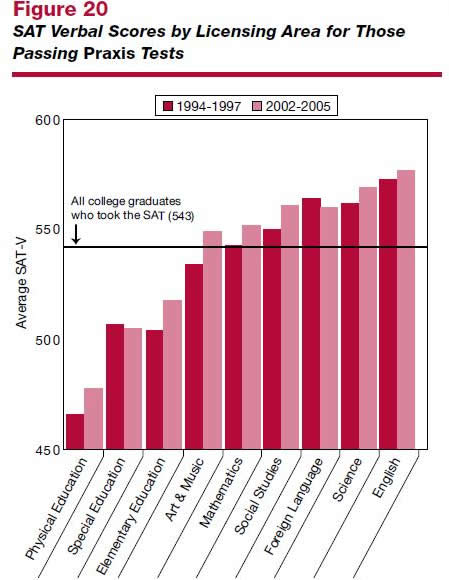
[I]t really looks to me like there’s a sharp discontinuity between two groups of teachers here. Physical and special education instructors, as well as elementary school teachers, are less intelligent than the average college graduate. The other fields far less so, and in their domain of specialization they seem to be superior to the average college graduate.

How Much Do We Spend On Dating?

A new study finds that our financial behavior varies depending on the gender ratio:

The perception that women are scarce leads men to become impulsive, save less, and increase borrowing.

Marina Adshade complicates the theory:

Women might be impressed with high levels of conspicuous consumption in short term relationships, but for long term relationships that conspicuous consumption doesn’t matter if the suitor is just accumulating debt as a result. What matters for long-term commitment is wealth.

Anna North examines international trends:

[Researchers] note that in America, cities with more men have higher consumer debt: "as men become more abundant in populations, American consumers desire access to immediate rewards." In China, the opposite appears to be true — places with a big surplus of men also have higher savings rates. Griskevicius et al think that might be because Chinese men need to save up for a "bride price" to pay the parents of their betrothed, and these bride prices tend to be higher when women are scarcer — "whereas men in one culture may tend to invest in mating effort by saving money for a one-time expenditure (bride price), men in another culture may tend to invest in mating effort by increasing immediate spending on courtship and mate competition."

Rupa Subramanya looks at how a similar phenomenon is playing out in India:

[In 2005, the state government of Haryana] launched a campaign popularly known as “No Toilet, No Bride,” which aimed to persuade women and their families that they should not marry a prospective groom unless they have or install a private latrine. The fact that this occurred in Haryana is significant given that along with neighboring Punjab, it has the one of the most skewed sex ratios in the country at 877 girls for 1,000 boys.

The Defense Budget Is Dangerous, Ctd

Peter J. Munson explains why defense overspending not only wastes vital national resources but also makes the military weaker:

While [Richard] Rumelt is writing about businesses, the words are all too familiar.  "Success leads to laxity and bloat, and these lead to decline.  Few organizations avoid this tragic arc."  While organizations with few strategic resources are forced to "adroitly coordinate actions in time and across functions," as these organizations gain a strategic advantage, they will "loosen their tight integration and begin to rely more on accumulated resources and less on clever business design. … They will lose the discipline of tight integration, allowing independent fiefdoms to flourish and adding so many products and projects that integration becomes impossible." This last statement is key to understanding DoD today… Directors and staffs of [DoD] agencies are constantly justifying their existence and their pot of money.  This, my friends, is the path to hell, decadence, and strategic decline.

Caption for the above Youtube:

I began filming this after a dozen or so train cars went by on a stretch of track south of Santa Cruz California. Where are the military vehicles going? Why are they being shipped? What could this possibly be for?

The Politics Of Baby-Kissing

137290887

A short history of the practice features this gem about President Andrew Jackson from 1833:

The woman handed the dirty-faced infant to Old Hickory. Jackson took it and held it up before him. "Ah! There is a fine specimen of American childhood. I think, madam, your boy will make a fine man some day." Then, with a quick gesture, he put the dirty face of the infant close to the face of Secretary [of War] Eaton, saying quickly and soberly, "Eaton, kiss him?" General Eaton pretended to do so with a wry face, amid the laughter of the crowd, and Jackson then handed the baby back to the happy mother.

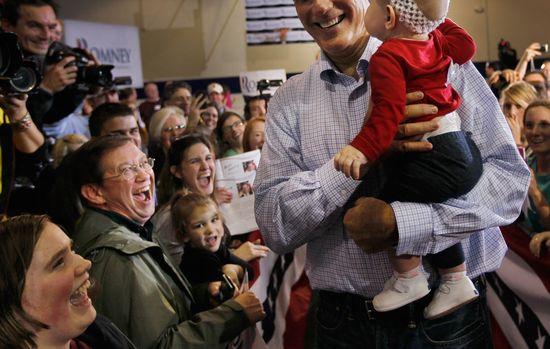
(Photo: People laugh as former Massachusetts governor Mitt Romney holds a baby during a campaign stop at Seven Oaks Park on January 18, 2012 in Irmol, South Carolina. By Joe Raedle/Getty Images)

Small Colleges Are Better At Diversity?

Researchers found that the social groups of students at big state schools were more homogeneous:

Instead of learning from people who were extremely different – who disagreed with their stance on abortion, or didn’t like ultimate frisbee, or never attended football games – the students were obeying the similarity-attraction effect, sifting through the vast population to find the most homologous possible circle of friends. As the researchers put it, “the larger social contexts afford better opportunity for finegrained assortment.”

This is sad on a number of levels. For one thing, the friendships were actually closer and longer lasting at the small colleges, suggesting that there is nothing intrinsically beneficial about seeking out similar people. (Opposites don’t attract, but they should.)

Why Is The Rent So Damn High?

Reason connects NYC's high rents to the city's rent control laws:

Josh Barro focuses on other land-use regulations and further red tape:

There is pent-up demand for new housing in New York City. Developers would be happy to come in, add supply, and drive rents down and vacancy up, benefitting consumers. All that is needed is for the government to get out of the way.

Why Would Aliens Be Tech-Savvy? Ctd

A reader writes:

There is a rather important point that undermines Tom Maudlin's argument. While it's true that there's only been one Earth species to develop technology (us), that's largely because we eliminated the competition.  We killed the Neanderthals and every other species that's shown the potential for technology. (And the few still around with potential – dolphins, apes, etc. – we have contained and have stunted their avenues for evolution.) That makes it far less meaningful that we're the only species to develop technology – we stacked that deck ourselves, and so it's not reasonable to extrapolate from it.

Another point about aliens and technology: it doesn't much matter whether it is likely or not that aliens will develop technology, at least not for our own, practical purposes. Given our relatively poor progress in getting off planet and out of our solar system in recent decades (after the Apollo boom), we're not apt to be visiting anyaliens on their own planets. So any aliens we do meet in, say, the next century, will almost certainly have high technology. Otherwise, they're not going to be visiting our solar system.

Another writes:

The Maudlin interview you linked was fascinating, and his observation about intelligence having evolved only once on earth is definitely worthy of further contemplation.  However, it's not exactly right for him to conclude that intelligence isn't very useful, or there would other species besides humans that are intelligent, such as intelligent beetles.  It could also be that our kind of intelligence is very hard to evolve, requiring an unlikely series of evolutionary events.  

For example, it could be that the intermediate stages between normal animal intelligence and human intelligence have selective disadvantages, or that an organism needs to accumulate a large number of unlikely traits simultaneously before the move from animal to human intelligence can happen.  In fact, that is the current scientific consensus: that it took many specific alterations in anatomy and metabolism from that of our common ancestor before we could evolve our very unique brains.

It is also worth pointing out that biologically modern humans were around a very long time before we invented civilization and technology.  We don't really know why it took so long for humans to make that leap.  We also don't really understand just how differently our brains are wired because we have grown up in a technological civilization, by comparison to our pre-civilization ancestors, but we do know that the wiring of the brain is heavily influenced by our childhood experiences and education, so it's almost certain that our intelligence is different from theirs, despite having pretty much the same genes.  So it's possible that there is more to the story than just biology.  One can speculate that there may have been other organisms that were close to having the right capacities, but didn't make the leap, for whatever reason.

Another:

You write that Tim Maudlin "pops a certain science fiction bubble" with his assessment that technologically-inclined intelligence would be quite rare. In fact, such is the long-standing assessment factored into the Drake Equation, which itself dates back to about 1960. The issue is that there are so very many stars in the galaxy that even with vanishingly small probabilities apiece of developing technology the odds of an advanced race remain quite high overall. Sci-fi's bubble remains intact.