Dreaming Of White Knights On Elephants

Douthat wants another Republican to enter the race:

True, any candidate who jumped in would have a necessarily uncertain path to the nomination (requiring, at the very least, more than one convention ballot), and by casting themselves as a white knight they would risk embarrassment on a significant scale. But with the field having been winnowed and their opening clear, their path would be smoother and their odds higher than many successful presidential candidates in the past — Barack Obama in 2008 very much included.

Joyner explains, once again, why the field is set. Larison piles on.


Explaining The Uncanny Valley

Alva Noë makes a game attempt:

Cartoons don't give us glimpses of worlds, they give us worlds to play in and toys to play with. Live-action movies, in contrast, don't give us opportunities to play; they give us access to hidden worlds. Here, then, is what I propose: the uncanny valley yawns not when animators fall short in their rendering of the human body — even if in fact they do — but rather when they get confused about what kinds of stories they are telling: Are they inviting audiences to play, or giving them an opportunity to watch? In this confusion, the story dies, and with it, the light in the eyes of the characters.

It's also a decent way to explain what's wrong with Mitt.

Americans Don’t Hate Romney For His Wealth

Josh Marshall counters the candidate's spin:

Mitt well captures the belief of the majority of people in the country that the system is rigged on behalf of the very wealthy. It’s not the wealth itself. People don’t begrudge Romney his wealth or his “success”. That’s Romney spin. I also don’t think people expect him to pay more tax than he’s legally obligated to do. If I were making Romney money, I certainly wouldn’t. But I’d also support changing the rules because we need that money to get the country’s finances in order. The problem Romney faces is that he’s a living breathing example of what many people see as the problem. And by his stated positions, he doesn’t think it’s a problem. If you’re running Mitt’s campaign, that’s a problem.

When Animals Train Humans

Paul F. Norris examines the relationship between the Boran people and a bird called the honeyguide, one of the rare human-animal relationships where "they appear to train us at least as much as we train them":

Honeyguides can fly swiftly across large areas and are expert at locating bee colonies, but have difficulty in extricating the combs on their own. Humans move more slowly along the ground and aren’t so adept at finding colonies, but once we have one in our sights, we’re able to overcome bee defenses and dig the combs out, even when the bees have nested deep within rock crevices and other hard-to-reach locations. Out of this opportunity for mutualistic benefit, honeyguides and humans have worked out an elaborate interspecies communication system that allows them to work in tandem with certain signals understood by both parties.

(Video via Norris)

SOPA’s Political Fallout

Timothy Lee sees an opening for the GOP to become the party of Internet freedom:

[B]oth parties are backing away from SOPA and PIPA. But so far the Democrats have shown more interest in reviving the legislation. Reid and Leahy have pledged to bring a modified version of the legislation back to the Senate floor later in the year. On the House side, Smith has continued to champion his proposal, but he has gotten no real support from the House Republican leadership, which has pledged to put the bill on hold until a consensus is reached. House Democratic leader Nancy Pelosi is also opposed to SOPA.

Meanwhile, a growing number of Republicans have been attacking the bill, explicitly tying their opposition to GOP themes like limited government, free markets, and antipathy to Hollywood. If Republicans play their cards right, the last week could mark the dawn of a new political alliance between Silicon Valley and the Grand Old Party.

Nick Baumann and Siddhartha Mahanta differ somewhat. David Post thinks bigger:

It’s a terrible label — “netizen” — but an important concept. If people don’t really believe they have an interest in this thing that we have built, then it is doomed. The converse, alas, isn’t true — but people giving a damn about the health of the Internet is a necessary (though not sufficient) condition for it to be healthy, going forward. And that’s what the events of this past week were about. All of a sudden, millions of people took the Net seriously as a place that needed defending, and millions more tried to figure out why those first millions were so upset and what they were upset about. It does not, by itself, solve any problems — we might still get some terrible law down the road, on this issue or any one of a number of others, that will strangle this medium. But it sets the foundation for processes that can solve those problems, and that is a very, very good thing.

Could Anti-Immigrant Rhetoric Cost The GOP The Election?

Ruy Teixeira keeps his eyes on the Hispanic vote:

If Hispanic support for the President winds up as strong as it now appears and their turnout holds up—giving Obama at least 75 percent of what should be around 28 percent of the entire vote—the benefits to the Obama campaign would be huge. Crucially, it would give him considerable leeway to lose white support but still win the popular vote. In fact, my estimates indicate that Obama, with this level of minority support, could do just as badly as John Kerry did with the white working class (a 23 point deficit) and white college graduates (an 11 point deficit) and still defeat his opponent.

Meanwhile, Adam Serwer explains that Romney is not fooling anyone with his toned-down approach to immigration in Florida.

Obama’s Long Game, Ctd

Now on to Hot Air's remaining attempts to criticize my essay. On healthcare:

Obamacare is "moderate" in the sense that it is one percent from a complete government takeover of the health insurance system. Democrats gamed the CBO to get a deficit-reducing score. The CBO’s alternative baseline — the one most consider the more realistic baseline — does not think the savings will materialize. And it’s funny Sullivan should mention the federal mandate on emergency-room care, as it is a driver of the so-called free rider problem, which is largely mythical.

Why not say, as Newt does, that a reform that includes the individual mandate (which was pioneered by the Heritage Foundation), and gives subsidies to the uninsured to get insurance, is one that was embraced by someone Gingrich calls a "Massachusetts moderate." It is entirely based on the private drug and insurance companies, without even a government-run competitor. Yes, I remain skeptical about whether it will, without further reform, save money. But it's conceivable – which is pretty damn remarkable given that it also gives us near-universal care. And go read the link about the "myth" of free-ridership. It's not mythical – because it's created, as the author concedes, by the 1986 law mandating ER treatment for anyone. Will Obamacare, modeled on Romneycare, cut those free rider costs? Yes:

In Massachusetts, the uncompensated care pool did shrink after the installation of Romneycare: but only by two-fifths. Uncompensated care in the Bay State was $661 million in the pool’s 2007 fiscal year, $409 million in PFY 2008, and $414 million in PFY 2009.

So you keep the same commitment to universal care but save two-fifths of the costs. Sounds like a gain to me. If this is the best the right can do against the substance of my essay, no wonder they merely piled on the cover-line and various ad hominem smears against yours truly. They've really got nothing else.

Will Florida Kill Newt’s Campaign?

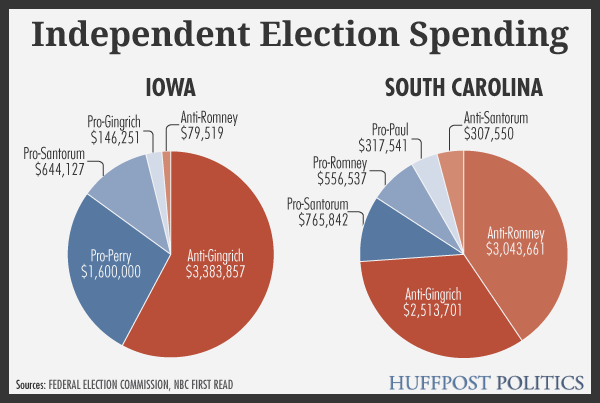
0119gopspending_update

Robert Costa isn't convinced that Gingrich is like McCain:

Gingrich’s strengths, of course, are different from those that elevated McCain. And their experiences have light overlaps, if that; both stumbled in the summer, and lost advisers. But McCain, unlike Gingrich, was always considered a plausible nominee.

Alana Goodman looks to Romney's "get Gingrich" advertising strategy:

Back in Iowa, Romney kept his hands clean for the most part, letting his Super PAC and an occasional campaign surrogate do the mud-slinging against Newt. This marks the first time Romney has personally taken such direct shots at Gingrich on the campaign trail.

According to Politico, this is part of a massive, $10 million Romney campaign assault on Gingrich, which will attack the former speaker’s character, lack of leadership skills, and negative reputation with his former colleagues on the Hill…Gingrich’s susceptibility to negative attacks was highlighted in Iowa. Weeks of ads blasting his lack of conservative credentials and work with Freddie Mac wore away at his poll numbers significantly. But because his surge came so suddenly in South Carolina, the Romney campaign did not have a chance to make a similar case against him in the state. Clearly, they’re not going to let themselves miss the same opportunity in Florida.

(Chart via Paul Blumenthal)

Egypt’s Slow Political Evolution

The country's Parliament is holding its first session today. Marc Lynch hopes it will do Egypt some good:

The seating of the Parliament completes an important stage in Egypt's roadmap to a political transition. It hasn't been pretty.  It hasn't been easy.  It hasn't satisfied everyone. The Islamist victories scared a lot of people.  The repeated outbreaks of horrific regime violence undermined its appeal.  And the next stage is likely to be just as contentious or more so.  But at last, the stage is set to discover whether an elected Parliament can jump start a transition to real democracy in an Egypt which so badly deserves it.