Josh Marshall doesn't think Gingrich can win:
It would be quite difficult for Newt Gingrich to beat President Obama. The bigger story is that he would likely devastate the congressional Republican party. He’d probably weigh down the GOP up and down the ticket. And that puts the whole thing in much sharper relief for Republican officeholders, committee chairs and money folks. If I’m right about that, that means they have to and will do virtually everything possible now to crush Gingrich and make Romney the nominee.
Jonathan Bernstein agrees:
Newt Gingrich remains almost as implausible a nominee as he’s been from the beginning of the campaign. He’s still the guy who has flipped on issue after issue after issue, including individual mandates on health care and climate change. He’s still someone who has ethics problems, and marital problems (yes, still). He’s still someone who isn’t much liked or trusted by those Republicans who worked with him when he was in office. He’s still someone who rarely goes a week without saying something that gets him in trouble. He’s still someone who has shown no ability to run a proper campaign — and while that doesn’t always matter, as we saw Saturday night, it’s apt to matter in some states, and in a hypothetical tough delegate battle, that matters.
So does Larison:
Gingrich isn’t going to be the nominee. The Republican primary electorate can’t be that stupid.
Chait differs:
Like almost everybody outside Gingrich's immediate family, I had already written him off twice. But he really seems okay. If some really crazy rich conservatives decide to write him some seven- or eight-figure checks, who knows?
Sean Trende believes Gingrich's South Carolina victory "absolutely will be repeated in state after state if something doesn’t change the basic dynamic of the race":
That’s not to say that Romney’s money and organization don’t give him advantages — they do. He remains the GOP front-runner, in my view, because it isn’t clear how well Gingrich can survive the long haul. But there’s a not-insubstantial chance, call it 35 percent, that Romney won’t be the nominee.
John Cassidy agrees that Romney isn't inevitable:
the main reason I think Newt could win is what is happening to Mitt's campaign. Outside of his own backyard, the former Massachusetts governor has yet to win more than twenty-seven per cent of the vote. At this stage, he is beginning to look ominously like another establishment favorite from the North East who had everything going for him except the voters in his own party: Ed Muskie.
Ed Morrissey calls Florida a "a survival state for Romney":
Losing South Carolina will undermine confidence in Romney’s ability to close the deal, especially by getting beaten so badly by Gingrich, who was third in polling two weeks ago and finished fourth and fifth in Iowa and New Hampshire, respectively. If Romney struggles in Florida, Gingrich might not need a lot of organization in the following couple of weeks to start winning races, no matter how many resources Romney throws at those states.
Henry Olsen thinks the Latino vote could boost Gingrich in Florida:
[Florida is] the only state where Latinos cast a significant percentage of the vote in the GOP primary, about 12 percent in 2008. Then, Romney got clobbered 50-16 by John McCain. Newt has started to run ads on Spanish stations in Miami alleging Romney is anti-immigrant, and Newt’s notably more compassionate line towards illegal immigrants who have lived in the country for a long time might pay pay dividends here.
Jazz Shaw says Gingrich is more stable than his foes suggest:
The common theme among many – particularly Santorum supporters – is that all they really need to do is wait for a while and Newt will blow himself up and go away. I mean, he always does, right? Well, Newt’s combustible tendencies may be real, but they haven’t managed a feat of self-immolation yet. Every time he says or does something which veteran observers think will be a fatal shot to his own foot, he somehow manages to turn it into a positive and gets standing ovations from the base.
Seth Masket thinks the Gingrich-Romney showdown will test whether GOP elites really determine primary elections:
If Gingrich were to somehow win the nomination, that would be pretty astounding, and we'd have to say that the system has changed. Perhaps the overwhelming number of debates changed the dynamic, and party insiders didn't control those as well as they can control primaries. Perhaps the rise of Super PACs made a difference, allowing a very, very small number of eccentric wealthy people to have inordinate influence over the contests.
Andrew Romano says Obama won on Saturday night:
[A Gingrich nomination] would be the luckiest thing that has ever happened to Obama. The amateurness of Gingrich’s candidacy is obscured when he’s on the debate stage, which is where most voters have encountered him. But on the trail, it’s unavoidable. As I wrote Saturday, “the level of nontraditionalness on display [at Newt’s campaign events is], to borrow a phrase, utterly profound—so profound, frankly, that it makes it hard to imagine Gingrich ever really being able to ramp up and go toe to toe with President Obama’s ultrasophisticated reelection operation.”
Jonathan Cohn isn't celebrating:
Maybe the Gingrich schtick stops working outside of South Carolina and the Republican base – and maybe, if he somehow won the nomination, he’d be the gift to Democrats that everybody supposes. That's the safe bet. But in a year that’s already proven so unpredictable, how can anybody be sure?
Andrew Sprung sympathizes:
Yes, an unstable demagogue should be a lot easier for Obama to beat than a candidate who'd make a plausible president — e.g., judging by past work product, Romney. But in a two-party system, either party nominating an unstable demagogue is a danger to democracy, both because any incumbent can be beat if economic conditions are bad enough or if catastrophe strikes, and because the takeover of one major party by extremists, reactionaries and hatemongers means we are always on the knife's edge. The counter-argument, often expressed by Sullivan, is that only by electing an extremist and getting its clock cleaned can a party submerged in its own ideology be dragged back to the center. That may have worked in the case of Goldwater. But Goldwater was a sober statesman compared to Gingrich, Perry, Palin.
Jennifer Rubin pens an open letter to Republican leaders:
It seems, gentlemen, it’s time to get off your .?.?. er .?.?. time to get off the bench and into the game. It is time to make the case for winning conservatism — a conservatism attractive to centrist voters that can be translated into a reform agenda. If conservatism becomes a movement of anti-media bashing and hyperbolic rhetoric, it will cease to be a force in American politics. And if it is led by an egomaniac whose personal advancement takes precedence over any principle, the GOP will be (correctly) mocked.
Pejman Yousefzadeh urges Romney to unload on Gingrich:
[A] reason why Gingrich won is that Romney has been playing it safe, believing that the nomination will be his, and that he can train his fire on President Obama. That thought should be banished from Romney’s head; he has to use the upcoming contests to decisively put away his competition. He can do so by going on the offensive against Gingrich, who actually represents a target-rich environment for Romney.
Romney is already taking that advice. Peter Lawler doubts it will be effective:
Negative campaigning against Newt, I fear, is like chemo: It won’t work as well the second time. His line that all the charges against him are part of the dispicable media plot to destroy him and all other decent men who run for president has taken hold. There’s also the problem that Romney won’t be so good in bringing the charges in person.
Larry J. Sabato and Kyle Kondik anticipate a campaign that goes until at least March:
Gingrich will fight hard, using elite opposition to him as a battle cry that has resonance with rank-and-file party members still smarting over the establishment’s “imposition” of John McCain in 2008. That makes the White House happy, even though it is not obvious that a long campaign is automatically bad for Romney. After Mitt’s self-inflicted wounds over releasing his tax returns during last week’s debates and stumbling answers on some other topics, it’s clear that Romney needs plenty of training before any fall showdown with Barack Obama. Hillary Clinton made Obama a better candidate during the 2008 slog; Gingrich might do the same for Romney. Or Romney and Gingrich might destroy each other, with Paul and Santorum, if he remains in the race, inflicting additional wounds on the eventual nominee.
Dave Weigel checks Sherman Cainbert's vote total:
Five of the candidates on South Carolina's ballot had suspended their campaigns before the vote; Herman Cain was the first to do so. And yet he got 6,324 votes, more than all the other drop-outs put together. Stephen Colbert's Super PAC "campaign" for Cain inspired real, carbon-based humans to come out and vote for Cain as a joke. (BuzzFeed's Rosie Gray actually met some of these people.) In Charleston, where Colbert and Cain held a pre-vote rally, Cain actually came in at 2.3 percent, better than twice as good as he did statewide.
Nate Silver wonders whether the rules of the game have changed:
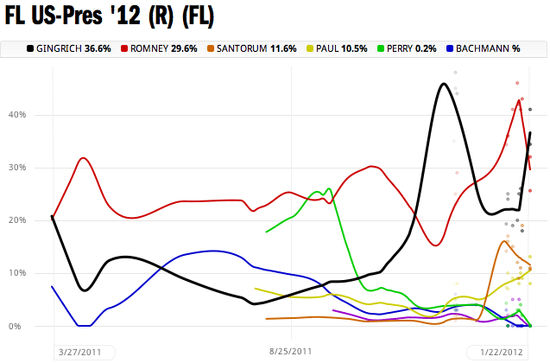
My view is that Mr. Gingrich’s win in South Carolina alone is not enough to be paradigm-breaking. But if he follows it with a win in Florida, all bets are off. Not only would that represent further evidence of Mr. Gingrich’s strength, it would suggest that we had been weighing the evidence incorrectly all along.
And John Heilemann predicts GOP panic should Gingrich continue winning:
If Gingrich wins Florida, the Republican Establishment is going to have a meltdown that makes Three Mile Island look like a marshmallow roast.

 The Dish