Can Smarts Save Us?

Natalie Wolchover imagines how society would change if our IQs increased to twice their levels today:

Although people like to blame social problems on human ignorance and stupidity, the scientists say removing these factors would not lead to the emergence of a harmonious Utopia. Greater intelligence does not come hand-in-hand with a greater ability to cooperate.

"Intelligence is independent of personality and emotion, so you can have very intelligent people who are also just kind of crazy people," Haier said. "Even if everyone had an IQ of 200, you'd have exactly the same range of personalities as you have now, and because that's a determining factor in how good your society is, you won't necessarily have a better society."
Obama’s Third Year Average Approval

It's 44 percent, his lowest yet. Rather like someone else in the not-so-distant past:

Looking just at other elected presidents' third-year averages, Obama's 44% is among the lowest, better than only Jimmy Carter's 37% average in 1979-1980. Ronald Reagan's third-year average of 45% was similar to Obama's.

Obama's low for the year was 38 percent and he's now around Reagan's third year average, 45 percent. Reagan's low point was 35 percent, but he rebounded more quickly and at this point was at 52 percent approval.

A Poem For Sunday

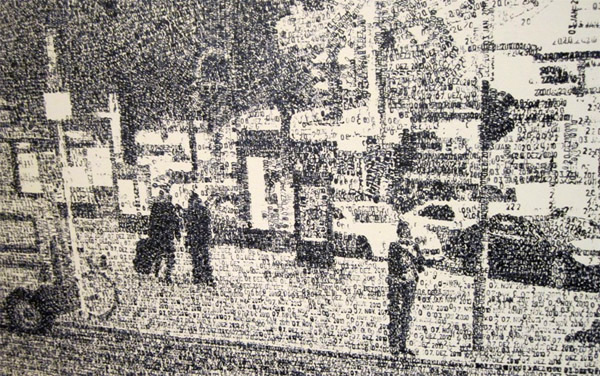
Stamp-2

"Before You Know What Kindness Really Is" by Naomi Shihab Nye:

Before you know what kindness really is
you must lose things,
feel the future dissolve in a moment
like salt in a weakened broth.
What you held in your hand,
what you counted and carefully saved,
all this must go so you know
how desolate the landscape can be
between the regions of kindness.
How you ride and ride
thinking the bus will never stop,
the passengers eating maize and chicken
will stare out the window forever.

Before you learn the tender gravity of kindness,
you must travel where the Indian in a white poncho
lies dead by the side of the road.
You must see how this could be you,
how he too was someone
who journeyed through the night with plans
and the simple breath that kept him alive.

The poem continues.

(Image: paintings made with rubber date stamps by Federico Pietrella via Colossal)

Gossiping For The Social Good?

Watching people cheat during a game made participants heart rates spike. Gossiping about the cheaters lowered the heart rates:

Surreptitiously passing along the news that someone has behaved badly—what’s technically called “prosocial gossip”—can relieve stress, as well as warn others to regard the rule-breaker with a wary eye, the researchers say. … What’s more, the researchers found, people who were most altruistic would gossip most readily about the transgressor, and even give up their compensation for the experiment to do so. If the most good-hearted among us are willing to pay to gossip, how bad it could it be?

Alasdair Wilkins raises an eyebrow:

It's an interesting study, and a potentially enlightening demonstration of how our supposed baser instincts can actually serve positive social functions. That said, there's a little room for skepticism here on how broadly this should be applied – it would be interesting to see a study that could also incorporate more destructive forms of gossip, such as participants being able to falsely accuse others of cheating. I would also like to see how this holds up outside a laboratory setting, where people might be more inclined to behave well on the assumption that, well, scientists are watching.

In Bed With Evangelicals

If it weren't also horribly "sexually stunted," Tracy Clark-Flory would be quite entertained by “Sexperiment: 7 Days to Lasting Intimacy With Your Spouse" by Pastor Ed Young and his wife, Lisa:

David Sessions deconstructs the evangelical obsession with sex:

[E]vangelicals are intensely concerned about keeping pace with the culture around them. It’s a weird form of progressivism, a fear of being left behind by history, even if it is rather spotty and selective. So because sex is such a huge deal culturally and politically, it is “on the brain,” and tends to push that sort of issue to the forefront of the discussion. I think at one point there was a sense, even if it isn’t as raw now, that talking about sex in a frank, explicit way could make up for the ways evangelical theology forces believers to remain culturally backward.

The Joys Of Living Alone

Eric Klinenberg celebrates the one-person household:

[W]e live today in a culture of hyperconnection, or overconnection. If we once worried about isolation, today, more and more critics are concerned that we’re overconncted. So in a moment like this, living alone is one way to get a kind of restorative solitude, a solitude that can be productive, because your home can be an oasis from the constant chatter and overwhelming stimulation of the digital urban existence. It doesn’t need to be—you can go home and be just as connected as you are everywhere else. That’s one of the stories of my book—the communications revolution has helped made living alone possible, because it makes it a potentially social experience. Certainly, the people we interviewed said that having a place of their own allowed them to decompress, and not everyone can do that.

Hearing Ron Paul Out

Peter Laarman makes the theological case:

We are all compounded of bits of good and bits of evil in a complicated admixture. And so trickster Jacob is not ultimately damned on account of his trickery in displacing his older brother’s inheritance, nor is King David ultimately damned for arranging to murder the warrior husband of his desired inamorata. The great European-American epic poets and novelists who inherit both the Hellenic and Hebraic traditions tend to favor the Hebraic mode of shadow and inference. They are not especially interested in presenting us with any “pure” types: in giving us unalterably evil or incorruptibly good characters who never vary, never change it up.

The Origins Of Bizarre Mormon Beliefs

Samuel Brown explains the theology behind some of the strange views catalogued in the above song. What connects them:

In historical context, some of the early Mormon beliefs that have persisted into portions of modern Mormonism are primarily concerned with puzzling through the meaning of life, our integration into the universe, the persistence and scope of human relationships. Though at times these beliefs bear a more antique flavor than many contemporary observers would favor, the Mormon tradition vigorously attempts to make sense of the world. In some respects these Mormon beliefs recall, in idiosyncratic specificity, the visceral stirrings of awe that strike many of us at some point when we stare into the night sky and wonder how we could possibly fit into the universe.

Sports And Crime

Franciso Mejía looks at the relationship:

Violence after frustration [in soccer matches] seems to be quantitatively important: robberies rise 28% compared to the previous week and assaults 26%, although these results are short termed: one hour. On the other hand, violent property crime decreases after an unexpected win: robberies fall by 44% compared to the previous week.

The same goes for American football:

A decade ago, Walter Gantz showed that the presence of an NFL game did slightly increase the number of domestic violence reports.  The results were stronger when there were upsets and the number of domestic violence cases was inversely proportional to the point-spread.

These studies should probably be viewed with skepticism considering similar studies have been greatly exaggerated.