What’s Likely To Happen In Florida Tonight?

FL_Projection

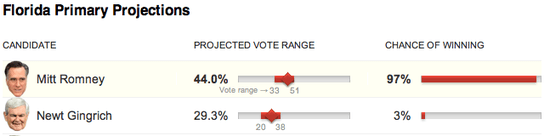
Nate Silver provides a forecast. In another post, he sorts through various recent polls:

[I]f Mr. Gingrich has some slim chance of winning, there’s also the chance that he could lose by 25 or more points. But they’re not where the balance of the evidence lies. Odds are, instead, that Mr. Romney will win by somewhere in the range of 10 points to 20 points, meaning that many networks are likely to declare him the winner shortly after polls close.

Charles Franklin's projections:

The end result is the standard trend putting Romney at 39.7 and Gingrich at 31.7, with Santorum at 11.5 and Paul at 10.2.

Mark Blumenthal adds:

[R]emaining voter uncertainty combined with the wide discrepancies among some of the polls is a warning that small variations in polling methodology can make a big difference in the results. Thus, while Mitt Romney appears headed for a Florida victory on Tuesday, his ultimate margin may still surprise. 

Romney may have taken a slight risk with going so full-bore in Florida, as far as expectations are concerned. Let's say his margin of victory is 5 points – 40 – 35. I'd say the news coming out of the state would not be that damaging to Gingrich, especially given the 5 – 1 advertising disadvantage he has had to counter.

Of course, if Romney does better than current expectations (by which I mean, given this zig-zagging race, the last three days), the reverse applies. But it's worth remembering that Florida only has 50 delegates this year – because it was penalized by moving its primary up. The Maine and Nevada caucuses provide more delegates combined. I hope you're sitting down because I agree with Sarah Palin. This thing should continue beyond the moment one candidate gets 100 delegates out of the 1,144 he needs to win. In very few contests, would you call the winner after four out of fifty rounds.

We'll be live-blogging for as long as it stays interesting.

There Are No White Knights On The Horizon

Josh Putnam calculates that another candidate isn't going to enter the GOP race. Pareene builds off Putman's argument:

Newt Gingrich is doing everything in his power to ensure that Mitt Romney will have a difficult time winning the number of delegates necessary to ensure the nomination, but even if Gingrich manages to make good on his threat to drag this out, math has already effectively eliminated the possibility that someone else less insane could take advantage of his work. And the candidates credible enough to make a serious “deadlocked convention” play would be too sensible to attempt it, because the result of denying Romney the nomination would be utter chaos.

Yes it really is that much of a clusterfuck at this point. But I have to say that Romney's last Florida debate performance and the ruthlessness with which he has tried to dispatch Gingrich this week have impressed me. He has the overkill-type ambition to win. But why? That's a question to which I don't have an answer. At times, he seems like a human being programmed entirely for worldly success – almost a machine. And an attractive machine, with no obvious massive flaws, a perfect family, an inspiring family background … who obviously has had to think about the envy of others his entire life.

But why has this otherwise purring political and financial machine been unable to dismantle that envy? And break through that human disconnect? He's trying, obviously. He aims to please, as James Bennet once drily remarked. But for what? For the lyrics of "America The Beautiful"? For what? I still don't feel I know or understand this machine. I don't think I'm the only one.

Why Cities Are Green

Mark Lynas believes that urban areas are the key to environmentalism:

In many parts of the world, if you want to marry the person you choose, be gay, be female and economically successful, or avoid daily backbreaking labour carrying water or fetching firewood, then you probably need to move to the city. In 1975 there were just three megacities of over 10 million people. Today there are 21. It sounds scary, but this unstoppable shift towards urbanisation actually ranks as one of the most environmentally beneficial trends of the last few decades.

As the UN Population Fund wrote in a recent report: ‘Density is potentially useful. With world population at 6.7 billion people in 2007 and growing at over 75 million a year, demographic concentration gives sustainability a better chance. The protection of rural ecosystems ultimately requires that population be concentrated (pdf) in non-primary sector activities and densely populated areas. City living is seldom lauded by environmentalists, but it may be our most environmentally friendly trait as a species, because urban dwelling is vastly more efficient than living in the countryside.

How Much Do We Need Troops?

GT_BOMB_120130

A lot, says Steven Metz. Fred Kagan agrees, arguing it is inevitable that "the United States will again send troops to fight in far-off lands." Peter J. Munson wants us to question that frame:

Given the inherent tensions built into America's institutions, the ability to successfully wage small wars of peripheral interest is nil. It took months, if not years, for these institutions to admit that America was even facing an insurgency in Vietnam, Iraq, or Afghanistan, much less begin to implement a strategy designed to counter the roots of these insurgencies. Given this analysis, the most logical way to deal with this conundrum is to raise the bar for entry into conflict. If American leadership is forced to make a more honest accounting of the costs, it will enter fewer conflicts. 

He sees a large combat-ready force as part of the problem:

Combat power stands ready in the form of an unparalleled, standing volunteer military with nearly instant global reach. As long as no significant reserve call-up or economic mobilization is needed, the commander-in-chief is relatively unhindered in committing this force to combat.  

Lawrence Korb zooms in on some of Kagan's more dubious claims.

(Photo: A US soldier keeps watching as other inspect the site of a suicide attack near the gate of Kandahar international airport on January 19, 2012. By Jangir/AFP/Getty Images.)

Obesity And Information Overload

Sailer7-600x382

Clay Johnson connects the two in The Information Diet: A Case for Conscious Consumption:

The concept of information overload doesn't work … because as much as we'd like to equate our brains with iPods or hard drives, human beings are biological creatures, not mechanical ones. Our brains are as finite in capacity as our waistlines. While people may eat themselves into a heart attack, they don't actually die of overconsumption: we don't see many people taking their last bite at a fried chicken restaurant, overstepping their maximum capacity, and exploding. Nobody has a maximum amount of storage for fat, and it's unlikely that we have a maximum capacity for knowledge.

Yet we seem to want to solve the problem mechanically.

Turn it the other way around and you see how absurd it is. Trying to deal with our relationship with information as though we are somehow digital machines is like trying to upgrade our computers by sitting them in fertilizer.

Brian Lam has reduced his web consumption, and points out that "clicking the like button 1 billion times will never give you an orgasm or a hug or a high five":

All this has freed up about 3 hours a day for me. I bought a model boat. I'm going to build it, and paint it. In the time I did that, I could watch 100 batman trailers (BAINNNN) or post that same batman trailer and rack up 100k clicks on The Wirecutter. I'm not batman-ing. I'm building my boat.

(Dum-Dum Bunny by Alan Sailer via Judy Berman)

“Totes Cray-Cray Abbrevs”

Screen shot 2012-01-25 at 4.48.17 PM

One theory as to why teenagers abbreviate everything:

Maybe cutting words off at these sounds is a little more common because the results are simply funny. Not that many English words end in ? or d?, and many of those that do have a bit of a silly ring: cadge, smidge, smudge, drudge, hodge-podge, fridge and such sit alongside a few respectable words like bridge and ridge and dredge.  Even fewer words end in ? than in d?, and tend to be French borrowings or produced by the -age suffix borrowed from Old French: mirage, dressage, frottage, arbitrage… So my guess is that it's fun to end a word in ? or d? just because English doesn't do so very often.

Stan Carey cuts teenagers some semantic slack:

[Y]outh is a time for rebellion from, and reinvention of, the world being inherited, and this is as true of linguistic expression as it is of any other behavioural domain. Slang, as Eric Partridge wrote, is the quintessence of colloquial speech, "determined by convenience and fancy". It lets people experiment with language at their ease and pleasure, playing with it as they would play with paint or putty, sharing new shapes as though it were Lego. You don’t have to be a creative writer to be creative with language.

The War On Pain Pills

Radley Balko advocates for sufferers of chronic pain:

The potential for abuse has attached to opioids a social and cultural stigma that can make doctors reluctant to prescribe them, and patients reluctant to take them, even in end-of-life care. But pain patients and their advocates say the bigger problem is that drug control has taken priority over ensuring access to effective treatment. To be sure, there is a divide in the medical community over the effectiveness of long-term, high-dose therapy. But what ought to be a research-driven debate among medical professionals has been corrupted by policies aimed at preventing addicts and drug pushers from obtaining painkillers, not what's in the best interest of pain patients. Police and prosecutors now dictate medical policy.

Did The Housing Bubble Get People More Homes?

Home_Ownership

Doesn't look like it:

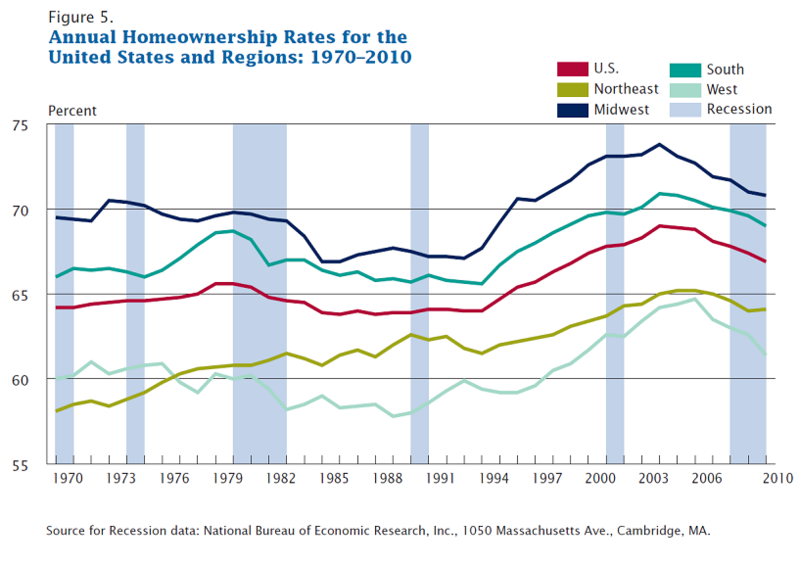
[W]e have to remember that cheap and easy credit was supposed to solve or at least address the housing problem itself. It was supposed to make access to housing possible for borrowers who otherwise had trouble getting loans. … What we can say, first off, is that the tradeoff – of increased homeownership for financial innovation in housing finance – was not worth it. The tradeoff was not even close to worth it. As the graph [above] shows, there was very marginal increase in home ownership. Even if we arbitrarily choose the year of the lowest rate of ownership (1993), even though it is not the beginning of the housing bubble, and compare it with the peak (2004), we get a 7% rise in homeownership, which can hardly all be attributed to financial innovation itself – and by the time the bubble burst most of the gain was wiped out.