Would Heaven Destroy Meaning?

Paula Kirby argues that heaven, as it is often imagined, would be horrid:

In the state of permanent, perfect bliss that is the very definition of heaven, ‘making a difference’ is ruled out. If the difference made an improvement, the previous state could not have been perfect. If it made things worse, the result would not be perfect. In heaven, neither is possible. Even being reunited with loved ones could not add one jot to their bliss or yours, for heaven would be, by definition, a state that could not be improved on. Just consider for a moment the hellish pointlessness of heaven. At least in our real existence our actions have an effect, for better or worse, and it is therefore worth trying to get them right. In an eternal life where we can have no effect whatsoever, we might as well be dead.

A Fashionable Habit

Screen shot 2012-01-18 at 11.34.31 PM

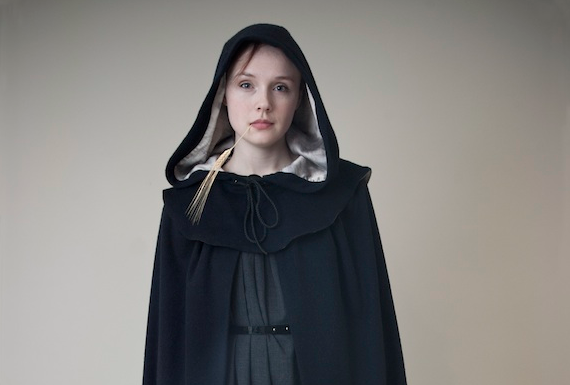
Mother Mary Magdalene turned to artist Julia Sherman for custom-designed habits for the Community of Compassion, a new Anglican Catholic order in Forth Worth, Texas:

Sherman pointed out that the nun’s habit has undergone dramatic changes in the last century. “In the 1960s,” she explained, “feminist nuns lobbied to gain the right to do away with the habit altogether. As a result of their activism, young religious women today have … reappropriated the symbol, modified it to their liking, and consider it to be an elegant wedding dress to be worn in perpetuity. One order, The Abbey of Regina Laudis, even made an alternate denim habit to be worn when they work, relating their lives to that of the American blue-collar laborer.”

(Photo: a partial view of one of Sherman's designs including the Harmony Hood ($208), Alban Cloak ($489), and Agnes Dress ($412).)

The Rise Of The Secular Funeral

Max Rivlin-Nadler notes it:

The funeral industry is in the midst of a transition of titanic proportions. America is secularizing at a rapid pace, with almost 25% of the country describing itself as un-church. Americans, embracing a less religious view of the afterlife, are now asking for a "spiritual" funeral instead of a religious one. And cremation numbers are up. Way up. In liberal, secular states, specifically in the Pacific Northwest, cremation rates have steadily increased to more than half of disposals, up from the low single digits in 1990.

Can Animals Love?

Barbara King lays out necessary conditions: 1) that "individuals of the same species choose to stay together in contexts that go beyond survival and reproduction" and 2) emotional "suffering results when the relationship between the two animals is severed for some reason." Her fears about applying those rules:

For one thing, using these criteria, love will be defined too often only in retrospect, once the relationship is over. For another, it's doubtful whether these criteria could distinguish between love and friendship. (Or, maybe, genuine friendship always encompasses love?) For a third, animals in the wild may ill afford giving off visible signs of weakness, so emotional suffering may be felt but hidden from view.

The Elegant Explanation

3863907931_d418b06e42_b

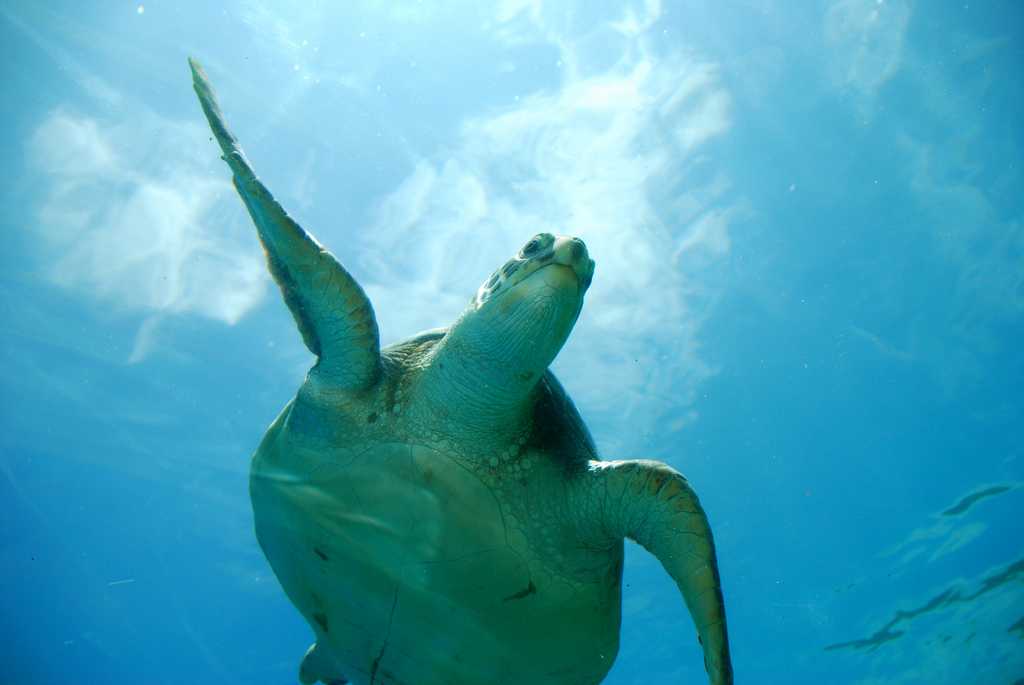
Edge.org asked 191 famous thinkers "What is Your Favorite Deep, Elegant, or Beautiful Explanation?” Daniel Dennett's choice:

I was told some years ago that the reason why some species of sea turtles migrate all the way across the South Atlantic to lay their eggs on the east coast of South America after mating on the west coast of Africa is that when the behavior started, Gondwanaland was just beginning to break apart (that would be between 130 and 110 million years ago), and these turtles were just swimming across the narrow strait to lay their eggs. Each year the swim was a little longer—maybe an inch or so—but who could notice that? Eventually they were crossing the ocean to lay their eggs, having no idea, of course, why they would do such an extravagant thing.

What is delicious about this example is that it vividly illustrates several important evolutionary themes: the staggering power over millions of years of change so gradual it is essentially unnoticeable, the cluelessness of much animal behavior, even when it is adaptive, and of course the eye-opening perspective that evolution by natural selection can offer to the imagination of the curious naturalist.

(Photo by Flickr user Kiuko)
More Than Words

The poet Sally Read describes finding Catholicism after a lifetime of atheism:

It’s been said before: being Catholic is like being in love. As a poet from a most secular culture, I have come to know the Church as the ultimate poem. An intricate composition of allegory and reality, that tries to give image to God’s presence on earth.

What Should Atheism Learn From Religion?

Alain de Botton wants to adapt the best parts of religion to atheism:

He summarized his ideas in a Q&A:

The starting point of religion is that we are children, and we need guidance. The secular world often gets offended by this. It assumes that all adults are mature – and therefore, it hates didacticism, it hates the idea of moral instruction. But of course we are children, big children who need guidance and reminders of how to live. And yet the modern education system denies this. It treats us all as far too rational, reasonable, in control. We are far more desperate than secular modernity recognises. All of us are on the edge of panic and terror pretty much all the time – and religions recognise this. We need to build a similar awareness into secular structures.

Blame The Brain?

Simon Rippon wonders why we think it's normal to say diseases can mitigate legal responsibility for crimes, but the structure of your brain itself cannot:

[C]onsider what the brain is: it is, essentially, a biological machine; 100 billion nerve cells living in a chemical soup and firing electrical impulses at each other. And in years to come, as neuroscience improves and expands our knowledge of the brain, we may reach the stage where your lawyer will be able to explain any particular criminal misjudgement as a result of this-or-that chemical overdose or deficit, this-or-that badly routed synapse, the growth of this-or-that cell, or – perhaps – this-or-that quantum random occurrence.

How will we respond to these future lawyers? What’s the difference between the idea that this-or-that bit of your brain (albeit perhaps a microscopic bit) made you irrational, and the idea that a large tumour made you irrational? A tumour is not some alien invader: it is a proliferation of your own cells. Is it, then, size that matters here? Surely not!