Why Tonight Matters

Kornacki explains:

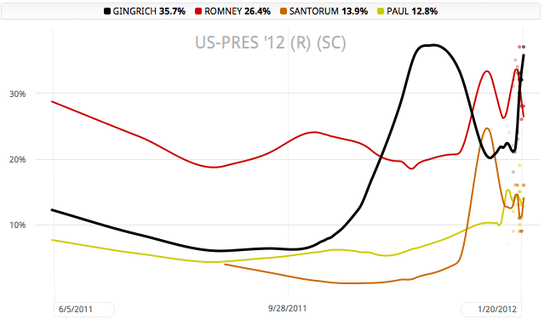
[F]inancially and organizationally, Romney’s campaign does seem far more suited for a drawn-out battle than Gingrich. But Gingrich’s South Carolina rise is further proof of how unusually volatile this GOP race is — and how sensitive to shifts in the dominant press narrative public opinion can be.

On the strength of two relatively unimpressive victories (one of which wasn’t even a victory, it turns out), Romney practically doubled his support nationally and opened commanding leads in South Carolina and Florida — two states that had seemed resistant to him for months. But just in the past few days, as the “Gingrich comeback” narrative has taken hold, that South Carolina lead has vanished and his national advantage has shrunk to just ten points.

Thus, the narrative that emerges from South Carolina Saturday night will go a long way toward shaping the GOP race in Florida.

Reading The South Carolina Tea Leaves

Newt_SC

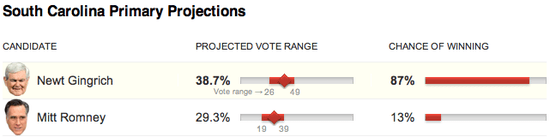
Nate Silver model now shows Gingrich as the overwhelming favorite in South Carolina. Silver cautions:

[T]hose looking for hopeful signs for Mr. Romney can find a couple. First, Mr. Gingrich somewhat underperformed his polling in both Iowa and New Hampshire, perhaps as a result of his middling voter-turnout operation. Second, the race appears to be much tighter — essentially a tossup — if you look solely at polls conducted using live interviewers, rather than those like Public Policy Polling that use automated scripts.

Final forecast from Silver here. Blumenthal says, with all the news in the past few days, to "expect the unexpected":

[W]hile the recent surge in support for Gingrich is undeniable, the events of the last 24 hours have the potential to produce new and unexpected changes in voter preferences. There is some precedent for such shifts, including the events just prior to New Hampshire's 2008 Democratic presidential primary and a special congressional election in 2009 in New York's 23rd Congressional District.

Scott Clement looks at where Gingrich is polling strongly:

Men have driven Gingrich’s late surge in pre-election polls, but his numbers haven’t improved much among women. Gingrich won 28 percent support among men in a CNN/Time/ORC poll released Wednesday, compared with 16 percent among women. It’s not clear how much impact, if any, the latest brouhaha over Gingrich’s problems with his ex-wife will have on voters Saturday, or which candidate stands to benefit. Regardless, South Carolina may mark the first contest with a significant – and potentially decisive – gender divide.

And, like PPP, YouGov's final poll has Gingrich ahead. An interesting detail:

South Carolina Republicans are almost equally divided on which is more important-a candidate's ability to defeat Obama or his positions on the issues. Not surprisingly, Romney leads Gingrich by 41% to 35% among those who care most about electability, but loses by a 30% to 17% margin among those who say "a candidate's position on the issues is most important."
The Currency You Leave On The Curb

From an investigation into bike theft:

Stolen bicycles have become a solvent in America’s underground economy, a currency in the world of drug addicts and petty thieves. Bikes are portable and easily converted to cash, and they usually vanish without a trace—in some places, only 5 percent are even reported stolen. Stealing one is routinely treated as a misdemeanor, even though, in the age of electronic derailleurs and $5,000 coffee-shop rides, many bike thefts easily surpass the fiscal definition of felony, which varies by state but is typically under the thousand-dollar mark. … [Sergeant Joe McCloskey, a bike-theft specialist with the San Francisco police department] estimated that 90 percent of bike thieves are drug addicts. In America’s rough streets, there are four forms of currency—cash, sex, drugs, and bicycles. Of those, only one is routinely left outside unattended.

The Book Club Bias

Bestselling writer Jennifer Weiner revisits her complaint that male novelists get reviewed more in the NYT:

Of the works of fiction whose authors [last year]were reviewed twice (either with two full reviews, or review plus roundup) and profiled, one was a woman and ten were men. The men who received two reviews plus a profile were David Foster Wallace, Albert Brooks, Julian Barnes, Kevin Wilson, Nicholson Baker, Tom Perrotta, Russell Banks, Jeffrey Eugenides, Haruki Murakami and Allan Hollinghurst. The only woman who received two reviews plus a profile was Tea Obreht (who also received a mention in the TBR column).

Teddy Wayne points out that the rule may hold true for the upscale 1% of writers, but since women buy about two-thirds of all books and 80 percent of fiction, "being a midlist male author who writes about males is a distinct financial disadvantage" :

Not only will you not get reviewed in the Times, but you won’t get reviewed in the women’s magazines that drive sales, like People and O, the Oprah Magazine. Book clubs will ignore you. Barnes & Noble will relegate you to the back shelves.  … For the most part, however, male authors are somewhat like male porn stars: getting work, but outearned and outnumbered by their female counterparts, who are in far greater demand from the audience (for very different reasons). There are the superstar exceptions, the Jonathan Franzens and Ron Jeremys, who prove the rule. Nearly everyone — insecure writers most of all — thinks they deserve more than they have.

Andy Ross, an agent, adds his two cents.

Heads Up

Yes, we'll be live-blogging the results from South Carolina tonight starting at 7 pm. When I say "we" I don't mean it royally. We all scour the web and the in-tray for data, ideas, views, reactions, images, as they come in, and I organize it all into a single post and write it in real time.

The kind of journalism that no one was ever expecting to do until a few years' ago.

“Reading While Enthroned”

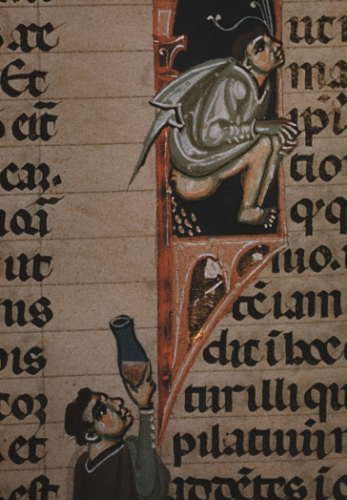
Carl S. Pyrdum III marvels at the medieval origins of the bathroom reader seen below. Ian Sample recently explored the history of reading on the toilet:

The anonymous author of The Life of St Gregory couldn't help but notice that the toilet 489304180-347x500of the middle ages, high up in a castle turret, offered the perfect solitude for "uninterrupted reading"; Lord Chesterfield too saluted the benefits, recounting the tale of a man who used his time wisely in the "necessary house" to work his way through Horace. This was but the beginning.

No writer owned the arena of toilet reading more than Henry Miller. He read truly great books on the lavatory, and maintained that some, Ulysses for instance, could not be fully appreciated elsewhere. The environment was one that enriched substantial works – extracted their flavour, as he put it – while lesser books and magazines suffered. He singled out Atlantic Monthly.

Update from a reader:

I'm reading this on my iPad while enthroned.  The more things change …

Hewitt Award Nominee II

"Let [Romney]  make this challenge: 'I'll release my tax returns when Barack Obama releases his college transcripts and the copy of his admission records to show whether he got any loans as a foreign student. When he releases that, talk to me about my tax returns,'" – Mike Huckabee.

Foreign student? Will Fox correct … oh … never mind … I forgot they aren't "actual journalists."

Hewitt Award Nominee

"Order a hit on a president in order to preserve Israel's existence. Think about it. If I have thought of this Tom Clancy-type scenario, don't you think that this almost unfathomable idea has been discussed in Israel's most inner circles? Another way of putting "three" in perspective goes something like this: How far would you go to save a nation comprised of seven million lives … Jews, Christians and Arabs alike? You have got to believe, like I do, that all options are on the table," – Andrew Adler, publisher of the Atlanta Jewish Times. He has now apologized.

Telling that a pro-Greater Israel fanatic thinks it's conceivable for the "most inner circles" of an ally to attempt to assassinate the president of the United States.