Does Facebook Expand Our Horizons?

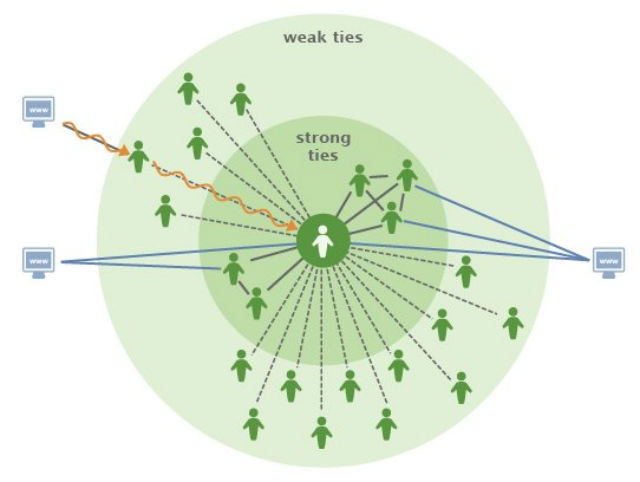
Facebook-Strong-Ties-vs.-Weak-Ties

Farhad Manjoo parses a new study commissioned by Facebook that complicates the theory of the online echo chamber:

Although we’re more likely to share information from our close friends, we still share stuff from our weak ties—and the links from those weak ties are the most novel links on the network. Those links from our weak ties, that is, are most likely to point to information that you would not have shared if you hadn’t seen it on Facebook.  … Social networks—even if they’re dominated by personalization algorithms like EdgeRank—could be breaking you out of your filter bubble rather than reinforcing it.

Rob Horning is skeptical of Facebook's motivations for conducting the study.

(Graphic via Mashable)

Is A Digital Book Ever Finished?

While acknowledging the ease with which authors can correct mistakes, Nicholas Carr worries about what comes with that privilege:

The ability to alter the contents of a book will be easy to abuse. School boards may come to exert even greater influence over what students read. They'll be able to edit textbooks that don't fit with local biases. Authoritarian governments will be able to tweak books to suit their political interests. … The promise of stronger sales and profits will make it hard to resist tinkering with a book in response to such signals, adding a few choice words here, trimming a chapter there, maybe giving a key character a quick makeover. What will be lost, or at least diminished, is the sense of a book as a finished and complete object, a self-contained work of art.

Building off Carr, Sam Krowchenko comments on "our need for the outdated":

When David Foster Wallace republished his 2000 article on John McCain in 2008, its inaccuracies were the key to its relevance — voters could compare the idealism of the 2000 Straight Talk Express McCain with the cynicism of his 2008 bid. That Wallace did not re-edit his work to reflect McCain’s change made his the writing all the more powerful. It was up to the reader to discern McCain’s transformation, not up to Wallace to point it out. … We need supposedly “self-contained,” outdated works to remind us of the process by which we arrived at the most accurate and contemporary works. If change becomes as easy as the rewriting of a digital document, we’ll only be able to see where we are. We’ll have no clue where we’ve been.

My recent thoughts on the publishing industry here.

The View From Your Window Contest

Vfyw_1-21

Clue: The photo was taken on Thursday.

You have until noon on Tuesday to guess it. City and/or state first, then country. Please put the location in the subject heading, along with any description within the email. If no one guesses the exact location, proximity counts.  Be sure to email entries to VFYWcontest@gmail.com. Winner gets a free The View From Your Window book. Have at it.

Banning A Book Won’t Stop Bigotry

Mein Kampf is effectively outlawed in Germany, except for academic study, but a British publisher wants to reprint excerpts and make them available in small brochures. Heather Horn grasps the bigger picture:

[F]ighting reprints is no protection against fascism, or even against poor taste and inflammatory rhetoric. Quite the contrary. This latest debate has a particularly nonsensical ring, as the attention has already been drawn — and the entire work is available on the internet anyway. But don't let the nonsense obscure what is truly an important point: either you believe in liberalism or you don't. And even if the letter of the German law isn't one of censorship — though legislating against the swastika and Holocaust denial suggests otherwise — the Bavarian state is misusing its power.

A Small World, Writ Large

An incredible project gets an incredible addition:

Originally scheduled to open in 2009, it has taken more than six years to complete the $4,440,000+ expansion to Hamburg's Miniatur Wunderland. The airport includes remote-controlled planes taking, landing and taxiing to terminals and hangers. Plus, there are luggage carts and other support vehicles scurrying about the tarmac.

How Many Movies Will We Watch Over A Lifetime?

AD Jameson is keeping track of his own number – 1,925 so far:

That doesn’t sound like too many, not after fifteen years of avid cinephilia. But to put it in some perspective, that’s roughly 128 feature films/year, or about one every three days. … We found last week that there have been at least 268,246 features made. (Since then, the IMDb’s count has grown to 268,601.) So I’ve seen little more than .7% of them—and remember, I think that IMDb count far too low.

Why he has given so many poor ratings to contemporary movies:

The more you watch from the present day, the more garbage you’re bound to see—but your conclusions will be your own. Conversely, the further back you go, the more you’ll be guided by the opinions of others. (If nothing else, what’s available will be largely determined by what’s remained popular.)

The Root Of Mitt’s Inauthenticity?

Rick Perlstein looks to Romney's father and the pillorying he endured for being too honest about the Vietnam war:

[Michigan Governor George Romney] supported it after returning from a trip there in 1965. Then, courageously, after a second trip in 1967, he began to criticize it. On September 4, 1967, a TV interviewer asked, "Isn't your position a bit inconsistent with what it was, and what do you propose we do now?" The line everyone remembers from his response: "When I came back from Vietnam in 1965, I just had the greatest brainwashing anybody can get when you go over to Vietnam." But he continued with a devastating, prophetic, and one-thousand-percent-correct assessment: that staying in Vietnam would be a disaster. The public, and certainly the pundits, weren't ready to hear it. …

The Mormon bishop, however, did not quit. Instead he leapfrogged across New Hampshire telling unseasonable truths – that LBJ was "spinning a web a web of delusion," and that "when you want to win the hearts and minds of people, you don't kill them and destroy their property. You don't use bombers and tanks and napalm to save them." His opponent, meanwhile, running what you might call a robotic campaign, just bullshitted about Vietnam, hinting he had a secret plan to end it. The truth was a dull weapon to take into a knife fight with Richard Nixon – who kicked Romney's ass with 79 percent of the vote.

When people call his son the "Rombot," think about that: Mitt learned at an impressionable age that in politics, authenticity kills.