The Defense Budget Is Dangerous

DOD_spending

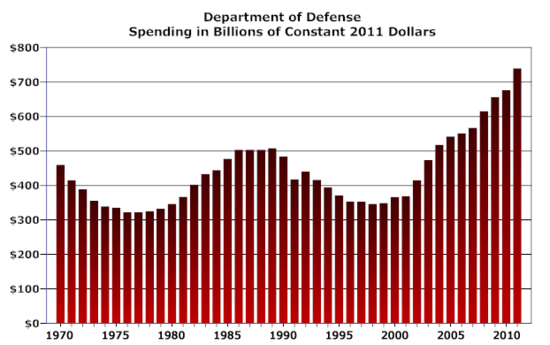
Robert Farley says the "size of the defense budget itself represents a threat to U.S. national security":

[T]he In theory, this should not be such a remarkable insight; one common narrative explaining the end of the Cold War is that the United States drove the Soviet Union to economic ruin by forcing it to maintain an unsustainable military budget. As Bernard Finel suggests, the United States has now committed itself to a degree of dominance over potential rivals that may be unsustainable in the long run, and that in and of itself poses risks. 

Joshua Foust likewise wants a serious assessment of Pentagon waste.

(Chart from Cato)

The Ikea Effect

Studies have found that we irrationally over-value objects we make ourselves. The details:

[W]e don’t love everything we make equally. First, the labor has to be hard enough to really make us feel that we’ve put some sweat equity into the project. When making things ourselves is too easy—say, screwing a light bulb into a new lamp—people do not come to overvalue their creations. On the other end of the spectrum, tasks that are too difficult—such that we can’t even finish them—lead to frustration and disappointment (and, let’s be honest, swearing), which also undercuts the value we place on our creations.

The Weed Of The Wild West

Regarding a recent MHB, a reader notes:

Interesting factoid about tumbleweeds: As iconic as they are in Westerns, they're actually a non-native exotic species imported from Eurasia in the 19th century. They've been here long enough that no one alive today remembers what the American West looked like without them. They're harmful to the environment in at least two ways. First, they compete with other plants for precious water, and then when they break off and start rolling, they damage the crust of soil, which has the ironic effect of making better growing conditions for the next generation of tumbleweeds since they thrive in disturbed soils.

But they can also help the environment:

[M]ost tumbleweed species grow quickly and outcompete other types of plants. In one study, for example, Russian sage sucked up an average of 44 gallons of water when competing with wheat, which can be the difference between a good wheat harvest and a bad one. However, this thirstiness and ability to remove chemicals from the ground could be useful. For example, another species of Russian sage, Salsola kali, accumulates high levels of various toxic pollutants, which might allow it to help clean up contaminated sites.

People Love Corporations

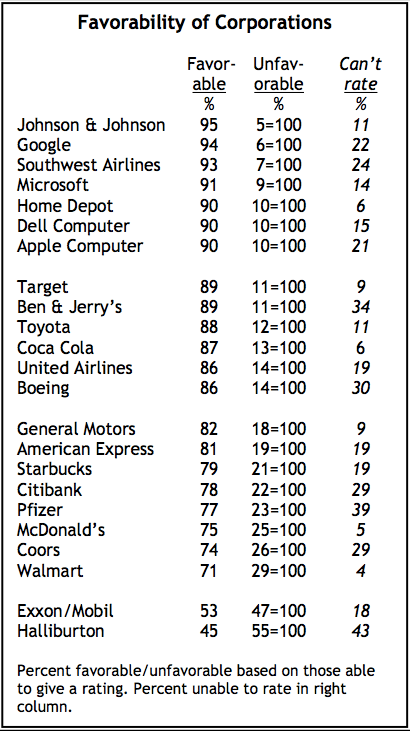
Andrew Gelman flags a survey from 2007:

OK, sure, now that there’s a recession on, Citibank probably doesn’t have 78% approval anymore. Still, these companies are pretty damn popular. You might think lots of Americans think Starbucks is stuck-up? Nope. 79% approval. Pfizer? 77%. I have no idea why Target is so much more popular than Walmart, but in any case all these numbers (with the exception of oil-spillin’ Exxon and war-profitin’ Halliburton) are stratospheric.

Chart on the popularity of various companies after the jump:

Companies_Popular

How Hard Is Dumpster Diving?

Too hard for a novice:

I opened the first dumpster, wondering what I might tell the store owner or police officer if we were caught. Should I go with, "I lost my wedding ring in there," or "My Pomeranian is trapped inside?" Then came the moment of truth. This dumpster, and all the others nearby, was truly foul. No edible treats were readily apparent among the stinky refuse. I'd have to climb in and start ripping into bags. I cannot tell a lie. I totally chickened out. I simply couldn't bring myself to do it.

Daniel Klein and Mirra Fine had better luck.

Drug Wars Are Not All Created Equal

Elizabeth Dickinson compares Colombia's drug crackdown to Mexico's less successful attempts:

At a very basic level, Colombia circa 2002 faced a very different set of problems than what Mexico faces today—and Uribe’s "democratic security" strategy was tailored to the former. Drug trafficking was linked to an armed insurgency that, however corrupted over the years, still rested on an ideology and concrete political goals. FARC and the paramilitaries both cared about territory for its own sake. Mexican cartels, on the other hand, are less bothered by symbolic gains and are happy to operate near or even within state institutions.

The very natures of the two states are different as well. "Colombia had never been in control of its territory, so the real challenge was to assert state authority for the first time," explains Shannon O’Neill of the Council on Foreign Relations. "In Mexico, that’s not the problem. The government has a presence in every small municipality; the question is, who do they report to? It’s a very different challenge; Mexico’s challenge is corruption."

Ad War Update

This new Romney spot features a former colleague of Gingrich accusing him of "leadership by chaos":

The second ad in the series is here. Zeke Miller explains Mitt's decision to stop ignoring Newt:

Romney's presidential campaign is renewing its assault on Newt Gingrich days before the South Carolina primary. … [T]his means one thing — the once cocky Romney campaign is growing nervous in South Carolina. The strategy of allowing Gingrich to fall under his own weight has been abandoned. Now Romney is trying to crush his rival.

Gingrich himself "fully expect[s] the Romney campaign to be unendingly dirty and dishonest." William Jacobson reacts to the above ad: 

Theater of the absurd is an understatement.  While Newt was advocating for the Contract with America and helping pass welfare reform and other conservative agenda items, Mitt Romney was running away from almost everything on the conservative agenda. …  Romney was very disciplined in 1994 — against conservatism.

In an animated preview of the Romney-Obama matchup seen below, Newt's Super PAC targets Mitt's electability:

An official Gingrich mailer in South Carolina showcases Romney's "pro-abortion record." Here's Santorum's latest against Mitt – an anti-establishment homage to Orwell:

Romney's PAC counters Santorum, calling him "the ultimate Washington insider":

The Daily Wrap

6a00d83451c45669e20162ffc4fb5b970d-550wi

Today on the Dish, Andrew refused to let Megyn Kelly off the hook – taking on her cowardice and Fox's here, here, and here. He also defended his treatment of Obama's civil liberties record in the Newsweek essay, explained why the downturn Bush inherited wasn't the same as the Great Recession, aired reader dissents here and here, thanked Althouse for a civil reply, reiterated his view that Romney could still lose the primary, and ushered in a new era for the GOP on the back of Paul's poll numbers. We noticed Mitt had problems with taxes, consistency on SuperPACs, avoiding financial crisesdebates, McCain's oppo research resurfacing, and all-around weakness. Gingrich surged (?) despite the possibility his ads were backfiring, Sarah got a spot in his (very hypothetical) administration and embodied chutzpah, and Kristol dared Paul to go all third party on Romney. Romney's whiteness was contested, Gingrich's race-baiting was still nasty, the Hispanic vote mattered, and SuperPACs shifted the landscape.

Today was also the Internet's day of protest against SOPA/PIPA: we explained why Wikipedia, among others, blacked out to protest the bills and found the opposition to the bills to be driven by companies scared of real innovation. An intervention in Syria looked to be counterproductive, Egyptian popular culture evolved strangely after the revolution, Iran couldn't destroy America, and the Chinese government might have started growing itself to death. Obama nixed the Keystone XL pipeline, recessions changed the nature of unemployment, tuitions kept skyrocketed, doctors died with dignity, a reader succeeded at self-publishing, and another reader couldn't stand yesterday's post on Sheri Lewis and Lamb Chop.

Chart of the Day here, Ad War Update here, Quote For The Day here, MHB here, Hathos Alert here, AAA here, and VFYW here.

Z.B.

Why The Latino Vote Matters

Stephen Ansolabehere assembles the basic facts:

Hispanic voters will continue to emerge in Texas, California, and other states where Hispanics have long been gaining in numbers. But the tide of Hispanic citizens is rising in some surprising places as well. The states with the highest percentage of Hispanic citizens under eighteen years old are North Carolina, Georgia, Alabama, Tennessee, Arkansas, and South Carolina. And closing the borders will not appreciably affect the increasing numbers of Hispanics and Hispanic voters in the United States for a simple reason: the Hispanic population is already sizable and has a much higher birth rate than the white population. The policies that the parties pursue now on immigration, education, and other matters that particularly affect Hispanics will define electoral politics for generations to come.

Nathan Pippenger is skeptical of Romney's efforts to appeal to Latino voters: 

More forward-thinking elements in the party realize that while hot-blooded rhetoric excites its white conservative base, the same rhetoric tends to alienate Hispanics. The long-term consequences of that dynamic could be damaging for Republicans, so in national politics, the party tries to woo Hispanics by stressing economic and cultural issues while downplaying immigration. But the effectiveness of this strategy has obvious limits: Eventually, immigration must be addressed.

(Full video of Romney's interaction with an undocumented student here)

Are Newt’s Attacks Backfiring?

Douthat believes so:

True, the Bain controversy may hurt Romney in the general election, at which point Gingrich will be able to claim some measure of vindication. But for now, all he seems to have created is a rally-round-the-frontrunner effect that might otherwise have taken weeks or months for Romney to achieve on his own.