Face Of The Day

GT_FACE-INDIAN-BOY_120118

National Bravery Award winner Om Prakash Yadav attends a press conference held to announce the awardees on January 18, 2012 in New Delhi, India. The eleven year old saved the lives of eight students, despite seriously burnt himself, when their CNG van caught fire and the driver escaped from the scene. Twenty-four children will receive award this year, five of them posthumously from Prime Minister ahead of Republic day. By Virendra Singh Gosain/Hindustan Times via Getty Images.

How Would Romney Avoid A Financial Crisis?

Nicole Gelinas encourages him to take Huntsman's lead on fixing "too-big-to-fail": 

Romney still needs a better position on this topic — not least because he comes from the financial industry. He could still turn that experience into an advantage (or at least less of a disadvantage) by saying that he knows the financial industry well enough to regulate it so that all its companies compete in a free market. 

Suzy Khimm asks questions about Romney's vague pandering on issues related to bailouts, Dodd-Frank and Europe. 

“Food Stamp President” Ctd

Adam Serwer takes on the race-baiting comments featured in Gingrich's new ad (seen above and highlighted in today's Ad War Update):

The ad is betting that Republicans are longing to see Gingrich lecture the first black president on how there's nothing racist about suggesting black people would rather be on public assistance than work for a living. It indulges two longstanding Republican fantasies: That Obama is an intellectual lightweight dependent on his teleprompter who would be easily dispatched by a knowledgeable conservative opponent, and that racism on the right is entirely an invention of liberals, who are the real racists

Fallows, meanwhile, is debating with readers about how to interpret Gingrich's goals. Jim's view:

Newt Gingrich knows exactly what he is doing when he calls Obama the "food stamp" president, just as Ronald Reagan knew exactly what he was doing when talking about "welfare Cadillacs."

There are lots of other ways to make the point about economic hard times — entirely apart from which person and which policies are to blame for today's mammoth joblessness, and apart from the fact that Congress sets food stamp policies. You could call him the "pink slip president," the "foreclosure president," the "Walmart president," the "Wall Street president," the "Citibank president," the "bailout president," or any of a dozen other images that convey distress. You decide to go with "the food stamp president," and you're doing it on purpose. 

TNC nods. Wilkinson puts the shoe on the other, McCain-sized foot.

How White Are Mormons?

Razib Khan counters Lee Seigel:

[O]ne needs to be careful about overemphasizing the whiteness of Mormons. First, remember that most Mormon males are missionaries abroad at some point in their life, so it isn’t as if they are unfamiliar with societies where non-whites are the majority. And, it is probable that around half of Mormons in the world today are not white (the claims vary on this issue). But it is also notable that Mormons in the USA today are far less white than they were just a generation ago.

TNC also attacks Seigel's piece:

I think there might be an interesting point to be made about the specific kind of "Leave It to Beaver" whiteness embodied by Romney and his family (emphasis on "might"). But this feels like an headline in search of piece. The notion that Mormons imagine their religion as "for whites"–and more so than other whites–is basically an act of mind-reading.

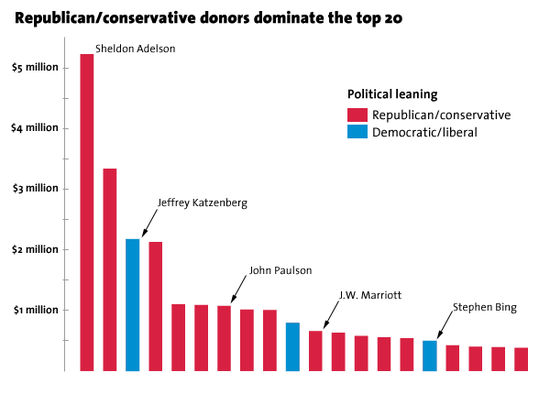
The Super PAC Era

Top_donors

Seth Masket ponders it:

This year … neither side really has any idea what the funding situation looks like in advance. Yes, Obama and (presumably) Romney will be able to look at each other's campaign finance disclosures, but those will only reveal a modest percentage of the spending that will occur this year. Where will these Super PACs deploy their spending? What sort of messages will they convey, and will those messages be consistent with what the campaign is trying to say? How do you form a strategy if you have no idea what your opponent's capabilities are, or if you don't even know what your own capabilities are?

Elliott points out that the worst is yet to come:

[A]t least the super PACs have to reveal their donors. There’s an entire separate category of political group – so-called social welfare organizations – that are expected to blanket the country with advertising but don’t have to reveal their donors. Ever.

(Chart of top political donors, at this point in the campaign, from Mother Jones)

Iran Can’t Destroy America

Mark Helprin claims that Iran is a "mortal threat" to America. Greg Scoblete counters:

The United States is orders of magnitude more powerful than Iran, has conventional and nuclear military forces that could destroy Iran several hundred times over, devotes more money to its defense every year than the entire GDP of Iran and yet in the up-is-down world of some defense analysts, we are the ones in "mortal danger."

Tom Ricks bets that Obama isn't foolish enough to go to war:

I just can't see Obama getting us involved in another Middle Eastern war. The American people certainly have no appetite for it. I think he almost certainly would lose re-election if a war broke out, because his base would fall apart and the left would go into opposition.

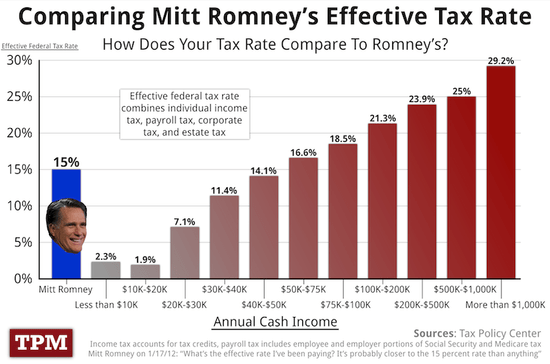
Chart Of The Day

Romney_Taxes

Romney's self-proclaimed tax rate in context:

When you account for the fact that most people also pay payroll taxes, and don't enjoy enormous deductions, credits or other benefits, you see that Romney's making out about as well as a taxpayer who makes $50,000 a year. Not bad for a man whose net worth is estimated to be in the neighborhood of a quarter billion dollars.

SOPA: Business Against Free Markets

James Allworth and Maxwell Wessel profile the corporations behind the legislation:

If you take a look at many of the largest backers of SOPA and PIPA — the Business of Software Alliance, Comcast, Electronic Arts, Ford, L'Oreal, Scholastic, Sony, Disney — you'll see that they represent a wide range of businesses. Some are technology companies, some are content companies, some are historic innovators, and some are not. But one characteristic is the same across all of SOPA's supporters — they all have an interest in preserving the status quo.

If there is meaningful innovation by startups in content creation and delivery, the supporters of SOPA and PIPA are poised to lose.

Even for those SOPA supporters that are historic innovators, their organizations focus on improving products in the pursuit of profit. They innovate to increase prices and limit production cost. Even when new models and technologies give rise to huge businesses, these incumbent firms reject meaningful innovation. On the other side of the debate, you'll see a few [of] the most successful companies in recent history. Wikipedia. Google. Twitter. Zynga. What these firms have in common is they have upended entire industries — and many are still in the process of doing so.

Brian Ries sat down with organizers from mega-sites Reddit and Cheezburger to discuss their "battle plan":

"I want people to understand," [Cheezburger's Ben] Huh assured me. “We’re not here to turn off the entire Internet. What we’re looking for is a diversity of responses. We need some people to shut down. We need some people to freak somebody out. What we really want to do is shock and awe. We want to wake up the public that had no idea this was going on so they can call their senators and say ‘No on PIPA.'"

Contact your senator here. Earlier coverage of today's web protests here.

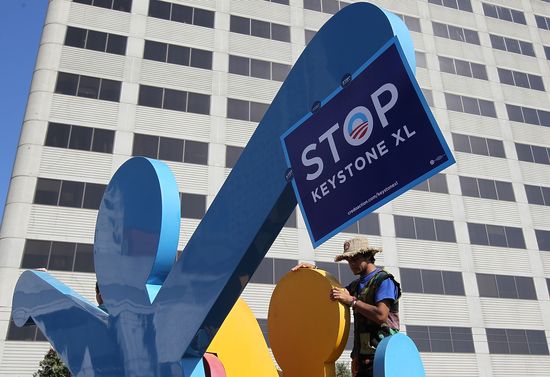
Obama Kills Keystone

GT_PIPELINE_120118

Today the president rejected the Canadian oil pipeline project, a decision that made many environmentalists very happy. In November, Frum explained why he supports the pipeline:

What will curtailing oilsands accomplish for the environment? Nothing. This is a big planet full of oil, and if the United States does not buy its oil from Canada, it will buy its oil from somebody else. So long as demand runs high, oil will be imported and burned. And it’s not like pumping the oil from the Gulf of Mexico, or transporting oil from the Middle East in tankers, is exactly environmentally risk-free.

Frum goes on to propose a carbon tax instead. Erik Loomis counters:

You mean denying this one permit isn’t going to halt climate change and isn’t the final answer to all our energy questions? Who knew! Frum might be right that we need some carbon taxes, but it is an absolute environmental victory to stop the Keystone XL pipeline.

Michael Levi criticizes both supporters and critics of the project. Jess Zimmerman rounds up her arguments against the project. And Steve Benen wonders why the GOP pushed Obama into a corner.

(Photo: A protestor against the construction of the Keystone XL oil pipeline climbs on a Keith Haring sculpture as he demonstrates outside of the W Hotel where U.S. President Barack Obama was holding a fundraiser on October 25, 2011 in San Francisco, California. By Justin Sullivan/Getty Images.)