Dissents Of The Day

In response my Newsweek cover-story, a reader writes:

I work in Washington as a regulatory attorney (I served in the government in 2009-2010 on a Recovery Act program), and I can attest that even on more obscure Very_gradual_change_we_can_believe_in_poster-p228383015915480890vsu7_500issues, the Obama administration has consistently been characterized by timidity in the face of any corporate opposition.  A desire to avoid confrontation and to not shake things up pervades the administration.

There is a view, one I think you share, that by seeking consensus, avoiding partisan rhetoric, and consistently moving to the middle of the policy spectrum even before attempting to engage Republicans, Obama has delivered on his promise to be above the partisan fray of politics as usual.  In my view, he has only served to put a spotlight on how broken the system truly is, and, in doing so, has sown still deeper cynicism in the public about the ineffectiveness of the government to address real problems.

Obama was not elected to make noble gestures towards non-partisanship; he was elected to change how politics and the government work in Washington.

Instead, he let the Republicans and the corporate lobbyists call the tune.  He passed health care reform by buying off the drug companies, the insurance companies, and the doctors.  His approach to banking regulation was similar.  He didn't change the system; he just played the game.  Nothing has happened on issues like climate change or immigration, nor does it appear that anything ever will.  The health care reform bill was vastly better than nothing, but appears to fall far short of what is needed to address our long term systemic problems (and even that was accomplished only after the longest and most painful legislative process imaginable).  The banking reform is not likely to prevent the next collapse.  We are no closer to resolving the long-term problems with debt and the federal budget than we were the day Obama took office.

The question of what Obama could or should have done is a difficult one and I don't pretend to have all the answers.  To start, he could have publicly acknowledged what the Republicans openly stated: that he would find no willing partners across the aisle.  He could have told the public that one of the two major political parties was baldly and intentionally attempting to cripple the federal government during a time of national crisis and asked the public to penalize that behavior instead of pretending at all times that he was dealing with a reasonable and sincere opposition party. 

He could have worked with Democratic congressional leaders to develop a legislative strategy designed to maximize the impact of Democratic majorities in both houses of Congress rather than squandering most of that time in a futile attempt to gain bipartisan support for watered-down bills.  He could have proposed aggressive legislation actually aimed at changing the political system through campaign finance reform and lobbying reform and passed it through a Congress under complete Democratic control. 

He could have instructed his appointees and the federal agencies to use the quite substantial legal authority delegated to them by Congress to adopt policies that advance the interests of the American people and to let the corporate lobbyists know that they aren't running the show any more.  He could have leveraged his support network to increase civic awareness and participation and to build support for fundamental (perhaps even constitutional) political reforms. 

I frankly don't know what would fix the dysfunction of Washington at this point.  But I am quite certain of one thing that will not fix Washington: doing nothing.  And that is what Obama has done.  We won't know what might work until we at least try something.

If he had started out his term as a fierce partisan of the left, he would have betrayed a core campaign promise: to try and move us toward a less fractured and polarized national debate. I agree he failed, but I also believe the GOP is almost entirely at fault. The point of my piece is that Obama cannot force the GOP to change; but he can demonstrate their unreason and in the long game, defeat them. But revealing their extremism and intransigence is important. It's the preliminary to beating them. Another writes:

I read the Newsweek cover story, and I'm sure you're going to get quite a large volume of comments due to the article's virtual "come and get me" stance.  But I thought I should give it a try as I might be able to add to a possible discussion.

In your defenses of Obama against his liberal critics, you seem to take it for granted that liberals at large don't have any issues they won't (or shouldn't) consider sacrificing for the sake of pragmatism.  I'm with you all the way that Obama has done a truly inspiring job propping up the economy until it can stand on its own again.  He constantly surprises, and just today his decision to kill SOPA fills me and my coworkers with hope.  

But it's not enough to repair the damage he's done.  I have the freedom to use the internet as it is now, but I have lost my guarantee under the constitution to equal protection under the law. My life is non-negotiable.  I will not trade my constitutional rights away so that the real good work of Obama's administration can begin in his second term.  There are some lines not to be crossed that aren't arbitrary or tribal.  They're actually the only ones that matter.  Denying habeas corpus rights, secret evidence, and asserting the right to kill Americans by his say alone are disqualifying issues for me, and I'm sure many others.

It constantly amazes me how you believe Obama deserves anyone's support for those actions.  If the economy were to vastly improve in the next four years, would it be worth it to lose our 4th Amendment rights?   It isn't to me.  And I hope it isn't for you, either.

Another:

The word "drone" is not mentioned once in your piece.  As a centerpiece of the "Obama Doctrine" on fighting international terrorism, any piece defending the president should defend that policy, or at least explain why its failures/excesses are not prime real estate for liberal grief. 

Likewise, simply washing away concerns over Obama's illiberal policy regarding civil liberties because he strictly forbids torture needs further explaining.  How does one compare indefinite detention with torture?  Is preventing the torture of one worth the indefinite detention of a hundred?  Surely there is an answer to this, and yours may very well be the correct one.  But this is a calculus that needs to be worked through explicitly.

And if preventing the cancer of United States sponsored torture is of paramount importance, shouldn't prosecuting those who authorized and performed take priority as well?  Wouldn't sending that kind of clear message be the most effective, long-term means of preventing such acts in the future?  Even if Obama wins another term, eventually there will be another president, either Democrat or Republican, who publically endorses or at the very least would privately authorize torture.  By allowing precedent from the Bush administration to stand, Obama is waving aside the one long-term tool he has for constraining torture's future practice: establishing and supporting legal punishment for those who would repeat the war crimes of their predecessors.

One more:

I enjoyed your Newsweek article and a reader's response on being stuck in the middle between Fox-ers and lefties whine it comes to Obama. But I must say you do not properly capture the left's critique. For the right, you offer "facts" to challenge their incorrect claims. For the left, you offer … not facts, but a simple argument: Obama is not as left as you wish so get over it. This is a far different matter. People on the left can and should complain about Obama, but that does not make us delusional or ignorant or even naive; it just makes us shit out of luck. Obama is a centrist, he is not a leftist, that was obvious to me back in 2007. Obama never claimed to be a leftist, true, but I can still want one for our country. That does not make me delusional; it just makes me powerless.

(The above poster is available to purchase here)
How Scared Is Fox? Ctd

A reader writes:

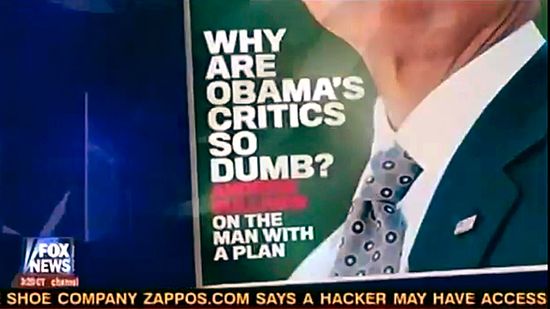
Re: Your statement, "Why are Obama's critics so dumb?" You are probably not aware of the fact that being dumb voters … and some voter fraud, is exactly why Obama was elected.

That was not my statement. It was the cover-line which I did not write and did not know about. But it's helpful to know where some people are coming from. Another:

It is my belief that Fox blurred your name out to prevent giving you some page hits. Fox News viewers might see it and say to themselves, "Who is this Andrew Sullivan bozo anyway? I'll check with Mr. Internet." And then they'd see your site, read what you have to say, and perhaps even wake up a little. Nope, too risky. Better just to make you a blur.

Fox And Friends also trashed the essay this morning, and Fox still refuses to give me any kind of right to reply. How surreal is it for a cable channel to be devoting so much time attacking an essay by someone – but won't have the author on to defend himself. How is that fair or balanced?

The Case Against War With Syria

Syria_GT

Marc Lynch makes it:

[T]he U.S. should not be contemplating military intervention in Syria. Risky, costly foreign policy decisions can not simply be taken to express moral outrage. They need to have a serious chance of success.  None of the military options currently under discussion have a reasonable chance of improving the situation at an acceptable cost, and their failure would likely pave the way to something far worse.

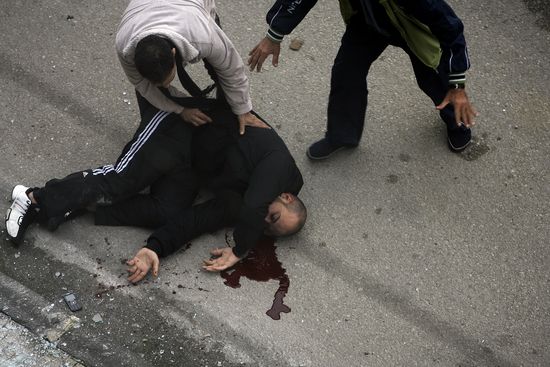
(Photo: A seriously injured Syrian man lies on the ground following a rocket attack in on January 11, 2012, in the western city of Homs, 162 kms north of Damascus. By Joseph Eid/AFP/Getty Images)

Quote For The Day

"Don't let anybody make you think God chose America as his divine messianic force to be a sort of policeman of the whole world. God has a way of standing before the nations with justice and it seems I can hear God saying to America "you are too arrogant, and if you don't change your ways, I will rise up and break the backbone of your power, and I will place it in the hands of a nation that doesn't even know my name. Be still and know that I'm God. Men will beat their swords into plowshafts and their spears into pruning hooks, and nations shall not rise up against nations, neither shall they study war anymore," – Martin Luther King, Jr., “Where Do We Go From Here,” an address to the Southern Christian Leadership Conference, August 16, 1967.

Hence my point about nationalism as a Christian heresy.

How Scared Is Fox? Ctd

6a00d83451c45669e2016760b671f5970b-550wi

Megyn Kelly's producer tells Newsweek that they are fully booked for today and have not responded about any slots Thursday and Friday. There is also no promise of any correction of the factually untrue statement that I have been "out there saying that Sarah Palin didn't give birth to her own child." I have never said that and, in fact, have taken extreme care never to say that. 

By even raising the question at all, I suppose, I grant the notion that Palin might have done something completely nuts credibility. My sin is in considering that she was crazy enough to do such a thing. The more I learned about her, the more plausible it is that she might be that crazy. And so I have stated that this story, in my mind, is not credible as it stands. And maybe some think that is itself so outrageous it disqualifies me from being a journalist.

But outrageous things do happen in public life. John Edwards, for example, was two-timing a wife who was dying of cancer. Was that such a vile allegation that asking him if it was true was not "actual journalism"? He lied, of course, until the National Enquirer got the story. Bill Clinton was crazy enough to screw an intern in the White House while being hounded by the far right for his previous sexual adventures.

There is a very critical distinction between saying something or writing something that you do not know is true, and asking a public official to clear up genuine questions about the stories she has told in public, while declaring herself an "open book." I have never proposed a single conspiracy theory. I just wanted evidence that Palin's remarkable, bizarre story is true – which would help her, if she's telling the truth, not me. I asked publicly and I asked the McCain campaign privately. I did what a journalist, in my mind, should do: get information and data, not just statements and blather. I also draw a distinction between a blog and a column or essay. I have never written at length about the Palin Trig stuff in a column or essay, because it's what Mickey would call "undernews". It's something blogs can do that other more formal formats in journalism cannot: ask questions, air debates, get conversations going that aren't supposed to be the final truth, but a provisional search for it.

And this wasn't some free-floating no-win question. It was a simple request for a document of some sort – conveyed privately if need be to a journalist – to put this matter to rest. That's not asking someone a question they cannot answer. Or using the device of "asking questions" to perpetuate a smear. And I might add of course that this blog also aired every single dissent on this and every single piece of evidence that backed up Palin's story. And that as soon as Palin removed herself from the pursuit of public office, I've barely covered her at all.

Kelly thinks this is not "actual journalism." And you can see why: her own channel employs said public figure.

They have a deep conflict of interest in covering or discussing her. And so, in the world of Kelly, actual journalism is never asking very difficult questions of a candidate you might eventually employ (which includes most Republicans who have ever run for national office or any Democrats who hate Obama). It is demonizing other journalists asking for easily available evidence, and then smearing that journalist and lying about his work on air without inviting him on to discuss his own arguments or allowing him a right to reply. Also: actual journalism according to Kelly means never correcting factual errors.

Ask yourself: there's a controversial cover-essay in Newsweek. The writer is prepared to come on and debate it. Why would Fox not even consider it? I've been on Hardball and tonight I'll be on Anderson Cooper's show. But Fox brings on two hired guns to talk about my piece, and actually blur out my name on the screen for some reason (either to make sure I remain air-brushed out of reality, or to deceive people that Newsweek is somehow institutionally making the point of my essay). Rich Lowry, moreover, says I cannot be trusted reporting on Palin. Rich Lowry. Here is how Rich Lowry, an "actual journalist" reacted to Palin's convention speech:

I'm sure I'm not the only male in America who, when Palin dropped her first wink, sat up a little straighter on the couch and said, "Hey, I think she just winked at me." And her smile. By the end, when she clearly knew she was doing well, it was so sparkling it was almost mesmerizing. It sent little starbursts through the screen and ricocheting around the living rooms of America. This is a quality that can't be learned; it's either something you have or you don't, and man, she's got it.

That's "actual journalism", according to Fox. But a tightly argued essay, backed up with evidence and data for every point, isn't. And neither is demanding accountability from public officials when they make bizarre claims like experiencing contractions while giving a speech. No Fox reporter has ever asked Palin about that. And they never would and never will. Because Fox, in the end, is about power and money, not truth. 

Obama’s Long Game, Ctd

Friedersdorf wants me to engage Obama's smartest critics, not his dumbest ones:

Obama has transgressed against what is arguably Congress' most essential check on executive power — its status as the decider of when America goes to war — and he has codified indefinite detention into law, something that hasn't been done since Japanese Americans were detained during World War II. But at least he doesn't torture people! How low we've set the bar.

It isn't that I object to Sullivan backing Obama's reelection if his GOP opponent runs on bringing back torture. Is he the lesser of two evils? Maybe so. But lauding him as a president who has governed "with grace and calm" and "who as yet has not had a single significant scandal to his name"? If indefinite detention, secret kill lists, warrantless spying, a war on whistleblowers, violating the War Powers Resolution, and abuse of the state secrets privilege don't fit one's definition of "scandal," what does? If they're peripheral flaws rather than central, unacceptable transgressions, America is doomed to these radical, illiberal policies for the foreseeable future.

Ryan Bonneville makes related points. They are perfectly valid, and I cited my criticisms on this score in the piece. I don't think they qualify as "scandals" in the usual Washington sense of corruption or cover-up. I wanted Obama to veto the NDAA and its indefinite detention provision – but the signing statement and the inclusion in the language of the bill that it changes nothing in existing law was, it seems to me, a reasonable compromise after the Senate passed it by a more-than-veto-proof 100 – 0.

In wartime, I believe the government has a right to find and kill those who are waging war against us, if it is impossible to capture them. I don't think wartime decisions like that need be completely transparent – or can be, if we are to succeed. And I think Obama has succeeded remarkably quickly in this new kind of war. He has all but wiped out al Qaeda by drone attacks and the Afghanistan surge. And his success makes these repugnant wartime excesses things that, in a second term, he could ratchet back. Even Bush racheted back in his second term.

But my primary issue has always been torture – the cancer it introduces into our legal, moral and civilizational bloodstream. That has gone. More will, if Obama continues to win this war and gains strength against the authoritarian pro-torture GOP by being re-elected.

Lesser of two evils in this respect? Yes.

Yes, Romney Could Lose, Ctd

He's ascending rapidly in national polls, he's thinking of skipping debates, his lead in Florida is prodigious … and yet. And yet. I sound like Jack Germond but I've been covering these elections my whole adult life, and have blogged three presidential elections on the Dish – and I'm still not completely sure it's over. 

Rubber-romneyWe live in an economy where millions are unemployed, millions more over-worked and losing pay, and the gap between very, very rich and everyone else has widened to extremes not seen since the 1920s. The pain of economic dislocation is everywhere and only now are we finding some green shoots, as we enter the second year of slow recovery from the bottom. We also know that the key difference between Romney and Obama on the debt is that Romney wants to cut it by entitlement and discretionary spending cuts alone, while Obama would also include defense cuts and some tax increases on the very very rich.

I think Obama has a slam dunk on that argument. But Romney is an incredibly compromised person to make the case for exempting the very very rich from any sacrifices at all, while asking the poor and middle class to bear the entire burden.

He actually said yesterday that earning $360,000 a year from speeches is "not very much." I repeat: he said that earning $360,000 a year is "not very much." He has also said half-seriously earlier in the campaign that he was "unemployed" and had worried about pink slips in the past. At Bain Capital, Bill Bain gave him a guarantee that if he failed, he would be able to go back to his old job and get back pay raises he might have missed. As for being "unemployed," we now know he earns around $26 million a year and pays 15 percent tax on it – under half what I pay on my own salary, since I'm in the top percentile. He makes impulsive bets of $10,000 on national TV.

What compensates for this massive problem in his image and record? His charm? His consistency? His relatability?

(Cartoon: Mitt Romney, revealing his extreme political flexibility. AKA Mr Fantastic. I prefer Mr Plastic Fantastic myself.)

Did Obama And Bush Inherit A Recession?

A reader quotes me:

This is what I mean by complete fantasies. Bush inherited a recession from Clinton? He inherited a boom and a surplus. He turned them into the worst recession since the 1930s and a crippling debt that made it very hard to recover.

The "Clinton Boom" was essentially over before Bush took office. The last two quarters of 2000 pretty much showed that the times of 3+% GDP quarterly growth were over (after a stellar 2nd quarter), and the first quarter of 2001 was the first negative growth quarter in many years after which the recession was called in March 2001. This gave Bush several weeks in office before the recession officially began, so it’s probably safer to say that Bush inherited a "slowdown," which turned into a relatively mild recession.

The official date of the recession under Bush was March 2001 – November 2001, caused by the tech crash and 9/11. So it started under Bush's tenure. The current recession – far, far deeper – began in 2007, and was already a year-old by the time Obama came into office – with a very steep swoon in the last quarter of 2008. That's my point. I should not have used the term "boom" to describe the last quarter of 2000. But the fiscal results of the just-finished boom gave Bush a surplus – which he turned into our current massive deficit, by adding $5 trillion to the next generation's debt. Obama, in contrast, arrived when the federal coffers were running completely dry.

Just to reiterate how far the right has strayed from reality, here's a completely neutral account of the recession this time around:

The economy shrank in five quarters, including four quarters in a row. Two quarters shrank more than 5%, and Q2 2008 shrank a whopping 8.9%, more than any other recession since the Great Depression. The recession ended in Q3 2009, when GDP turned positive, thanks to economic stimulus spending. The recession was also the longest since the Depression, lasting 18 months.

Only crazies think that the stimulus did nothing or even, in Romney's ludicrous lie, "made things worse." Look: you can argue we should have let everything fail: the global financial system, the domestic auto industry and the entire economy. That's Ron Paul's point. It would "liquidate the debt" and, in his view, lead to a faster recovery. But Paul would also admit that this brutal nineteenth century style recession would – at this point – have made unemployment far higher than it now is.

Does anyone doubt that if Obama had taken the GOP's advice, they'd now be calling him the new Herbert Hoover?

Romney, Paul, And Electability

As the media continues to focus solely on Romney, Gingrich and Santorum in South Carolina, the national polls for the fall are fascinating. I don't think they're very good indicators of who'd do best against Obama, but they're all we've got objectively at this point in the game. Currently, Obama is beating all of them in the poll of polls. But two Republicans stand out: Romney and Paul. Romney is 1.2 percent behind Obama and his favorables/unfavorables are far worse. Paul is next, with a 4.6 percent gap. Then you fall off to Gingrich and Santorum – behind Obama by 10.5 and 8.5 percent respectively.

What does it tell you about the state of our politics that the second strongest Republican against Obama is a non-interventionist, anti-drug war, hard money, let-them-all-fail libertarian? Until Republicans figure that out – as Mark Steyn and Michael Tanner have begun to do at NRO – they'll keep staggering on in a neocon desert.