Why Obama Should Be Reelected

Sullivan_Cover

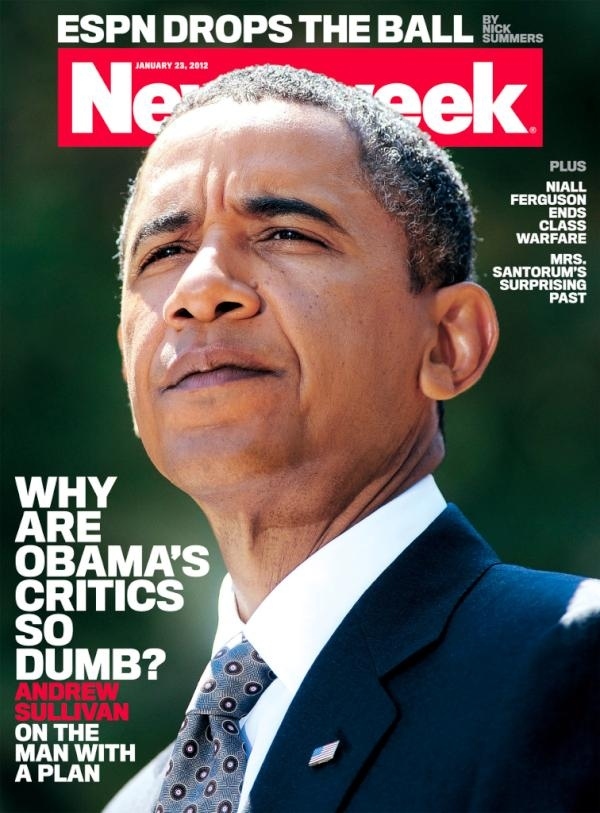
My Newsweek cover story is now up. A teaser:

By misunderstanding Obama’s strategy and temperament and persistence, by grandstanding on one issue after another, by projecting unrealistic fantasies onto a candidate who never pledged a liberal revolution, [the left] have failed to notice that from the very beginning, Obama was playing a long game. He did this with his own party over health-care reform. He has done it with the Republicans over the debt. He has done it with the Israeli government over stopping the settlements on the West Bank—and with the Iranian regime, by not playing into their hands during the Green Revolution, even as they gunned innocents down in the streets. Nothing in his first term—including the complicated multiyear rollout of universal health care—can be understood if you do not realize that Obama was always planning for eight years, not four. And if he is reelected, he will have won a battle more important than 2008: for it will be a mandate for an eight-year shift away from the excesses of inequality, overreach abroad, and reckless deficit spending of the last three decades. It will recapitalize him to entrench what he has done already and make it irreversible.

I wondered when I wrote this what the reaction would tell me. Just browsing at a few of the right-wing blogs, I see that they have attacked it without actually, you know, reading it. Althouse is a classic example:

I don't even want to read it. It just seems like red meat for Obama fans. And what a cliché! Republicans are stupid.

Half the article is devoted to liberals and Democrats! But it would be too much for her to actually read it. Hinderaker:

The time when liberals could seriously try to peddle the lie that conservatives are stupid is long, long gone.

Again: half the essay grapples with how liberals have misread Obama as well. But if you are Power Line, you don't have to read the actual piece. Then he reveals exactly how dumb he is and how right I am:

We who are unhappy that unemployment has increased on Obama’s watch, that over-regulation has stymied economic growth, that our children now owe a $15 trillion debt that we can’t pay–hey, we’re just dumb! We obviously aren’t smart enough to understand how devastating our economy, unemploying millions of Americans and burdening our children with trillions of dollars in debt is really a great idea.

As I note in the piece, the worst month for job losses in this recession happened to be Bush's last month. At that point, we were losing something like 750,000 jobs a month, with an annualized drop in GDP approaching 9 percent! Within a year of that, the US had gone back into job creation. Since then, we've added 2.4 million jobs or so – almost all in the private sector. As for debt, the notion that Obama gave us $15 trillion of it is something most Republicans seem now to believe. This is the truth:

Under Bush, new policies on taxes and spending cost the taxpayer a total of $5.07 trillion. Under Obama’s budgets both past and projected, he will have added $1.4 trillion in two terms. Under Bush and the GOP, nondefense discretionary spending grew by twice as much as under Obama. Again: imagine Bush had been a Democrat and Obama a Republican. You could easily make the case that Obama has been far more fiscally conservative than his predecessor—except, of course, that Obama has had to govern under the worst recession since the 1930s, and Bush, after the 2001 downturn, governed in a period of moderate growth. It takes work to increase the debt in times of growth, as Bush did. It takes much more work to constrain the debt in the deep recession Bush bequeathed Obama.

Then Breitbart's outfit says I'm the editor of the Daily Beast! Yes, that's Big Journalism. None of these critics shows any sign of having read the actual article. Is it too much to ask that they rip me apart after thinking rather than before?

It's not a book, for Pete's sake. It's less than 3,000 words, and has strong criticism of the left in it. Maybe the headline, which I didn't write, set them off. So a simple challenge: show me where I'm wrong and we can debate this. Or are you only synapses firing into the partisan night?

Is The Recovery A Mirage?

Nouriel Roubini isn't buying the generally optimistic response to the new jobs numbers:

U.S. consumers remain income-challenged, wealth-challenged, and debt-constrained. Disposable income has been growing modestly—despite real-wage stagnation—mostly as a result of tax cuts and transfer payments. This is not sustainable: Eventually, transfer payments will have to be reduced and taxes raised to reduce the fiscal deficit. Recent consumption data are already weakening relative to a couple of months ago, marked by holiday retail sales that were merely passable.

At the same time, U.S. job growth is still too mediocre to make a dent in the overall unemployment rate and on labor income. The United States needs to create at least 150,000 jobs a month on a consistent basis just to stabilize the unemployment rate. More than 40 percent of the unemployed are now long-term unemployed, which reduces their chances of ever regaining a decent job. Indeed, firms are still trying to find ways to slash labor costs.

Mitt’s Mexican Heritage

Larry Kaplow spotlights it – and a missed opportunity: 

Not only does Romney speak little about his Mexican roots, but he has defined himself in the primaries by criticizing pragmatic positions from other candidates as being soft on immigration. … To his credit, Romney did mention in New Hampshire the other day that his father was Mexican-born, a sign he might be intending to reposition himself for the general election. But does that even mean more denial of Romney's roots? Neglecting the long and interdependent relationship between these two countries in favor of playing to fears of Mexican immigrants stealing the jobs of U.S. citizens is denying history. A long time ago, a few Americans named Romney headed to Mexico for safety and freedom. Now others come from Mexico to find security in the United States, something the would-be Latino president should surely understand.

Of course, Romney is also comically white:

He is nearly always in immaculate white shirt sleeves. He is implacably polite, tossing off phrases like “oh gosh” with Stepford bonhomie. He has mastered Benjamin Franklin’s honesty as the “best policy”: a practiced insincerity, an instant sunniness that, though evidently inauthentic, provides a bland bass note that keeps everyone calm. 

Chart Of The Day

Less_Death

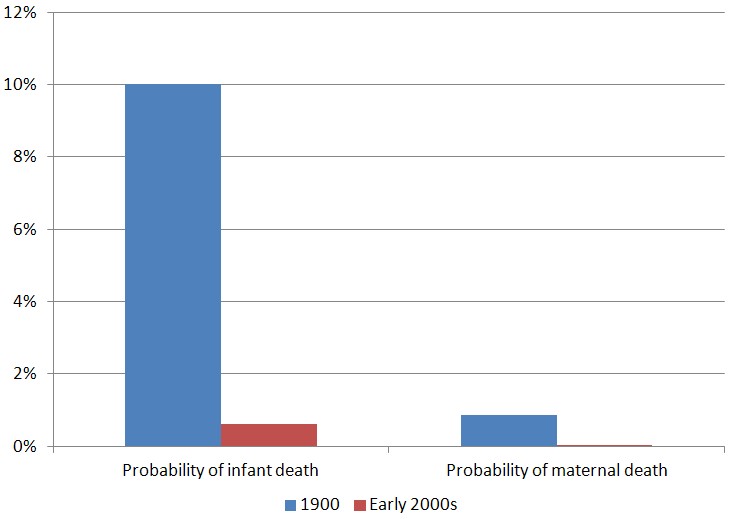
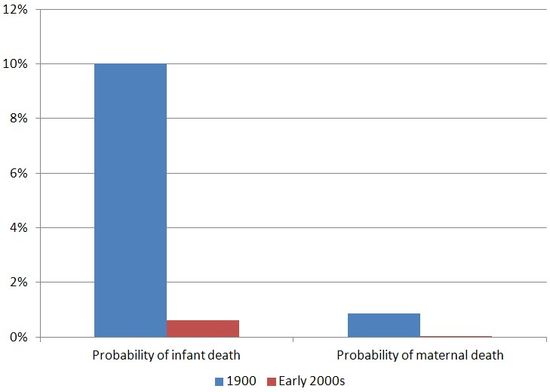
Austin Frakt reflects on the progress we've made over the past century:

Yes, the early 2000s probability of maternal death is there, it’s just so small that you can hardly see it. In addition to these impressive gains, life expectancy rose from 50 to 78 years over the century. Leading causes of death in 1900 were pneumonia, influenza, diarrhea, injuries, and cancer, in that order. Today they are cancer, heart disease, stroke, emphysema, and injuries. All these changes are largely due to great strides in public health.

Follow-up here.

Truman The Noninterventionist

A reader writes:

Not to pile on your "Ike The Interventionist" post, but I just finished reading All the Shah's Men by Stephen Kinzer, and if you had to lay the blame of all our current troubles with Iran at the feet of one man, you can make a strong case that Eisenhower is that man.  (Other candidates: Kermit Roosevelt, who did most of the US's groundwork in the coup, and Winston Churchill, who pushed hard for it from Britain's end.) Eisenhower greenlit the coup practically the moment he was in office. Whether it was his indifference to the facts on the ground in Iran, his own hawkishness, or even the ease with which the hawks around him manipulated him, Eisenhower's willingness to topple Iran's democracy set us on a collision course with the Middle East, and Tehran in particular, that we've been feeling the result of over the past 40 years.  That fact alone makes him arguably one of the least impressive presidents of the last century.

Another also read Kinzer's book:

While he may not be "in the full rounding" of best president of the last century, the end of Harry Truman's administration was more inline with what I think you were intending. Let me offer some evidence.

In All the Shah's Men, Stephen Kinzer writes about how in 1951-1952 British concerns over Mossadegh's nationalization of AIOC led Churchill's having no problem planning a coup. Mossadegh found out about Britain's intentions (Oct 1952) and hobbled the effort by closing the British Embassy in Tehran. Kinzer writes that the British asked Truman for help and he turned them down, claiming that the new CIA "had never overthrown a government, and Truman did not wish to set the precedent." (pg 3)

The British, not taking no for an answer, especially with Truman as a lame duck, began lobbying the not yet sworn-in Eisenhower. Kinzer writes that the American attitude towards a coup changed radically after Dwight Eisenhower was elected in November of 1952. Within days of the election, a senior agent of the British Secret Intelligence Service came to Washington for meetings with top (still serving in the Truman administration) CIA and State Department officials. Eisenhower had not even taken office yet and already the two Dulles brothers were changing US foreign policy and attitudes toward interventionism.

Truman had many flaws, but he was uneasy about undermining democratically elected governments. In fact, it was not until the events of 1949 (Soviet nuke and establishment of Communist China) that Truman really began to pivot from his default foreign policy goals of promoting stability and thwarting the return of Fascism, making sure Germany couldn't rise again militarily and undercutting Franco's regime, which was seen as "established with Fascist support."

I know, I know, I haven't adequately addressed Kennan and the birth of Containment in 1946/47, but I wanted to make the point that Truman, at least to the British, in October of 1952 still was not in favor of intervening by coup. And that Eisenhower either knew of what was being planned (to be carried out under his name) while he was president-elect, or he was hands-off and let the Dulles brothers begin setting precedents.

For further reading, Stephen G. Rabe in The Killing Zone, David F. Schmitz in Thank God They're On Our Side, and Greg Grandin in The Last Colonial Massacre do an excellent job of telling the history of the US intervention in Guatemala in 1954 (organized by … the Dulles brothers).

Huntsman Drops Out Reax

GT_HUNTSMAN-FACE_120106

Buzzfeed Politics:

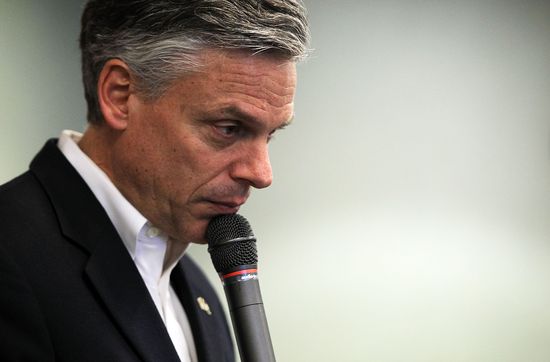
The party Huntsman imagined — modernizing, reforming, and youthful — could still be born. That might be the reaction to a second smashing defeat at Obama's hands, or that might be where President Romney takes his re-election campaign. But it's now hard to see Huntsman leading that change. He bet, too early, on a fantasy, and ran for the nomination of a party that doesn't exist, at least not yet.

Dave Weigel:

The sorts of voters who liked Huntsman: Moderates who will naturally move to Romney, Democrats and liberals who can feel better about their Ron Paul protest votes. The number of voters who fit this profile moving forward: minimal. Which was always the problem. You work with the party you have, not with the party you may wish you had.

Nate Silver:

Although Mr. Huntsman had relatively little support in the polls outside of New Hampshire, recent surveys suggested that the plurality of his supporters had Mr. Romney as their second choice.

Patricia Murphy:

The first, and most obvious problem with Huntsman was that he was just dull– on a debate stage, a campaign rally or nearly any other venue. The most memorable details of his campaign kickoff in front of the Statue of Liberty were the fact that it was in front of the Statue of Liberty and that his staff spelled his name wrong on his campaign materials. What did he say in his speech? Who knows?

Byron York:

Huntsman's problem was that, whatever his position on some key issues, he sent out political and cultural signals that screamed NPR, and not Fox News, that screamed liberal, and not conservative. Even though conservatives agreed with Huntsman on many things, they instinctively sensed he wasn't their guy.

Ed Morrissey:

 Jon Huntsman wasn’t a “pragmatic centrist who could reach out to Democrats.”  He governed in Utah as a conservative in a state controlled by the GOP, but talked like a centrist who despised conservatives.  Huntsman’s expensive and embarrassing flop really isn’t much more complicated than that.

Alex Altman:

As a relative moderate running in a bull market for conservatives, Huntsman may have been doomed from the start, but he inflicted further damage by failing to zero in on a message. 

Tim Murphy:

Huntsman's endorsement likely won't make much of a difference at the ballot box (the "Huntsman voter moves to Romney" jokes were fast and furious on Twitter) but, as the Democratic National Committee is already pointing out to reporters, it will provide an interesting contrast with…Jon Huntsman's previous statements. Huntsman's spent much of the last six months trying to tear Romney down, in speeches, debates, and advertisements (most of which have now been taken down from YouTube).

Along the same lines, Andrew Kaczynski rounds up some of Huntsman's best attacks on Romney. Amy Davidson:

Huntsman had said he had a “ticket to ride” after coming in third place in New Hampshire. What he really had was an indication that seventeen per cent of the voters in New Hampshire could still tolerate the sound of his voice; the only ticket was a rather crumpled one he could hand to Romney, for him to tuck in his pocket. And that’s about all Huntsman—who will be an early case study in the transition from not-Mitt to pro-Mitt—and the rest of us have been left with. 

Jim Fallows:

The question I've long wondered about — based on my assumption that he wouldn't / couldn't win this time, and that the odds are still in Obama's favor this fall — is whether having run, and lost, in 2012 will make him better or worse positioned for the run I had always assumed he was preparing for, in 2016. We can't tell anything about politics in real time, but my guess at the moment is that the run will have left him somewhat better off, bruised and rejected as he and his (attractive) family and staff must be feeling now.

Michael Tomasky:

[E]ven though he lost the voting contest, he did very well indeed in the media contest and is nicely positioned to have another go in 2016. 

(Photo: By Alex Wong/Getty Images.)

Should Kids Play Football?

Jonah Lehrer restates the dangers:

Despite tremendous improvements in football gear and helmet technology, the rate of concussions among high school athletes has not significantly decreased in recent decades. There are many factors behind this lack of improvement, but the most important variable is the dramatic increase in both the size and speed of players. "I've seen these changes firsthand," Rollinson says. "The players I'm coaching now have muscles that you almost never saw fifteen years ago. They work out more, they drink their protein shakes, they know how to bulk up. This also means that these kids are dishing out some very big hits."

Will Tuitions Ever Stop Rising?

Large

Kevin Carey doesn't think so:

College won’t kick the habit of raising prices until the things they care about—money and reputation—are seriously threatened by competitors. Therefore, federal policymakers should help create those competitors by helping establish many brand-new colleges and universities.

Along the same lines, The Daily calculated the cost of college for a baby born today should "college costs keep rising as they have for the last three decades":

The Daily analyzed historical, inflation-adjusted price data from the College Board to see what a bachelor’s degree might cost the class of 2034 in 2011 dollars. The result: Total tuition and fees would top $232,000 for an average-priced four-year private college and nearly $81,000 at an average-priced public university — up 111 percent and 167 percent, respectively, from the average class of 2012 tuition.

(Chart from a Moody's report (pdf))