The Super Pac war is on in South Carolina:
Month: January 2012
Is There A Gene For Religion?
Not necessarily. A recent study focuses on a peculiar gene:
This particular gene variant seems to make people more susceptible to environmental influences – whether religious or otherwise. If you looked at these people in a religious environment, then you would say that this is a gene 'for' religion. Put these same people in a non-religious environment, and you would say that is a gene 'against' religion!
The Unsettled Theology Of A Children’s Book
Austin Allen praises Madeleine L’Engle's A Wrinkle in Time:
[T]his tale of physicists and witches, Genesis and general relativity conflates so many genres and worldviews in 200 pages that there’s something unassimilated about the finished product. L’Engle claimed that “it was only after it was written that I realized what some of it meant,” and while this might sound like standard authorial coyness, I actually believe her.
What she seems to have intended to do is add a new twist (wrinkle?) to C. S. Lewis’s Narnia books. Those, too, combine fantasy with a religious message; The Magician’s Nephew even includes an element of planet-hopping sci-fi. But while the Lewis of Nephew was a veteran children’s author who knew, metaphysically speaking, where he stood, the L’Engle of Wrinkle was a relative newcomer, and there’s something less slick and complacent about her universe. Blend pagan myth with Christian themes and you’re repeating an old formula; stir in large quantities of secular literature and modern science, and you get a more intriguing, more volatile chemistry.
Ask Me Anything: Thoughts On Buddhism?
Update: A reader responded to this answer here.
How Does Humanity Progress?
Norm Geras rips into John Gray's claim that the West is deluded by "a myth of progress in which humanity is converging on a universal set of institutions and values:"
I could argue against this by saying that one can 'believe' in progress in a different way: that is, simply by thinking it might be possible to make changes for the better, improving the world as we know it now, but without imagining that all conflicts can be brought to an end or all serious human problems solved. However, as Gray is evidently resistant to this notion, perhaps I'll just leave it at this: even if we were to listen to him and fasten our attention on the present, take meaning from the here and now, human beings seem to have an impulse to do things better - better next time than last time, avoiding that mistake, introducing this modification, and so on. They also, many of them, want good things for their children, sometimes better things than they had themselves or perceived they had. For these kinds of reason, the present already contains something of the future, and living in the present can't entirely shut the future out.
Face Of The Day
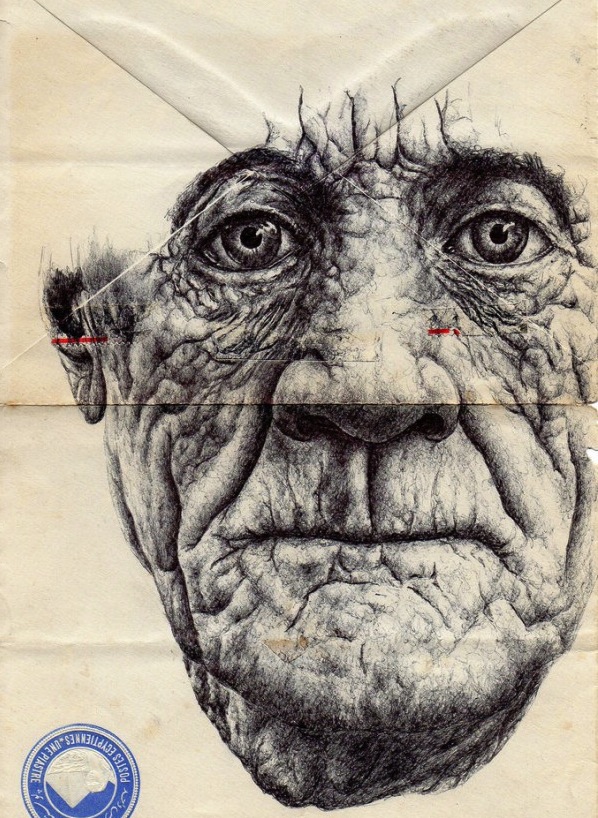
Christopher Jobson captions:
London-based artist Mark Powell has chosen the backs of old envelopes as a canvas for these delicately rendered portraits of the elderly, using nothing more than a standard Bic Biro pen to create the delicate folds and wrinkles of their skin. I love everything about these. See much more of his work here and he sells a number of art prints over on Society6. If you liked this also check out the photography of Lee Jeffries.
Why Are The New Atheists So Often Boring?
Leah Libresco tries to explain why the spate of anti-religion books sometimes seem like intellectual snoozers:
I won’t deny that the New Atheists are going after the intellectually easy targets, but that’s because the anti-intellectual evangelicals are much more politically threatening than the Aquinas-reading theologians. We have to fight all of them on gay marriage, but it’s the boring ones who tend to make trouble when it comes to evolution, global warming, and medicine (HPV doesn’t increase promiscuity, btw).
Since we atheists think we’ve only got this world, we focus more of our efforts on the people who we think are actively harming themselves or others. Plus, a lot of the most active people in the movement (the scientists under threat) have backgrounds that are much better suited to rebut the anti-empiricism crowd. (The crash course in evolutionary biology in The God Delusion is good, the rest is more meh).
"Ask Andrew Anything" take on the New Atheists here.
A Poem For Sunday
"High Flight" by John Gillespie Magee:
Oh! I have slipped the surly bonds of earth
And danced the skies on laughter-silvered wings;
Sunward I’ve climbed, and joined the tumbling mirth
Of sun-split clouds – and done a hundred things
You have not dreamed of – wheeled and soared and swung
High in the sunlit silence. Hov’ring there,
I’ve chased the shouting wind along, and flung
My eager craft through footless halls of air.
Up, up the long, delirious, burning blue
I’ve topped the wind-swept heights with easy grace
Where never lark, or even eagle flew –
And, while with silent lifting mind I’ve trod
The high untrespassed sanctity of space,
Put out my hand and touched the face of God.
Magee was 19 years old when he died in a mid-air collision over Lincolnshire, England in 1941. Rebecca Maskel has more.
Is Religion Easier?
Cognitively, yes:
Religion’s modestly counterintuitive representations, icons, myths, stories, and rituals are materials that every normal human mind finds familiar and easy to use by the time that we have reached school age. By contrast, science’s radically counterintuitive, abstract theories, mathematical representations, and elaborate experimental designs pursued in unusual and often exotic environments are difficult to comprehend and remember, let alone create.
The Formulas Of Life
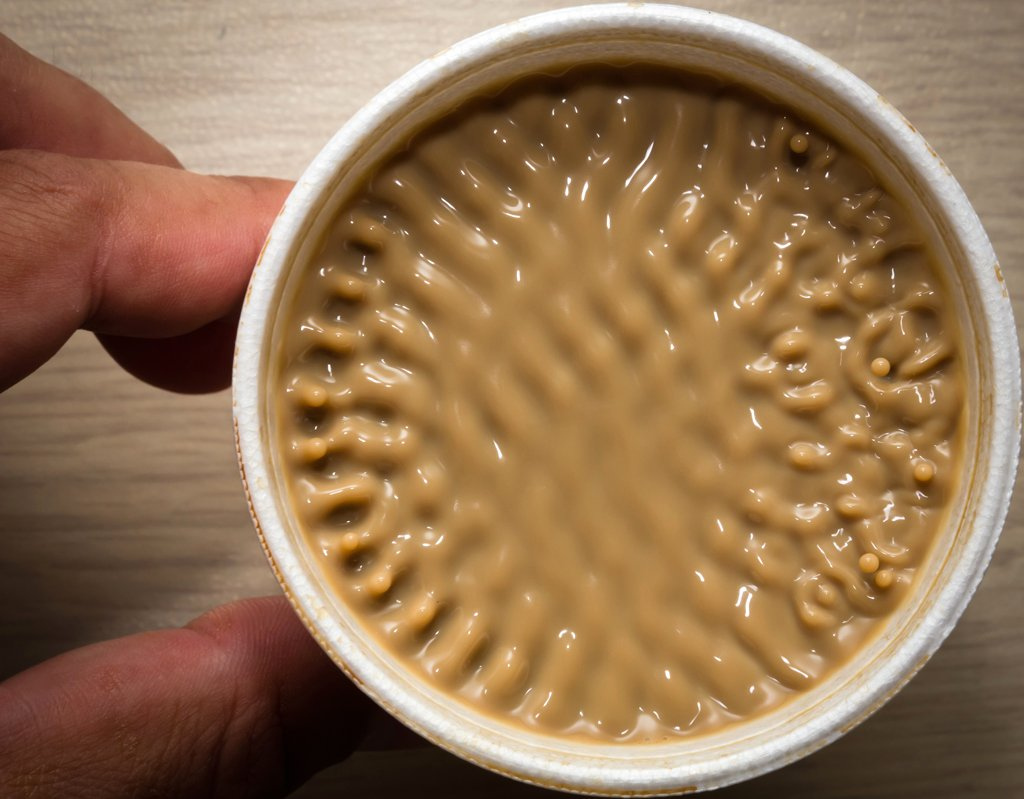
As an undergraduate, Adam Frank spent days learning the equations of a vibrating membrane. After class he bought coffee and placed it on a humming ice cream freezer and the pattern was suddenly made manifest:
The sacred often appears to us in the middle of our “profane” everyday activities. We are taking a walk in the park thinking about what we have to do tomorrow and—bam!—suddenly we see the breathtaking tangle of vines curling around a tree or the deep stillness of the robin sitting attentive on its branch. This shift in attention is exactly what happened to me that day in the cafeteria. I was just buying a cup of coffee but my experience was suddenly, radically transformed when my attention was shifted through the lens of the science I had just learned. The breathless excitement that overwhelmed me (and I had not even touched the coffee yet) came because I felt as though I was seeing the invisible superstructure of the world laid before me even in the most humble of objects. Science—specifically the mathematical physics of elastic surfaces—made that experience of the sacred possible.
(Photo by David Melchor Diaz)
 The Dish