Should Secular People Pray?

Julian Baggini test-drives prayer:

Prayer provides an opportunity to remind oneself of how one should be living, our responsibilities to others, our own failings, and our relative good fortune, should we have it. This is, I think, a pretty worthwhile practice and it is not something you can only do if you believe you are talking to an unseen creator. Many stoics did something similar and some forms of meditation serve the same kind of purpose. My version is simply a few minutes of quiet reflection on such matters each morning.

Eric MacDonald draws a distinction:

[T]he first thing one learns about prayer is that it is not primarily an asking for oneself — although there’s lots of that — but offering oneself. Anything else is really a declension from prayer.

I assume that the Muslim, bowing in humble submission, is not only asking but offering. It’s like that in most religious traditions. Nor is it out of duty to an absolute Sovereign, as Baggini puts it; prayer is much more a loving response than a duty. Augustine famously said that our hearts are restless until they find their rest in god, and it’s that kind of “letting go and letting god” as the phrase has it, that stands at the centre of what people mean by prayer. Not that people don’t ask and hope that their askings will be answered, but that’s not the heart of prayer as it is usually understood.

Yoga, Sex And Spirituality

Some yoga practitioners are bent out of shape over the above ad for Equinox gym, accusing it of sexualizing an ostensibly spiritual activity. Lisa Miller challenges the assumption that there's a clear line betweeen "holy" and "profane" in religious practice: 

Spiritual satisfaction and authenticity have always been matters of taste (as well as of time, place and tribe), and those who claim too loudly to have found the "right" path to a higher truth are at a disadvantage for having said so. In America today, there are the Amish and there are televangelists. Some might say the Amish have a "purer" religion, but millions get a thrill and perhaps even existential guidance from the happy platitudes of Joel Osteen.

And of all the religious patterns occurring among Americans now, none is more prevalent than the widespread dissatisfaction with established religion, a falling away of the faithful from the structures and rules of conventional Judeo-Christian worship. In its place is a more do-it-yourself spirituality, a cobbling together of private-prayer, transcendent experience and family tradition; for millions of these DIYers, yoga and meditation meet a need that regular churchgoing can’t fill.

Live-Blogging The Huckabee Debate

137005024

8.34 pm. Well, there did turn out to be a moment in the forum worth noting. This hyper-partisan crowd booed Gingrich when he cited Mitt Romney. Which confirms my decision to bail out. A debate in which criticism of other candidates is not allowed and in which boos break out when it happens is not one worth watching if you are, you know, a journalist.

One possibility that would make sense of the latest Reuters poll and the booing tonight is that Gingrich's ads have created a backlash for him – and maybe even a boost for Romney. But one outlier poll is a rather slim reed to base this argument on.

8.25 pm. Well, I tried. I can't see this pageant producing anything interesting at this point, and really cannot watch it any more. It's Saturday night. Watching these individuals lie and posture and pander is too much for me to handle. Back to my life … and apologies for the abrupt end. If something meaningful happens at all, I'll cover it later.

8.21 pm. A questioner: "there seem to be more and more discrimination against religion." Romney panders shamelessly, backing the Christianist view that the government should reflect Christian emblems. This debate so far is no debate, and awful, but Romney is literally making me nauseated.

The canned responses to the hysterical premises of the questioners reveals an almos reptilian quality in the man. Maybe it's just me, but Romney made my skin crawl tonight for the first time in one of these events.

8.17 pm. Romney addresses a Ron Paul supporter who asks what he would do to win Paul voters.  His first response was to tout his intention to increase military spending, regardless of its fiscal impact. Romney then says that the Obama administration has imposed price controls on healthcare and "it hasn't worked" – hence the increase in healthcare costs. Seriously, he's out of his mind.

8.12 pm. Romney is actually saying that newly-elected president Obama chose not to seek compromise with Republicans but to ram his agenda through "against the will of the American people." The sheer distortion of reality that Romney is prepared to unleash is staggering. He truly is prepared to say anything about Obama, and has only one criterion beforehand: will it help or hurt me? The idea of a reference to something called truth is beyond him.

I have to say that the setting of Romney sitting down in an armchair and answering questions makes him look even smugger than normal.

8.10 pm. Romney's up – moving a question about housing to blaming Dodd-Frank for burdening the private sector. Then he panders on a home mortgage deduction.

8.08 pm. Ron Paul declined an invite, leaving Huckabee to predict he would not win the presidency.

8.07 pm. No criticism of other candidates allowed. That's what Super Pacs are for, I guess.

8.03 pm. The big news of today is a poll that diverges from the other recent polls. The Reuters-Ipsos poll gives Romney a massive lead. The others show a lead of something like 5 percent. This one shows a lead of 20 percent. Outlier or harbinger? Dunno.

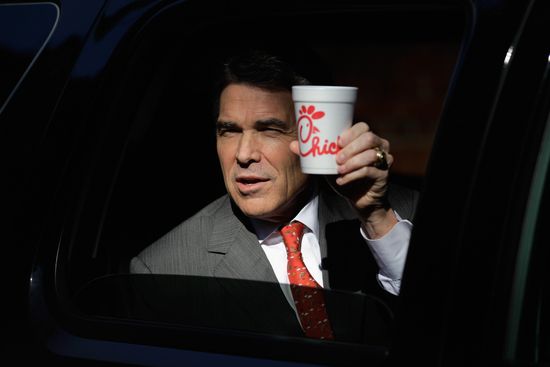
(Photo: Republican presidential candidate, Texas Gov. Rick Perry holds a cup as he drives away after attending a Huckabee forum on January 14, 2012 in Charleston, South Carolina. Republican presidential candidates continue to campaign for votes in South Carolina ahead of their primary on January 21st. By Joe Raedle/Getty Images.)
Stamped With A Kiss

Stamps

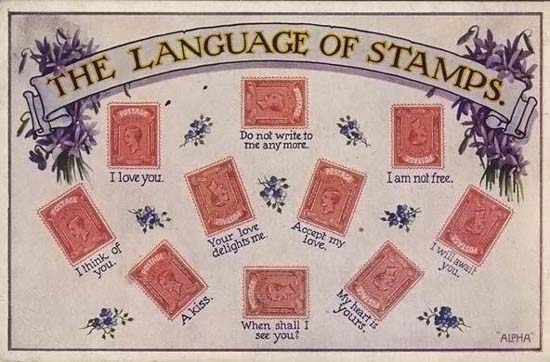
Postage stamps used to convey messages of love:

On philatelic and auction sites you sometimes find postcards which illustrate with small pictures, similar to naval flag signals, what it means if the stamp was stuck in this or that position on the card. The custom is probably as old as the greeting card itself, which started its world conquering tour from the Austro-Hungarian Monarchy in 1869. … The new fashion spread rapidly, and after the turn of the century the rules of the language of stamps received their particular chapter in the etiquette books along with the languages of flowers, handkerchiefs and fans.

Steve Delahoyde laments, "Turns out I've been unintentionally saying "I love you" on all the bills I've paid over the years."

Is Serendipity Slipping Away?

Voyageurs-1-600x450

Ian Leslie hopes not:

In 1952 a French sociologist called Paul-Henry Chombart de Lauwe asked a student to keep a journal of her daily movements. When he mapped her paths onto a map of Paris he saw the emergence of a triangle, with vertices at her apartment, her university and the home of her piano teacher. Her movements, he said, illustrated "the narrowness of the real Paris in which each individual lives".

To some degree, the hopes of the internet’s pioneers [to foster serendipity] have been fulfilled. You type "squid" into a search engine, you land on the Wikipedia page about squid, and in no time you are reading about Jules Verne and Pliny. But most of us use the web in the manner of that Parisian student. We have our paths, our bookmarks and our feeds, and we stick closely to them. We no longer "surf" the information superhighway, as it has become too vast to cruise without a map. And as it has evolved, it has become better and better at ensuring we need never stray from our virtual triangles.

Along similar lines, Farhad Manjoo chides Google for incorporating social media into its search engine:

While my friends are thoughtful and knowledgeable people, their views on the tens of thousands of large and small inquiries that I bring to Google every year are almost always irrelevant. When I’ve got a clogged toilet, I want advice from an expert—a plumber, preferably, but I’ll even take the stranger who wrote this eHow post. What I don’t want to know is which link my boss consulted when his toilet was clogged.

Earlier coverage of the "filter bubble" here and here.

(Image: Les Voyageurs by Cedric Le Borgne)

Tears Of A Clown

Greg Beato fears for Ronald:

3855626806_15bd946a78_b McDonald’s is in the midst of an ambitious, multi-billion-dollar global makeover; its middle-aged mascot has no place in it. In an April 2011 investor’s call, McDonald’s CEO Jim Skinner announced that the company was planning to reimage 2,200 outlets around the world that year. Five months later, in September 2011, McDonald’s revealed it was committing $1 billion to Canada alone, with a goal of upgrading all 1,100 of its restaurants there by the end of 2012. In France, it has enlisted the help of Parisian designer Patrick Norguet to give its most forward-looking outlets the futuristic appearance of a 1960s airport.

The ultimate goal of all this transformation is tastefulness. … Amidst the sleek walnut paneling and modernist dining chairs, however, the chain’s longtime mascot looks less like a crown prince than a red-headed stepchild.

(Photo: Banksy vs Bristol Museum by Leo Reynolds)

What Ever Happened To Chatroulette?

Austin Carr checks in on the website. How Chatroulette's naked man problem was solved:

When users flag someone enough times for indecent behavior (by clicking a button), the offender is automatically transferred to a partner site. Thanks to deals with adult dating services like FriendFinder.com, Chatroulette is earning cash hand over fist from the referral traffic. "Basically, once we detect a person is naked, he'll be kicked from our service to another website," Ternovskiy says. "So, we're actually getting revenue from naked men right now."

These exhibitionists were a major headache for Ternovskiy before becoming a major source of income. Though helping to create buzz on the site initially (for better or worse), they were also a bandwidth drain, often nexting through as many as 800 users in just 15 minutes. According to Ternovskiy, Chatroulette is now earning $100,000 per month due to its refined business model and content-control system–all from "naked men." That's triple the site's monthly "mainstream" or "normal" revenue, as Ternovskiy refers to it.