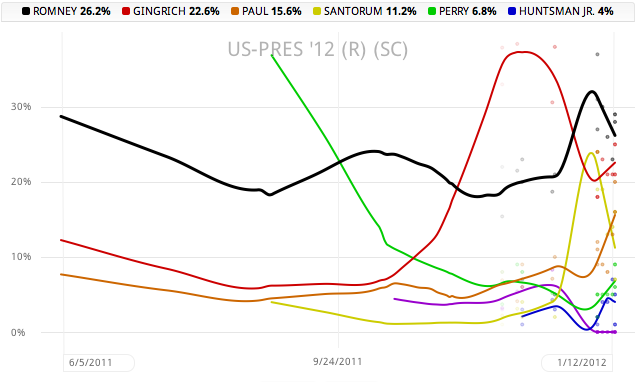
South Carolina: Santorum Sinks, Newt Rises, And Paul Surges

Poll_Of_Polls

Rasmussen – the second outfit to report polling data after New Hampshire – shows a less dramatic, but still real, shift than the Insider Advantage poll. Before New Hampshire, the GOP-tilted polling outfit put Romney at 27, Santorum at 24 and Gingrich at 18. After New Hampshire, some of Santorum's support has shifted to Newt and Ron: it's now Romney steady at 28, with Gingrich at 21 and Santorum dropping eight to 16. Ron Paul has surged from 5 percent in October to 16 percent today.

The latest ARG poll is even more striking: Paul has surged to 20 percent in South Carolina: a stunning result that overturns a lot of expectations. This military state may actually share the military donors' views and loathe what neoconservatism has done to wreck American influence abroad and fiscal balance at home. So it's 29 – 25 – 20, with a week to go. I'd say any one of those three could win.

What effect will the Bain bomb have? As Bubble would note, who can say? All we know is that Romney was tied with Kennedy in the polls by Labor Day of 1994 in the Massachusetts Senate race in a year that was perilous for Democrats. After the Bain ads, independents fled Romney and Kennedy won by 17 points.

Romney’s Favorite Tax Loophole

Howard Gleckman explains carried interest, often referred to as "the carry":

The carry allows general partners in investment deals to receive compensation in the form of tax-advantaged capital gains, which are taxed at 15 percent, rather than as salary, which would be taxed as ordinary income with a top rate of 35 percent. This happens because the managers are paid with a fee (up to 2 percent) plus 20 percent or more of their investor’s profits. Those profits are taxed as capital gains even though the general partners may have little or no money of their own at risk in the deal.

So you make millions off companies, even when they go bankrupt, and you get taxed at rates the middle class would love to pay. Run on that in Ohio.

Romney’s Empathy Problem

A reader writes:

All of that money, all of those highly-paid advisors, years of preparation … and the best response that Mitt Romney’s team can come up with for one of our society’s biggest issues sounds like the words coming from a Jerry Springer guest being booed offstage:  "Y’all are just jealous!"

Another writes:

It wasn't too long ago that Romney, in anticipation of the general, expressed his concern for the middle class and, explicitly, his lack of concern for the future prospects of the already-rich: "I'm not worried about rich people. They are doing just fine." And now, in responding to Newt, he has taken the bait and full-throatedly claimed the mantle of defender of Wall Street. Not too savvy, and somewhat reminiscent of Obama's "clinging to guns and religion" gaffe. It's not a game-changer, as Obama's error wasn't, but it reinforces certain preconceived notions and makes the fires in the Democratic camp burn more brightly.

Another:

I've been thinking about this for a few weeks, and it really crystalized with the video you posted earlier, in which Romney accuses his opponents of envy.  Mitt Romney's fundamental electoral problem is that he comes off as a complete asshole. 

He's got all the characteristic asshole qualities: a dismissive, contemptuous attitude towards rivals; lack of any evident feeling or empathy; a completely transparent willingness to say whatever voters want to hear in any given situation; arrogance; untrustworthyness; smarminess – you name it, he exudes it. 

To a certain degree, I imagine nearly all politicians are assholes, but the successful ones find a way to deflect it.  Obama is very good with self-depreciation. Dubya had a down home, "have a beer with him" demeanor. Clinton exuded warmth and interest. Romney just comes off like a prick in a suit and hasn't found any way that I've seen to exhibit any self-awareness around this. 

At a time in which people are angry and frustrated, this dude is wearing a "kick me" sign and doesn't seem to know it.  Can you imagine anyone thinking, "That Mitt Romney, he really cares about us"?  That is why the Bain stuff is so devastating – it gives a form to this rather evident but hard to pin down quality about him: that he seems like just a total asshole.

“My Name Was Not Eric. It Was Faggot”

A testimony about what fundamentalist Christianity and social ostracism can do to a human soul:

Eric – after making this video and struggling to overcome the impact of this psychological and physical warfare against him – killed himself two days ago at the age of 19. His own mother had tried to exorcize the gayness out of him. His own mother.

You want to know why so many of us are so impassioned to change the world that effectively killed this human being, made in the image of God? To love and save the Erics of today, and to prevent the laws and culture that reduce him – and all that he is – to the word "faggot." And this is a task real Christians need to be in the vanguard of, rather than adding to the pain and torture that seeps into the lives of so many, so young, and so vulnerable.

Why is that so hard to understand? Can anyone doubt where Jesus would be in this battle?

Romney Avoids The Issue

He needs to do better than this on the Bain question:

I've been reading the new book by Boston Globe reporters Michael Kranish and Scott Helman, "The Real Romney." Its chapter on Bain is very helpful. Romney was originally an old-school management consultant at Bain and Company, using his prodigious mastery of data and Harvard Business School talent to advise companies. But then the founder of Bain, Bill Bain, asked his star analyst to do something else: start a venture capital company that would invest using exactly those skills. Romney was assured that if it didn't work out, he'd get his old job back, plus any raises he might have missed, and a cover-story that he was desperately needed back at Bain and Company. It was a reputation risk-free assignment by a wealthy man for his favored son. It sure wasn't risky small business entrepreneurialism.

Here's the description of a classic success in Romney's business record:

In 1996, Bain invested $27 million as part of a deal with other firms to acquire Dade International, a medical diagnostics equipment firm, from its parent company, Baxter International. Bain ultimately made ten times its money, getting back $230 million. But Dade wound up laying off more than 1600 people and filed for bankruptcy protection in 2002, amid crushing debt and rising interest rates. The company, with Bain in charge, had borrowed heavily to do acquisitions, accumulating $1.6 billion in debt by 2000. The company cut benefits for some workers at the acquired firms and laid off others. When it merged with Behring Diagnostics, a German company, Dade shut down three US plants. At the same time, Dade paid out $421 million to Bain Capital's investors and investing partners.

Remember: for Bain and Romney, this was a huge investment triumph. But when you break it down, you see the core issue. This was not just about restructuring or remaking or rebuilding companies. It was about making more money than God by leveraging debts, selling companies, and gutting workforces. Notice that Bain's dividends are the first things these collapsing firms pay off. Even Romney has admitted it can get ugly to the NYT in 2007 (again from Kranish and Helman):

"It is one thing that if I had a chance to go back I would be more sensitive to. It is always a balance. Great care has got to be taken not to take a dividend or a distributuion from a company that puts the company at risk," he said, adding that taking a big payment from a company that later failed "would make me sick at heart."

This is a lot of heartsickness. As the New York Post reported,

Romney's Bain invested 22 percent of the money it raised from 1987-95 in five businesses – Stage Stores, American Pad & Paper (AMPAD), GS Industries, and Details – making a $578 million profit.

Every one of them went bankrupt, with the loss of many, many jobs. The question Romney has to answer is: how is it "capitalism" to make so much money from companies that went bankrupt? It's one thing to be a businessman and make money by building an enterprise. But Romney never managed a business, apart from Bain. He just made a large part of $250 million by investing in companies that went belly-up.

Wouldn't you like to make money that way? Do you know anyone who does?
Could The Bain Bazooka Backfire?

John Heilemann finds reason to think so:

[T]he belief that an anti-business message appeals to tea partiers is rooted in a misunderstanding of the movement. “Criticizing Bain did for Mitt what he couldn't do for himself — converted him from a flip flopping political opportunist to a proud, ruthless creator and destroyer of companies and men,” notes a savvy progressive organizer of my acquaintance. “That's a feature, not a bug for tea party folks, the vast majority of whom are not wage workers like the ones who got laid off. As Theda Skocpol observes, the tea party is composed mainly of small business owners, retirees, military families, and women who don't work — not a laid off steel worker among them.”

Allahpundit isn't sure whether the Bain attacks will be effective but he wants to find out:

If “creative destruction” is now anathema to Republican voters, we should try to find that out sooner rather than later so that the party can move left and start pandering appropriately, yes?

Ad War Archive

Our Ad War updates, organized by date:

2012

January:
13 / 17 / 18 / 19 / 20 / 21
23 / 25 / 26 / 27 / 28 / 31 31(II)

February:
02 / 03 / 04 / 07 / 08 / 10 10(II)
14 / 15 / 16 / 17 / 18 / 21
22 / 24 / 28 28(II)

March:
01 / 02 02(II) / 06 06(II) / 07 / 08
12 / 13 13(II) / 14 / 15 / 16 / 20 20(II)
21 / 22 / 23 / 26 / 27 / 30

April:
02 / 03 / 04 / 05 / 10 / 11 / 12
14 / 16 / 17 / 19 / 24 24(II) / 25
26 / 28 / 30

May:
01 / 03 / 04 / 07 / 08 / 09 / 10
15 / 16 / 17 / 18 / 19 / 21 / 23 23(II)
24 / 29 / 30 / 31

June:
04 / 05 / 06 / 07 / 08 / 12 / 13
14 / 15 15(II) / 18 / 20 20(II) / 22
25 / 2627 27(II) / 28 / 29

July:
02 / 03 / 05 / 06 / 09 / 10 / 11
12 / 13 / 14 / 16 / 17 / 18 / 19 / 20
23 / 24 / 26 / 27  27(II) /30 / 31

August:
01 / 02 / 06 / 07  07(II) / 08 / 10 10(II)
13 / 14 / 15 / 17  17(II) / 20 / 21 / 22
23 / 24 / 27 / 28 / 30 / 31

September:
04 / 05 / 06 / 07 / 10 / 11 / 12 / 13
14 / 17 / 18 / 19 / 20 / 21 / 24 / 25
26 / 27 / 28

October:
01 / 02 / 03 / 04 / 05 / 08 / 09  09(II)
10 / 11 / 12 / 15 / 16 / 17 / 18 / 19
22 / 23 / 24 / 25 / 26 / 29 / 31  31(II)

November:
01 / 02 / 05 / 06