On a related note, here is but one “fifth column” mea culpa.
Question? askandrew@thedailybeast.com Video archive here.
On a related note, here is but one “fifth column” mea culpa.
Question? askandrew@thedailybeast.com Video archive here.
Leon Hadar reads New Hampshire as evidence:
[I]f you consider that Huntsman came in third in New Hampshire, winning 17 percent of the vote, and you combine that number with the 23 percent that Paul mustered there, it is possible to conclude that 40 percent of the Republican voters in New Hampshire have rejected President George W. Bush's global military adventures and democratic crusades. Moreover, the three most radical neocons in the race — former House Speaker News Gingrich, former Pennsylvania Senator Rick Santorum, and Texas Governor Rick Perry — who cannot wait to start bombing Iran — in the case of Perry, to re-invade Iraq — got altogether 20 percent of the vote in New Hampshire.
Marc Tracy looks to Rand Paul's popularity:
[T]here is a genuine constituency for Paul and Paul-ism in the Republican Party, the "progressives for Paul" meme notwithstanding: there are some progressives who support Paul (Katha Pollitt has a superb column explaining why they shouldn’t), but the largest coherent voting bloc that would be amenable to a Paul-like candidate is the Tea Party. And we know this because the Tea Party’s favorite politician is … Sen. Rand Paul, Republican of Kentucky and son of (and crucial supporter of) Ron Paul.
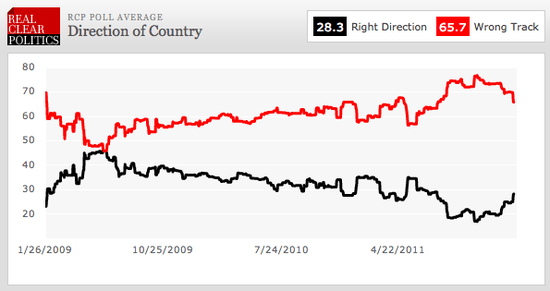
I note merely that since last October, the direction seems to have changed a little. The right direction thread has jumped about ten points and the wrong direction has dropped about ten points, for a big swing of 20 points. In October, there was a 61 percent gap between right and wrong direction; now, that gap is 38 percent.
Contra Frum, Eli Lake reports that Israel is the most likely suspect:
Patrick Clawson, the director of research at the Washington Institute for Near Policy, said the signs point to Israel. "This sophisticated technique is uncharacteristic of the Iranian armed opposition and the Iranian government, it is characteristic of the Mossad," he said.
"I am unaware of episodes when Americans and Europeans have done this kind of assassination. Of course, the Americans are involved in assassinations using predators, but not this kind of operation with agents on the ground, the natural suspect is the Mossad."
A former Mossad officer now living in Canada who goes by the pseudonym Michael Ross said the attacks bore the hallmarks of an Israeli operation. "This tactic is not a new one for the Mossad, and worked very effectively against Egypt’s rocket program in the 1960s. During that period, the scientists involved in that project were assassinated and the program suffered immensely."

CERN, Europe, 11.45 am
Mitt Romney supports pegging the federal minimum wage to the Consumer Price Index. Yglesias figures that "[i]ndexing the minimum wage to inflation should appeal conservatives" and that it "would deny Democrats the political weapon of random increases." Reihan Salam revisits Ron Unz's comprehensive proposal for a substantial hike:
I find it unimaginable that Romney would support a steep increase in the federal minimum wage. Yet were he to do so, he would devastate his Republican rivals. A significant minimum wage increase is backed by a large bipartisan majority, leaving aside its substantive merits. Unz emphasizes the impact on immigrant workers, though this policy would also have some nontrivial impact on teenagers, etc.
James K. Galbraith recently endorsed raising the federal minimum wage to $12 an hour (the current rate is $7.25):
The plan isn't just good for Republicans — it's good for the economy.
What would workers do with the raise? They'd spend it, creating jobs for other workers. They'd pay down their mortgages and car loans, getting themselves out of debt. They'd pay more taxes — on sales and property, mostly — thereby relieving the fiscal crises of states and localities. More teachers, police, and firefighters would keep their jobs.
Would this hurt competitiveness? Not at all. That's an issue for manufactured goods and traded services like insurance and banking, sectors in which everyone already earns far more than $12 an hour. The jobs we're talking about are in non-traded services like checkout clerks, haircutters, domestic help, and food-service workers — you can't run a deep fryer in Terre Haute from Bangalore.
Revealed:
Jack Shafer imagines it:
Maybe it won’t happen this campaign, but I can see the day that a complete documentation on every politician of note, produced on the Web in Wikipedia fashion, would make opposition research redundant. When that day comes, we’ll finally be able to see our candidates in full and see that nearly every one of them has flip-flopped; made a fortune from either honest graft or dishonest graft; mistreated, divorced, or cheated on a spouse; taken drugs; lied; cheated; violated taboos; told dirty, racist, or otherwise tasteless jokes; stretched the fabric of the campaign finance laws; associated with bad people; engaged in resume inflation; taken dubious payments; or otherwise transgressed—just like you.
When the day of the Super Dossier comes, and it may even come by 2016, the power of the Web will teach us that nobody has enough character (Nixon? Clinton? GWB?) to be president. At that point, maybe all this standard human frailty will have become sufficiently normalized that we’ll have to pick our chief executive based on the policies and programs he binds himself to pursuing.
Aaron Carroll points out that accidents, homicide, and suicide are among top killers of children:
I know legions of people who work every year to save kids lives. I think it’s one of the most worthy causes there is. But I rarely see massive campaigns and fund-raising drives to prevent assault and homicide. I don’t see many for suicide. I don’t see ribbons for safer cars. Yet these are the things that kill children in droves. More small children were killed in assaults than for all cancers combined. When you get into the 15-24 year old range, accidents (especially cars) are #1, homicide is #2, and suicide is #3.
Hishaam Aidi assesses the use of hip-hop as part of US democracy promotion in the Arab world:
For State Department officials, the hip hop initiatives in Muslim-majority states showcase the diversity and integration of post-civil rights America. The multi-hued hip hop acts sent overseas represent a post-racial or post-racist American dream, and exhibit the achievements of the civil rights movement, a uniquely American moment that others can learn from.
But it's unclear how persuasive this racialised imagery is. Muslims do not resent the US for its lack of diversity. Where perceptions are poor, it is because of foreign policy, as well as, increasingly, domestic policies that target Muslims.
Liam Stack profiles [NYT] a Libyan hip-hop collective's experience during and after Qaddafi. Their first video, above, was filmed in Qaddafi's former compound in Bab al-Azizyeh (though the song was released in March).
 The Dish