
St. Louis, Missouri, 11.45 am
St. Louis, Missouri, 11.45 am
Andrew Exum is appalled, but not shocked, by the video of Marines desecrating the corpses of Taliban soldiers:
Just look at the official propaganda from the Second World War, a conflict most Americans have seen only through a sanitized Spielbergian lens. Look at the lengths to which the United States and Japan went to dehumanize the other. Now imagine how that translated down at the platoon and squad level in heavy combat. One big difference today is the diffusion of camera phones and other media allow the ugly dehumanizing effect of war to go viral. In a way, I am glad. Since so few Americans actually fight in our wars, it's good that Americans see the effect war can have on other people's sons and daughters.
Ackerman wonders why the outrage to date has been greater in the States than in Afghanistan. Debra Cassens Weiss compiles evidence suggesting that the episode qualifies as a war crime.
Despite recent violence, Marc Lynch believes it was wise for the US to leave:
I argued years ago that only an American withdrawal would force Iraqi politicians to find a sustainable political equilibrium. I never expected it to be a pretty one, or to be an easy process. But I would say that this is exactly what has been happening and what we will see unfold over the coming years.
Prime Minister Maliki was deeply reckless and misguided to try to arrest Vice President Tareq al-Hashemi — and yes, it is extremely worrying to watch Hashemi flee for refuge in the Kurdish areas. Insurgents have carried out some horrific bombings to try and destabilize the situation. While a lot of people see this as the opening stage of the coming collapse, I saw it as their testing the new political arena to see what they can get away with and how far they can go. That's not a surprise. All Iraqi political actors, from the Sadrists to Iraqiyya, will do the same. The test is whether the new Iraq can absorb those provocations and settle down. I hope and pray that it can. But this was going to happen no matter when the U.S. withdrew — and this was the time to do it.
It's worth pointing out that Iraqis favored American withdrawl:
60% said that the Americans pulling out of the country was good, 30% said it was negative, and 10% were unsure. 68% of Shiites had a positive response, with a plurality of Sunnis, 48%, and Kurds, 45%, having the same view. When asked what emotion they had about the event, 22% said they were happy, 35% were worried, and 30% were both. The most worried were Sunnis at 45%, and the most happy were the Shiites at 26%. This showed the divergent opinions Iraqis had about the December 2011 withdrawal date. A majority wanted the U.S. to leave, but were apprehensive about what would happen next.
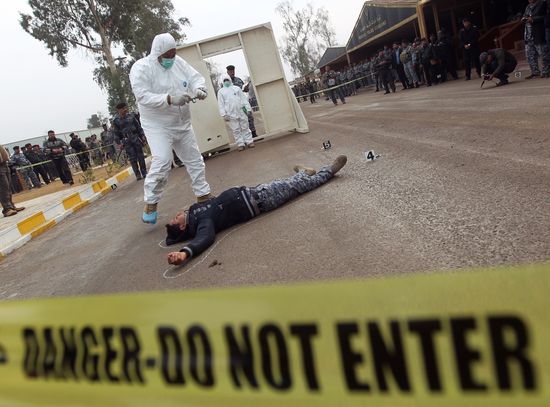
(Photo: An Iraqi policeman in Baghdad on January 8 takes pictures of a simulated dead body in a forensic drill during the first graduation ceremony for 440 national policemen, trained solely by the Iraqi trainers without the support of Italian Carabinieri since the withdrawal of U.S. forces. by Ahmad Al-Rubaye/AFP/Getty Images)
A reader writes:
My husband, parents, and sister all run or ran small businesses. Their income depends or depended on keeping their businesses healthy. Thus they thought about how to do that, including recruiting and training employees and compensating them well, to retain them and build their business.
But in Bain's – and Romney's case – the health of the businesses was less than relevant. In many cases, the point was to run up the stock price, borrow (sometimes from pensions) and cash out. Romney made lots and lots of money from failure. And, of course, that failure hit their employees and the communities in which they worked. Their jobs and pensions and health coverage are gone. The white working class has suffered considerably from this approach to capitalism, the kind that doesn't care about building businesses but only extracting wealth for very few. Some years Bain made an 88% profit.
And, frankly, how has it helped the American macro-economy? I don't see that it has. This is not even creative destruction. It's just destruction.
Thomas Schaller says it's only getting worse:
As Republicans try to simultaneously please both the xenophobic elements within the conservative base and the Latino voters it needs to compete nationally, they may be tempted to seek a quick-fix solution, notably the selection of a Latino vice-presidential running mate. Symbolic shortcuts to demographic parity don’t necessarily work, of course, and may create as many problems as they solve. (Think of all the female independents and disgruntled Hillary Clinton supporters driven immediately and irreversibly to Obama’s candidacy after McCain in 2008 picked Sarah Palin as his running mate.)
Some pushback on the documentary's claims here from Fortune. I don't think the defense works emotionally, and splitting hairs about when Romney formally left Bain doesn't remove Romney from Bain's taint. He founded it. Its methods remained consistent. He still made money off it. Still, there are some errors that need to be aired. I just don't think Romney can get in the weeds of each accusation without making things worse. So he has to do something much bigger.
This is Mitt's Jeremiah Wright moment. Can he meet it, the way candidate Obama did?
Exposed:
More details on the scandal here.
'Tis true!
The New York Times' public editor wants to know. Yes, it's that bad. But this is instructive, isn't it?
Joe Klein argues against blaming Romney for job losses. But he doesn't let Mitt off the hook:
To my mind, the more questionable private equity practices had to do with the way they restructured the companies they bought: it was always in the direction of higher returns–higher salaries and bonuses for executives, higher returns for the investors in their funds. What’s wrong with that? Nothing, in principle. In practice, it led to a lot of short-term, quarter-to-quarter, thinking; often it led to a stripping away of research and development, less emphasis on the patience needed to bring new products to market and an addiction to ever-increasing profit margins. This caused a fundamental distortion in the free market system.
Yep, and it meant those companies were strapped with debt, while Bain sucked the equity life out of them.
And as we saw, it just so happens that Bain often sold the stocks at peaks, and then the companies swiftly tail-spun into bankruptcy. I have to say I am not envious of the wealth of others. I celebrate the success of others. I have often refused to demonize the wealthy or even criticize them.
But this is not about being wealthy; it's about how you get wealthy. The more I learn about what Romney actually did, the more Wall Street in the worst sense it appears to be. Not making things, but manipulating things; not building companies, but ransacking them with clever plays in the stock market, helped by positive reviews from Lehman Brothers, for goodness' sake. The contrast with the people actually living out there in the heartland, with his glib, slick celebration of money for its own sake is … well brutal.
Maybe he has a better story to tell about jobs created. He needs to get it out there quickly.
But Mitt's role in life has been that of the repo man, who wins the lottery every time he brings bad news. He may be necessary, but you sure don't like him. And in this recession, I have to say it could be fatal.
Game on.
 The Dish

