Readers have been submitting some great MHBs lately:
Thought you might be interested in this video by kogonada. It's a "Breaking Bad" remix of all those POV shots in the show. A pretty seamless montage.
Readers have been submitting some great MHBs lately:
Thought you might be interested in this video by kogonada. It's a "Breaking Bad" remix of all those POV shots in the show. A pretty seamless montage.
Friedersdorf takes a close look at those who have shied from the commitment:
[I]t's a sign that there is little enthusiasm for any candidate among a diverse array of influential movement conservatives, and that doesn't portend well for the eventual Republican nominee. He'll have a difficult time generating enthusiasm, and may be tempted to try compensating as John McCain did: by making a risky VP pick to drum up support (or give ideologues cover for offering it) — though hopefully the right has at least learned that lesson in the last four years.
Nick Gillespie makes it:
… just happens to be Netanyahu's chief propagandist in Israel. Sheldon Adelson is a Greater Israel fanatic, whose newspaper in Israel has featured full-on attacks on president Obama, featuring … Newt Gingrich. It's important to understand that the Israeli prime minister is engaged in a full-on political campaign – against the re-election of the president of the US.
Anouar Majid thinks the protests have created a chance to revive our reputation in the Muslim world:
One thing that is striking about the recent revolts in Tunisia, Egypt, Libya, Syria, Yemen, and Bahrain is the absence of any anti-American slogans or denunciations of the Great Satan, as the Iranian regime refers to Uncle Sam. On the contrary: signs of pro-American sensibilities abound.
Democracy protesters carried homemade placards displaying slogans and statements (sometimes translated into French) of fundamental American rights. The United States’ republican culture, founded in the late eighteenth century, and given a brief burst of energy during the early days of the Obama administration, walked side by side with the protesters. President Obama expressed support for the demonstrators, while Secretary of State Hillary Clinton cautioned Arab leaders that they were sinking in the sand the day before Ben Ali fled Tunisia.
One should not forget also that the Tunisian revolt was sparked by the dispatches of U.S. diplomats revealed by WikiLeaks. For many, WikiLeaks was proof that the United States was an imperial power whose consuls never ceased to keep an eye on the world’s nations and their doings; to Arabs and Muslims, however, the leaks were further proof that their regimes had no credibility whatsoever and that they were, indeed, sinking. That’s because the consular reports reflected America’s belief in freedom and equal opportunity; they expressed contempt for palace corruption even as they did business with Ben Ali and other rulers to safeguard their nation’s interests. And then, of course, the United States helped dislodge Libya’s Moammar Qaddafi from power through its military intervention.

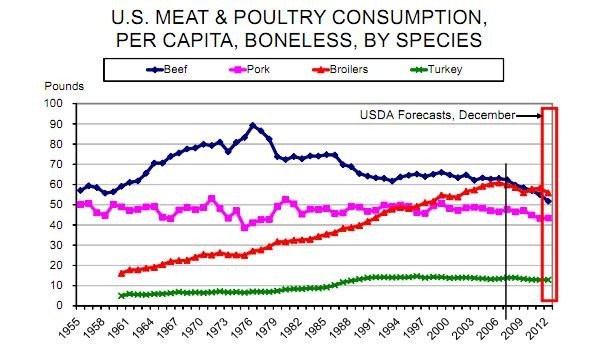
Mark Bittman credits [NYT] a recent, significant fall in meat consumption to changing attitudes:
Some are choosing to eat less meat for all the right reasons. The Values Institute at DGWB Advertising and Communications just named the rise of "flexitarianism" — an eating style that reduces the amount of meat without "going vegetarian" — as one of its top five consumer health trends for 2012. In an Allrecipes.com survey of 1,400 members, more than one-third of home cooks said they ate less meat in 2011 than in 2010. Back in June, a survey found that 50 percent of American adults said they were aware of the Meatless Monday campaign, with 27 percent of those aware reporting that they were actively reducing their meat consumption.
Chart via Brad Plumer, who highlights an economic explanation:
The Daily Livestock Report blames rising meat prices in the United States. As countries like China and India get richer, they’re eating more meat, which is helping to drive up U.S. exports and making beef, pork, and chicken more expensive here at home. Ethanol also plays a role: Nowadays, American farmers divert bushels and bushels of corn to make fuel, which drives up feed prices and, again, makes meat pricier.
Drones now make up nearly a third of US military aircraft. David Cortright makes the case against their use. Benjamin Wittes and Ritika Singh push back:
Cortright may argue that “terrorism is more a political and law enforcement challenge than a threat that can be addressed by military means,” but it is worth remembering that the opposite of targeted killing is not usually law enforcement. It is often less-targeted – that is, more indiscriminate – killing. The important flip side to Cortright’s anxiety that drones will lower our inhibition to go to war is that drones can also limit the scope and scale of military action. The United States is not going to take a hands-off approach to states like Pakistan and Yemen, where law enforcement is not a feasible option. Drone warfare permits a highly calibrated military response to situations in which the alternative may involve not lesser but far greater uses of military violence.
He's not telling:
Jacob Sullum compares Romney's 2008 position on medical marijuana to his current one. Raw Story says he's ducking questions on drugs:
[Romney's] website mittromney.com makes no mention of the war on drugs, except for the transcript of an speech from October in which he said he would begin talks with Mexico "to strengthen our cooperation on our shared problems of drugs and security." Last week in Laconia, another student asked Romney if he thought patients that used medical marijuana should be arrested. He dodged that question with a jumbled answer, stating he was "in favor of having the law not allow illegal marijuana."
Hooman Majd relays public opinion from the country:
Few in Iran believe that the nuclear program is a quest for a Shia bomb to obliterate Israel once and for all. No, the Iranian people, from my greengrocer to college students who resent their government, still consider the nuclear question in generally nationalistic terms. The particular regime in power is of passing relevance. So sanctioning Iran’s central bank and embargoing Iranian oil, tactics the White House may be using as a way to avoid having to make a decision for war, will neither change minds in Tehran nor do much of anything besides bring more pain to ordinary Iranians. And making life difficult for them has not, so far, resulted in their rising up to overthrow the autocratic regime, as some might have hoped in Washington or London.
Larison adds his thoughts.
A reader fills out the fracking debate:
Just like the generation and harnessing of any energy source, including solar and wind, natural gas extraction has an environmental impact and we should pretend that it doesn’t. However, we also shouldn’t exaggerate that impact either.
I work for an engineering company which provides services to gas companies working in the Marcellus Shale in Pennsylvania. The economic impact from this work is real. No other industry is investing, or planning to invest, tens of billions of dollars into Pennsylvania over the next 5 to 10 years. Billions will be paid out in land leases and royalties to families. Well-paid, skilled construction and engineering jobs are being created and maintained. Gas prices for utilities, industry and families are low and are likely to remain affordable for the foreseeable future. This is a resource we should be using because it provides investment in America and American jobs and infrastructure.
The headlines will continue to be filled with the isolated problems, which is fine, as holding a spotlight on the industry will keep everyone conscious about the risks. That said, please don’t fall into the trap of the either/or debate. The conservative debate, as with the generation and harnessing of any energy source, should be what needs to be done to ensure the risks are managed appropriately.
From the other side of the debate:
As one of your readers has noted, upstate New York (where I live) is being rocked to pieces by the fracking issue.
Today is the deadline for the Department of Environmental Conservation to receive comment for its latest Supplemental General Environmental Impact Statement (SGEIS). In its current state (already revised once), it is full of give-aways to industry, including NOT requiring companies to list the chemical ingredients of their frackingfluids deemed "proprietary", and proposes using fracking flowback water (laced with chemicals and radiation from the shale) on rural roads as a de-icer and to keep down dust.
At last count, the DEC has received over 18,000 comments, and a few thousand more are expected by today. Meanwhile, over a dozen towns and municipalities across the state have used their local zoning laws to limit or exclude drilling from their jurisdictions. The energy industry is suing two of the smallest towns to overturn these rules on the grounds that local governments cannot "regulate" the energy industry (despite the fact that state law allows towns to use zoning to limit or restrict mining). The industry is threatening other towns with expensive lawsuits as well.
The EPA is only just now trying to get a handle on the public health effects of fracking in Texas and Pennsylvania – two huge laboratories for what now seems like a sick science experiment gone wrong (why not drill for gas in suburban backyards?). France and Quebec have banned the practice outright. The headlong rush to frack my state is one of the most frightening experiences of my adult life. I feel sick for what the people of Pennsylvania have been experiencing and scared to death of the same thing happening here.
Another stakes a middle ground:
Gasland, whose trailer you posted, is borderline agitprop that plays very fast and loose with both scientific fact and personal narrative. Which is not to say that there aren't real social and scientific risks with this drilling technology. There most certainly are and Josh Fox is right to raise them, however imperfectly, to the fore. But focusing on this issue in particular obscures the larger (and much riskier) issue of coal and oil energy production and consumption – which, in turn, points to the much, much riskier issue of climate change. Fracking is a second or third order problem here.
You're correct, though, in focusing on the way the term conservatism has drifted over time, and I'm reminded here of Wendell Berry's work, which you might urge your readers to check out. Also of interest is this popular piece on capitalism, conservative identity, and climate change by Naomi Klein. Money quote:
Climate change detonates the ideological scaffolding on which contemporary conservatism rests. There is simply no way to square a belief system that vilifies collective action and venerates total market freedom with a problem that demands collective action on an unprecedented scale and a dramatic reining in of the market forces that created and are deepening the crisis.
My own, ever-shifting sense is that conservatives and liberals alike need to deal with capitalism's destructive neoliberal form, and until we do that, we're going to continue radically overstepping ecological limits. Keep up the good work highlighting this issue on the Dish. And know that I'm working hard to bring conservatism back into the academy, where it's sorely, sorely needed.
(Photo: A worker cleans and lubricates the head of the machine, after the stimulation hydraulic fracturing of one segment of the well is finished, at Southwestern Energy Co.'s natural gas production site at the Marcellus Shale formation in Camptown, Pennsylvania, on October 19, 2011. The Marcellus Shale, located in the U.S. Northeast, contains natural gas, which is obtained through hydraulic fracturing, a technique in which millions of gallons of water, sand and chemicals are pumped underground to break apart the rock. By Julia Schmalz/Bloomberg via Getty Image)
 The Dish