There's been some more pushback from Exum against my claim that Obama – and not Bush – deserves credit for killing bin Laden in such a daring and valuable raid. Andrew argues that Bush's public pronouncements that bin Laden was no longer relevant was psy-ops, trying to fool the enemy, not actual policy. But he cannot argue that Bush didn't allow Osama bin Laden to escape in Tora Bora – one of the biggest mistakes of the entire war. Meanwhile, Dan Froomkin – fired for being critical of the war by the WaPo neocon brigade – showed that Bush's decision to focus elsewhere wasn't merely rhetorical:
For more than three years [after Tora Bora], Bush treated bin Laden a lot like the wizards in the Harry Potter books treat He Who Must Not Be Named. In the summer of 2005, Bush started invoking bin Laden again — but this time, to win support for his Iraq policy, which was very much on the ropes. "Hear the words of Osama bin Laden," Bush said, "'This Third World War is raging' in Iraq."
By 2006, on the stump for his fellow Republicans, Bush was citing bin Laden extensively. The president cast bin Laden as the oracular leader of a global movement, and warned of the possibility of an Islamic caliphate "stretching from Europe to North Africa, the Middle East, and Southeast Asia" — an unsubstantiated fantasy with only one thing going for it: It served the political agendas of both men.
Meanwhile, in an Oval Office session that same month, Bush told to a group of conservative columnists that focusing on bin Laden didn’t fit with his military plans. Putting "100,000 of our special forces stomping through Pakistan in order to find bin Laden is just simply not the strategy that will work," he explained.
So he talked up bin Laden for domestic political reasons, while abandoning the hunt in reality. The lack of troops at Tora Bora was an inexcusable failure. Then there was the deeper strategic decision to focus resources on Iraq, not Af-Pak. Bush then bungled putting pressure on the Pakistanis to help get the mass-murderer:
American intelligence officials say that the Qaeda hunt in Pakistan, code-named Operation Cannonball by the CIA in 2006, was often undermined by bitter disagreements within the Bush administration and within the intelligence agency, including about whether American commandos should launch ground raids inside the tribal areas…In order to keep pressure on the Pakistanis about the tribal areas, officials decided to have Bush raise the issue in personal phone calls with Musharraf.
The conversations backfired. Two former United States government officials say they were surprised and frustrated when instead of demanding action from Musharraf, Bush instead repeatedly thanked him for his contributions to the war on terror. "He never pounded his fist on the table and said, 'Pervez you have to do this,' " said a former senior intelligence official who saw transcripts of the phone conversations. But another senior administration official defended the president, saying that Bush had not gone easy on the Pakistani leader.
In 2006, Bush formally closed down the hunt for bin Laden:
The Central Intelligence Agency has closed a unit that for a decade had the mission of hunting Osama bin Laden and his top lieutenants, intelligence officials confirmed Monday. The unit, known as Alec Station, was disbanded late last year and its analysts reassigned within the C.I.A. Counterterrorist Center…The realignment reflects a view that Al Qaeda is no longer as hierarchical as it once was, intelligence officials said, and a growing concern about Qaeda-inspired groups that have begun carrying out attacks independent of Mr. bin Laden and his top deputy, Ayman al-Zawahiri.
Almost immediately upon coming to office, Obama dramatically improved military-intelligence cooperation, focused much more on Af-Pak, and briefed by Panetta in his first months, reversed course on finding and killing OBL:
In June, 2009, [Obama] drafted a memo instructing Panetta to create a “detailed operation plan” for finding the Al Qaeda leader and to “ensure that we have expended every effort.” Most notably, the President intensified the C.I.A.’s classified drone program; there were more missile strikes inside Pakistan during Obama’s first year in office than in George W. Bush’s eight.
Now, the defenses of Bush. Exum:
I have a very small amount of personal experience with special operations in Afghanistan during the Bush Administration years. Cross-border operations into Pakistan were never explicitly ruled out. Rather, they were treated with all the gravity they deserved. Yes, you can go into Pakistan if it means killing or capturing Osama bin Laden. But if you go into Pakistan, crash a helicopter or get into a gunfight with Pakistani police and don't get bin Laden … well, you can imagine what the costs would be to U.S. policy in the region. That was the logic in 2004, and as far as I can tell based on subsequent research, that remained the logic in 2011 and even today.
But that was precisely the logic that prevailed with vice-president Joe Biden who, as I revealed in my "Obama's Long Game" essay, and has now been confirmed, argued against the raid. It was Obama who made that dangerous, ballsy call. It was Obama who argued in a 2008 debate with McCain that he would be prepared to ignore Pakistan and launch a raid in that country if OBL was found there and the US could get him. He was derided as "naive" and without the experience to be commander-in-chief. McCain specifically said he would not authorize such a mission. (The self-serving notion that torture got bin Laden was made by the torture enthusiasts, Thiessen and Yoo. Previous Dish rebuttals here and here, and bonus ones from Adam Serwer here and here.)
Look: no president remakes the entire intelligence and military apparatus and there's no question that Obama inherited a huge intelligence and military apparatus from Bush which inevitably played a part in the intelligence behind the raid and the capacity to carry it out so well. But from insisting on a new priority on getting bin Laden in 2009 to the decision to launch the raid, against much advice, and even personally insisting on extra helicopters to increase the odds of success: these were all Barack Obama's choices.
As I said, if he were a Republican, he'd be on Mount Rushmore by now.
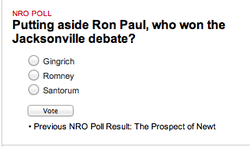 the Pew Research Center's Project for Excellence in Journalism. This week, less than 5 percent of all campaign stories focused on Paul, the lowest point since Dec. 11. when strong performances in Iowa and New Hampshire helped stoke some interest. Over the same period, Paul's performance in the polls has only improved, going from the single digits to 12.7 percent, putting him nearly even with Rick Santorum,
 Capital invested in them. Bain invested in Staples when it had only one store, so there were likely fewer than 200 employees at the time. Bain appears to have invested in the Sports Authority when it had fewer than ten stores. Unfortunately, there are no public data to say how many people were employed at that time. At the end of 1998, Staples had more than 42,000 employees, Sports Authority had almost 14,000, Gartner Group had almost 3,000, and Steel Dynamics had over 500. So at the beginning of 1999, when Romney left Bain Capital, these four companies alone employed almost 60,000 total employees. While some of the job growth at Sports Authority came from acquisitions, there is no doubt that these four companies created tens of thousands of jobs over the period.
 The Dish