A Three-Way Race In South Carolina?

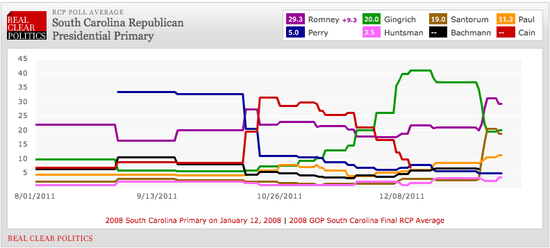
Screen shot 2012-01-12 at 10.37.20 AM

Since his triumph in New Hampshire, Romney has gone … south in South Carolina. Above is the poll of polls, to give a broad state of the race this week. But the movement in the one poll since Tuesday's primaries shows a radically tightening race, with Gingrich and Romney now tied for first, with 23 and 21, and Paul and Santorum neck and neck for second, at 13 and 14 percent respectively.

This is wide open. And Romney is eminently beatable. Among the under-20s Gingrich is beating Romney by 31 percent to 10 percent. Among those between 30 and 44, Santorum and Paul are vying for first place.

28 Minutes Later

Gingrich dutifully provides a mash-up of Romney’s best gaffes to suggest that he’d lose to Obama in the debates. As Jennifer Rubin notes, the “most delusional thing about Newt is that he thinks he would do well in debating Obama.” A Gingrich email blast yesterday warned of “a thousand years of darkness” if he doesn’t beat Romney. Ed Kilgore analyzes the brutal half-hour anti-Bain ad by Newt’s PAC :

You can make your own judgment, but this is one of the most devilishly effective attack communications I’ve personally ever seen–a heat-seeking missile aimed directly at the white working class id. 

Here it is, perhaps the 28 minutes that will kill the Romney candidacy. Make your own mind up:

Steve Benen has watched it:

The challenge for Romney and his team is both the video itself and the realization that the victims it highlights are not alone — for the next 10 months, Americans will be introduced to a whole lot of people and communities who suffered “when Mitt Romney came to town.”

Brains And Beauty

Contrary to popular belief, the intelligent aren't more likely to be ugly:

[T]he bulk of the evidence suggests that smart people are not "usually ugly." In fact, the opposite seems to be true: Either smart people are more beautiful than average, or dumb people are more ugly (or both). And while no facial features within the normal range could ever be that useful as a predictor of intelligence, people can perform better than you’d expect from random chance [at guessing intelligence] using nothing more than a head shot.

Should We Abolish AP Credits? Ctd

A resounding "no" from readers:

I have to strongly disagree with Michael Mendillo's piece disparaging the AP program. From my personal experience attending a shitty public high school in Florida (which has perhaps the worst public education system in America), AP classes were a saving grace that enabled me to get into Harvard. The AP tests gave me the opportunity to demonstrate academic ability independent of the laughable standards in my home state. For my tenured, unionized teachers, the AP tests incentivized them to actually work, since the state would grant them bonuses for good AP scores. I freely admit that AP is not as rigorous as a competitive college course, which is why selective schools will not grant credit. Nonetheless, taking even a quasi-college level class can be indispensable to later success. In my experience at Harvard, where I majored in chemistry and biology, most of my peers had taken a full slate of AP science courses; those who hadn't were seriously disadvantaged.

Another writes:

Mendillo argues that the College Board is somehow setting the curriculum for colleges, which is a pretty ridiculous claim.

Colleges can pick and choose which AP courses they accept for intro credit and which they don't. If the college decides something outside of the AP Computer Science A/B test should be in its intro-course curriculum, the college puts that outside-the-AP-course thing in its curriculum and then doesn't accept the CS A/B credit. If a college does accept an AP course for credit, it means the college has examined the AP course curriculum, compared it to its own intro-level curriculum, and made the determination that the AP curriculum is either identical to or greater in scope than that intro class. The College Board has no authority in that decision.

Another:

At the root of his argument is a belief that the type of learning done at universities is not possible for "students 15 to 18 years old." This is little more than ageist nonsense. The types of students who set out to take lots of AP exams are not the targets of general education requirements. They enter university with a broad range of interests, and these don't suddenly disappear when they start doing more advanced work. But, with the credit gained from AP exams, they can take real courses in other fields rather than having to sit through a 200-person lecture with a professor who won't learn many names and a graduate student TA who does all of the grading and most of the small-group and individual consultation with students.

Another:

I disagree with Dr. Mendillo's argument, particularly his assessment of introductory college courses. Essentially, his point is that unlike AP courses, college courses go beyond rote memorization of facts into the realm of meaningful interaction with scientists and their state-of-the-art research. And thus, it is a shame that students are allowed to AP out of classes that are not in their major. This belief diverges from reality.

Firstly, cutting-edge science has no place in an introductory science course. The goal of such a course is to provide students with the basic facts that form the framework of a discipline. Thus, almost all of an introductory college course must be focused on memorizing facts. There's no way around it if you want to educate your students properly. Moreover, introductory classes don't yield any meaningful interaction between professor and pupil. These classes everywhere are faceless throngs of students that are never taught by leaders in the field.

Which begs the question: if a non-major can get the same framework of facts in a more intimate setting and free up a semester or two for more advanced courses in their field of study… why is that a bad thing?

Another:

Because of my performance on AP testing, I was able to gain 20 hours of college credit at the large national university I attended. In the end, these credits allowed me to graduate one semester early, thereby saving me $10,000 in out-of-state tuition, and also allowed me to find full-time employment six months before I planned to. In all, these AP credits equaled to me over $20,000 in cost savings and the gain of a paycheck.

While high schools and colleges have broadened a dual-enrollment curriculum the last decade, it still lags in many parts of the country and many high school students are unable to take or afford college courses that can later be used as transfer credits. Until then, AP remains a cheap and viable way for high-achieving students to gain college credit while in high school.

Another success story:

By taking 10 or so AP classes while in high school, my daughter graduated from University of Georgia program in three years, saving around $25,000 in out-of-state tuition and living expenses. She is spending her "bonus year" traveling abroad and working several jobs to save money for medical school. She was fortunate that her high school was one of the top-rated public schools in the nation, and her AP classes were taught by college-level professors. She was able to get all the required basic courses out of the way, allowing her time in college to go deeper into her area of focus so that she double-majored, and had time for participating in volunteer work in her field and a part-time job.  Win win.
Who Are Hackers?

Biella Coleman, an anthropologist who studies the sub-culture, provides a primer:

It is true that hackers can be grasped by their similarities: they tend to value a set of liberal principles: freedom, privacy, and access; they tend to adore computers—the glue that binds them together; they are trained in specialized and esoteric technical arts, primarily programming, system administration, security research, and hardware hacking; some gain unauthorized access to technologies, though the degree of illegality greatly varies; foremost, hacking, in its different forms and dimensions, embody an aesthetic where craft and craftiness tightly converge and thus tend to value playfulness, pranking, and cleverness and will often perform their wit through source code or humor or even both: funny code.

Why Are White Men Singing Less? Ctd

A reader writes:

Are white men really less present in music? On the Top 40 pop charts, sure. But Country? Nope. Nine of ten there, with the tenth being an all-white mixed-gender group. What about Rock? Nope. Ten for ten there. How about Adult Contemporary? Parity: five of ten for white guys, four white women, and one all-white mixed-gender group.

It seems that what Dr. Science has quantified is not the disappearance of white men from popular music, but the takeover of dance and R&B/hip-hop of the Top 40 radio format – which did indeed occur in the late '80s. Those genres have long been dominated by women and black performers, respectively, so it should be no surprise that when "Top 40" switched from playing music in the then- and still-white-men-dominated rock tradition to playing music from the dance and R&B/hip-hop traditions, we would hear a lot fewer white men on Top 40 radio.

Another writes:

Perhaps white males are not charting in proportion to their numbers because today's music industry is driven less by vocal talent and more by identity and sexuality. 

Hip Hop fans are somewhat obsessed with the artists street cred and it is a genre that does not exactly push the envelope vocally.  You can see the influence of sexuality when you compare the looks of today's top 40 females with those of the pre-MTV 70s.  I love Carole King, but nobody wanted to see her writhing across the stage in her underwear.  So, that leaves room for only so many dorky white guys.

Along those lines:

Since you're only considering chart-topping songs, isn't the real question "Why are white male singers being marketed less?"?

Another reader:

In the US, black has long been constructed as an identity that was essentially opposed to mainstream culture. But we've been undergoing a process in which the nation is becoming increasingly racially inclusive, which includes trends like white people moving back to "inner-cities," increasing exposure to diverse cultural outlooks via the internet, and increasing numbers of Americans claiming mixed-race identities on the census.

The increasing inclusiveness explains why more Americans are interested in listening to diverse types of music. The fact that a "black" identity has historically been constructed in opposition to mainstream culture explains why it's easier for non-white artists to be considered "cool" or "edgy." In the past, the "edginess" of black music was popular, but often filtered through white artists who were more acceptable to mainstream audiences.

Hip-hop is you America!

Save The Cows!

Eric Andrew-Gee is more concerned about slaughterhouse practices than about seal hunting or bullfighting:

Yes, a bull’s death in the ring is more painful than a cow’s death in a slaughterhouse, and I don’t wish to excuse the brutality of this tradition. But slaughterhouses often provide animals with a gruesome death, too. According to a 2008 federal audit, the stun guns meant to knock cows out before they’re killed sometimes don’t work, which means animals end up being cut into pieces while fully conscious. And this raises another question: Why is the brutality of the animals’ death set above the brutality of their lives? Shouldn’t we be more concerned about animals with a terrible quality of life and an often-miserable death than about harp seals and fighting bulls, which have charmed lives but more starkly violent deaths?

I explained my attitudes on meat-eating and factory farming here.

Campaign Signs Might Actually Help? Ctd

A reader writes:

As a working organizer, it surprised me that the principal effect organizers are going for wasn't mentioned in the article or contemplated by the study. The effect we look for when asking a supporter to participate in a visibility campaign is an increase in the commitment of the supporter. Having taken the step of contributing resources – whether money or lawn space – to the campaign, a supporter has a personal investment in the success of the campaign and so is likely to do more. Sometimes this means more donating (and since donations are quantifiable, many campaigns focus on that), but what it will almost always mean is that the supporter will be motivated to advocate for the candidate among friends and family. That advocacy, which comes with commitment, is where the real persuasive value of lawn signs lies.

The Daily Wrap

Today on the Dish, Andrew loved Ron Paul's attempt to make it a two-man race of ideas (with the help of a pithy reader and some sympathetic writers), saw conservatives opening up to Paul, labelled the killing of an Iranian nuclear scientist terrorism,  went after the NYT for refusing to outright do the same and defended himself on the point against readers, remembered the past 10 years of Gitmo, and caught Mitt in a lie about his gay rights record. We compiled reax to Romney's romp in New Hampshire, looked to South Carolina for his Lee Atwater moment, thought the primary schedule might hurt the GOP with Hispanics (Florida notwithstanding), saw more evidence of a GOP enthusiasm problem, kept tabs on pundit and reader debates over the Bain days, and wondered what the hell Perry and Gingrich thought they were doing in the race.

 Iran's Hormuz hawkishness was counterproductive, the case to strike Iran lacked a compelling endgame, Russia enabled Assad's bloodthirst, Ike seemed (contra Andrew's view) to be something of an interventionist, and Scotland may have wanted out of the UK. Employer-based healthcare limited your ability to fire your insurance company, layoffs weren't firings, the GOP hamstrung the IRS, Wall Street was (huge shock here) unpopular, rich people shoplifted, we lived in a time of short-term jobs, people thought about giving up on the stock market, and one man boldly proposed to save the economy with free ponies. The History Channel failed at, er, history, burglars stole computers, mothers absorbed baby DNA, pot was kinda good for you, a dude took a self-portrait every day for 13 years, AP credits were debated, and readers kept on discussing Amtrak and conservative environmentalism.

Attack Ad of the Day here, Hewitt Nominee here, Quote for the Day here, AAA here,  VFYW here (with neat reup from yesterday's contest winner here), Face of the Day here, and MHB here.