Why You Can’t Fire Your Insurance Company

Pivoting off the Romney gaffe, Peter Suderman points to the main reason insurance choice is limited:

The tax exclusion for employer sponsored benefits has shaped the American health care market for decades, locking people into job-based insurance, decimating the individual health insurance market, and making it difficult for people to pick a health insurance plan early in life and then stick with it. Romney frequently talks about wanting to make health insurance work more like a market, but neither he nor any of the other Republicans have proposed getting rid of the tax exclusion for employer-provided benefits.

(Democratic Sen. Ron Wyden, who recently teamed with GOP Rep. Paul Ryan on a joint Medicare reform plan, proposed shifting away from employer-sponsored health insurance as part of The Healthy Americans Act in 2008.) There are obvious political reasons for avoiding the topic: Along with the home mortgage deduction, the tax break for job-based health insurance is among the most popular tax breaks. But it’s responsible for a big part of the mess the American health care market is in, and yet no one really wants to touch it. 

Ike The Interventionist

A reader writes:

I respect your choice of Eisenhower as #1 president for the past century, but I do have to dispute one point you made: Eisenhower not only would have proceeded with Bay of Pigs, but was the final authority in the creation and structuring of the plot from the beginning. While the CIA and Dulles crafted the plans that led eventually to the idea of invasion, Eisenhower approved all of their machinations and saw that they were funded. Finally, the invasion idea itself was either concocted by Eisenhower or enthusiastically endorsed by him, and he and was prepared to persuade President-elect Kennedy of the invasion plan's likely success.

More on Ike's role here. Historian Mark Byrnes counters me with more facts. Another reader:

Did Eisenhower not, in 1953, authorize a CIA mission to depose Mossadegh in Iran? Did he not, in 1954, authorize the CIA mission that led to the overthrow of Jacobo Arbenz in Guatemala? The success of these actions, which had long-term negative consequences in both Iran (and we are still dealing with that today) and Guatemala, was a huge part of the reason that elements within the U.S. government were confident of the success of the Bay of Pigs.

They are the precursors to the Bay of Pigs, but even leaving aside their role in setting the stage for the Bay of Pigs, the CIA's involvement in the overthrows of Mossadegh and Arbenz had huge negative consequences long-term for the United States and for the respective countries involved. Given that this is the case, why do you insist on holding onto this image of Eisenhower as a passive president who avoided the very kinds of entanglements that his government, in many respects, pioneered in the 1950s? I think your view of Eisenhower is far too romantic and uncritical.

Another adds to the list:

In 1958, Eisenhower and the U.S. military got involved in Lebanon to protect the regime from what he deemed as a threat by international Communism. When the Eisenhower Doctrine is considered, it would make perfect sense for Eisenhower to proceed with the Bay of Pigs invasion. Quote from Eisenhower’s 1957 speech that outlined the doctrine:

… to secure and protect the territorial integrity and political independence of such nations, requesting such aid against overt armed aggression from any nation controlled by international communism.
Why Do The Rich Shoplift?

Kathryn Westcott explores the paradox: 

[Barbara Staib of the National Association For Shoplifting Prevention in the US] explains that while other people might turn to alcohol, or binge eating, others turn to shoplifting. "Some people are trying to find solace in shoplifting," she says. "It gives them the 'rush', a 'high' – it can be a relief, if only a temporary one, as they suffer remorse afterward, when they get caught. "These are people who go into a store and the opportunity arises. For some reason they rationalise, they convince themselves that it's OK – for that moment. This is maladaptive behaviour – a way of coping with things."

NYT Fail

They refused to use the word torture to describe torture because it offended Republicans. Now they refer to an incident in which a mysterious figure on a motorcycle sticks a highly sophisticated bomb on the side of a car in Tehran, assassinating a scientist, and it's not an act of terrorism. It's an act of "terrorism". Maybe they're just using it in the British fashion to indicate the Iranians are merely describing it thus. But what word would the NYT use to describe a targeted car bomb, if, for example, it was planted by Hamas in, say, Tel Aviv or New York and killed a government scientist? Seriously, this matters. If this was not an act of terrorism, designed to create terror among scientists and others in Tehran, then it was an act of war.

My fear is that this is state terrorism directed by Netanyahu, in an attempt to increase tensions to bring about the full-scale war against Iran's nuclear program, over Washington's objections. But once US allies sanction car-bombing assassinations, it is legitimizing their use by others here. You reap what you sow.

What The Hell Is Gingrich Doing?

The full half-hour hit piece against Romney from Gingrich's PAC can be viewed here. Bernstein tries to discern Newt's strategy:

[M]aybe, as some have said, it's just blind rage revenge against Mitt Romney, even if by staying in he's actually helping Mitt. After all, Newt is a great snake oil salesman, but not a particularly good strategist, whatever he constantly says about himself.

Massie is on the same page:

[I]f nothing else, Newt's kamikaze assault on Romney won't make him the nominee even were it to be successful. That's one of problems with kamikaze missions, you see. So the only people who really beneift from this are Newt's other rivals and, more importantly, Barack Obama.

Why The GOP Can’t Reach Hispanics

Carlos Hanson partially blames the primary schedule:

Latinos make up only about 2 percent of Iowa's population; even less in New Hampshire. Nationally, though, Hispanics account for about 16 percent of the population. More than 21 million are eligible to vote — although, right now, only about 11 million are actually registered. … Florida alone will award more delegates to the winner — 50 — than Iowa and New Hampshire together. And Latinos constitute about 14 percent of voters there. That's not enough to single- handedly win an election, but it's enough to sway the outcome. That primary, on Jan. 31, will say a lot more about who Hispanics like in the Republican field than the three contests that came before it. But what it might do is knock out a candidate who has shown he cares about Latinos. A poor enough showing in New Hampshire could permanently damage a candidate's chances to bring in money to continue, even if he doesn't drop out.

Today In Syria: Russia’s Role

A rare CNN report from inside Syria provides valuable footage of protests on the ground. It's important to keep in mind how dangerous it is to produce such dispatches: French journalist Gilles Jacquier was killed today covering the violence in Homs (EA has compiled a tribute to him here). If you wonder where the Assad regime is getting the weapons to continue murdering people for so long, look to Russia. Hussain Abdul-Hussain has more on that country's Syria policy:

Moscow has a clear interest in the survival of the regime of President Bashar Assad, a major importer of Russian arms. Syria reportedly buys 10 percent of Russia’s annual arms exports at a cost of $1 billion. In Libya, Russian arms makers lost close to $4 billion in contracts with the downfall of Moammar Gadhafi. Moscow is keen to prevent a repeat in Syria…Should the Arab mission be deemed a failure, world opinion would certainly tilt in favor of U.N. intervention. In that case, Russia would find itself alone at the U.N. fending off another Western diplomatic offensive. Meanwhile, indicators show that Assad’s grip on power is weakening and his finances – needed to keep his military machine going – deteriorating. In a second diplomatic showdown at the U.N., expected in February, Russia might not rush to Assad’s defense and could instead compromise with other world powers over his removal.

Right now, of course the UN isn't doing much of anything. EA flags a series of humor videos made by the Syrian opposition and Zeinobia reviews an old documentary about the Hama massacre. Here's a large funeral/protest in Deir ez-Zour:

Here's another one in Hama:

Finally, these are a protestor's last breaths after being shot in the head in Homs:

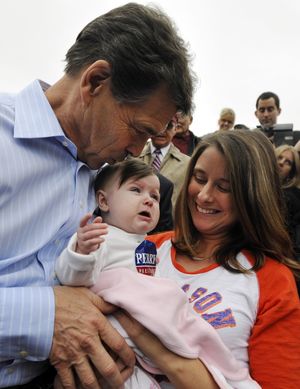
What The Hell Is Perry Doing?

Matt Glassman explores explanations for Perry's seemingly inexplicable choice to stay in the race:

It’s not hard to imagine someone like Perry coming out of Iowa thinking 

136577135Well, it’s really long odds now, but that’s better than nothing, and definitely better than the embarrassment of dropping out.  And besides, if I stay in at least I might be able to prevent that pompous Gingrich from winning South Carolina. And that wouldn’t be the worst chit to have in my pocket during the Romney administration, especially if I can influence his immigration policies.

In my personal experience, this sort of political thinking is more common than most observers think. Candidates at all levels of politics can be romantics about their chances of winning far past the point of any viability; anyone who gets this far almost certainly feels like fate is on their side. But most candidates can also credit their success to harnessing opportunities and salvaging victories even in defeat. And all of this serves to remind us how complicated political strategy can be, and how little we can sometimes say absent a full understanding.

(Photo: Texas Goveronor Rick Perry kisses 7-month-old Elaina Stephens, as her aunt Candi Tennyson looks on, during a campaign stop at the Beacon Drive-In January 8, 2012 in Spartanburg, South Carolina. After suffering a fifth place finish in the Iowa caucuses and essentially skipping New Hampshire, Perry has returned to the campaign trail in South Carolina with events for the next several days in hopes of keeping his candidacy alive. By Rainier Ehrhardt/Getty Images.)