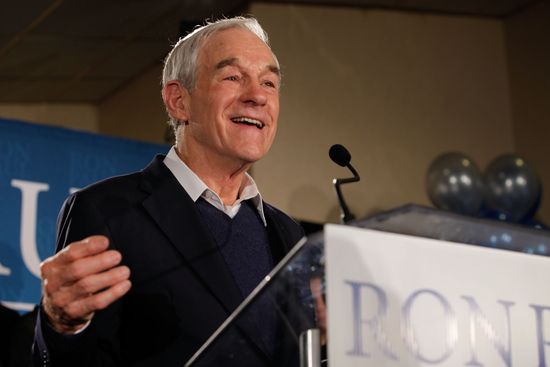
The cheers of Ron Paul's supporters:
Brian Doherty celebrates Paul:
The giddy spirit of the Paulistas will march on; every single one of the youth volunteers I spoke to, whether the ones put up by the campaign in hotels or sleeping on Free Staters floors, said they were quite confident they'd be moving on to work for Ron Paul's victory in South Carolina, in Nevada, in Maine, in Massachusetts, in New York, in Florida. As I moved through the Paul fans' resolute and well-earned good cheer and joys and in-jokes of weary gangs who have been through the wringer together, I started thinking: how will the significance of what's going on here with the Paul movement continue to be misread or ignored?
Jim Fallows compares Paul's and Huntsman's speeches:
The difference between the Ron Paul and Jon Huntsman "victory" speeches just now is the difference between someone (Paul) who didn't actually expect to win the nomination and was mainly advancing a cause, and someone (Huntsman) who must have entertained dreams not simply of an upset in New Hampshire but of going all the way.
Alex Massie ponders the inevitability of Romney:
Sure, something could happen to defeat Romney. Sure, he's not a compelling front-runner. Sure, there are reasons to be worried that turnout in the GOP contests thus far has been lower than might have been predicted a year ago. And, yeah, you look at Romney and you think that, well, even if he's not wholly underwhelming he sure ain't greatly whelming either. But who else is there? Asking the question reveals the gaping horror at the heart of this process: there is no-one else.
Jonathan Bernstein thinks the race is almost over:
The problem is that both Santorum and Perry have shown themselves to be such weak campaigners that even with a hefty boost, it seems unlikely they could defeat Romney. And if that’s the case, and if party actors believe that’s the case, then it’s far more likely that they either remain quiet or even shut things down by supporting Romney. All in all, it’s not quite over yet, but it’s getting very, very close to being over.
Nate Silver calculates Romney's odds in South Carolina:
I’m not quite ready to say that Mr. Romney has the nomination locked up, but when you evaluate the known unknowns, they don’t seem that threatening to him. We may be nearing the point where an unknown unknown — a heretofore unexposed scandal, a major gaffe, an “oops” moment in a debate — is what it would take to trip Mr. Romney up.
Bill Kristol hasn't given up:
Now it's on to South Carolina, where the ball is in Rick Santorum's court. Can he leave Gingrich behind and become the conservative alternative to Romney? And can he actually beat Romney there? I think that's more possible than does almost everyone else I've spoken to tonight. But I'll grant that lots of things that are possible don't actually happen.
John Hood differs:
I enjoy political spin. I practice political spin. I helped create and work on a 14-year-old TV show with “Spin” in the title. But there are limits to spin. It has to have some connection to facts that readers and viewers can readily see for themselves. Downplaying the significance of Romney’s early victories is foolish.
Daniel Horowitz is furious that Romney is likely to win:
After three years of campaigning against Obamacare, we are on the verge of elevating the Thomas Edison of anti-free-market healthcare to the party’s highest honor. With the presidential election going downhill, it is probably time to apply our Tea Party energy to the congressional elections. In the coming days we will redouble our efforts here at Red State to elect conservative members to the Senate and House.
Peter Beinart analyzes Romney's misguided attacks against Obama in his victory speech:
In recent presidential elections, successful candidates have picked up on something that many Americans already suspected about their opponent, and used it to negatively define him. Reagan did that with Carter’s pessimism, Bill Clinton with George H.W. Bush’s lack of connection to the economic struggles of ordinary Americans, George W. Bush with John Kerry’s lack of core conviction. If there’s a worry that Americans already have about Obama, it may be that he has spent too much time in an ivory tower and he doesn’t really understand American business. That’s a critique that Romney would be well positioned to level, though it’s also an invitation to scrutinize his own business career. The pessimism claim, by contrast, feels manufactured and inauthentic, which if Romney isn’t careful, may become the American people’s narrative about him.
First Read looks at turnout:
For the second-straight contest, GOP turnout was pretty pedestrian, especially given the party’s supposed enthusiasm about defeating Obama in November. With 95% of precincts in, turnout in last night’s Republican primary in New Hampshire was slightly under 240,000, which is about the same as it was it was in 2000 and 2008. While turnout will increase once the other 5% comes in — setting a record just like it did in Iowa — it won’t be a WOW figure like we saw on the Democratic side in ’08.
Dave Weigel has a case of deja vu:
I'm thinking of a Republican primary. It starts with a candidate (John McCain/Mitt Romney) who ran once before, came in second place, and won over the party's elite class without winning over its base. Other candidates, understandably unwilling to accept this, line up: An under-funded social conservative (Mike Huckabee/Rick Santorum), an elder statesman who's walked to the altar three times (Rudy Giuliani/Newt Gingrich), a libertarian who wants to bring back the gold standard (Ron Paul/Ron Paul).
Jonathan Chait sees the same parallel:
Conservatives came out of 2008 haunted by their failure to coalesce around a single candidate, allowing the candidate they least trusted to gain early victories against a divided field and win unstoppable momentum before they could gain their footing. They are living their nightmare again.
Michelle Malkin is more succinct:
Who wants nose plugs?
Ross Douthat considers the also-rans:
If Romney loses to Barack Obama, the Republican Party is not going to nominate Rick Santorum in 2016 when it could nominate Chris Christie or Jeb Bush. Nor will it reconsider Newt Gingrich or Rick Perry when it could fall in love with Marco Rubio or Bobby Jindal. In the end, there’s only one potential second-placer in this field who can plausibly claim to be making a down payment on the future. And that future’s name is Rand Paul.
Jim Burroway notes that the most anti-gay candidates flopped:
[T]wo of the three top finishers have kept the National Organization for Marriage at arm’s length. Yes, Romney signed and won the primary, but 40% of the the GOP’s own voters backed candidates who didn’t. What’s more, audiences openly booed Santorum’s making The Gays a central talking point of his campaign, making that the most visible indication of how Granite Staters feel about anti-gay politics.
Ezra Klein believes that moderation is winning the Republican primary:
[Romney] is, of the Republicans running for president, the least extreme in his policy proposals, and also the most likely to capture the nomination. If Huntsman counts as a moderate, then so does Romney — and so, in their presidential preferences so far, do a plurality of Republican primary voters. They have, after all, not only backed Romney, but they have decisively rejected Rick Perry and Michelle Bachmann, the candidates aimed most squarely at Tea Party wing of the GOP.
Matt Yglesias counters:
[W]e should be clear that one of the main reasons Romney is in a commanding position is that his conservative critics have had difficulty identifying any concrete ways in which a non-Romney in the White House would lead to more conservative outcomes than a Romney administration.
Amy Davidson asks why so many candidates are still running:
Is what’s keeping at least some of the candidates in the race—or “the hunt,” as Huntsman called it—not the illusion of victory but the sheer joy of knocking things down? Grown men don’t have as many opportunities as they might to act like toddlers. This isn’t a train going to South Carolina or to anywhere in particular. It’s a set of careening bumper cars. The question, and not just for the Republican Party, is when it becomes a demolition derby.
Ed Kilgore is focused on negative ads:
The big question now is whether conservative opinion-leaders, who have basically resigned themselves to Romney as nominee, begin to denounce Gingrich for his anti-Romney nastygrams in SC. If they fail to do that, it might tempt the struggling survivors of the competition so far–not only Newt, but Paul, Santorum and perhaps even Rick Perry, who desperately needs a southern breakthrough fast–to go collectively nuclear on Mitt.
And Matt Steinglass implores journalists to break with tradition:
How about we spend a few months trying to find out what Mitt Romney would actually do as president, and whether his policies would be beneficial? I think it would be especially worthwhile to devote some effort to this because it's unusually difficult to figure out what side of various issues Mr Romney is on, or what side he's on at the moment, or what side he'll be on by the time the general election really gets rolling this summer.
 The Dish