Today In Syria: Assad’s Speech

The dictator gave a bizarro-world address to the nation today that, judging by the Syrian responses, doesn't appear to leave much room for compromise. Daniel Serwer parses the speech:

The President’s response in his first public statement in more than six months is to double down, attributing the rebellion to the international conspiracy rather than the international effort to force him out to his method of dealing with what originated as a nonviolent rebellion.  He is not being obtuse.  He knows perfectly well what is going on in the streets.  He is trying to survive by rallying nationalist Syrians, especially minorities that fear a Sunni Islamist takeover, against the internationals.

Amal Hanano is ready to declare the Arab League mission a failure. Dominic Evans worries the Free Syrian Army has control over the armed opposition. Tamer Mallat blasts failures in opposition strategy:

The uncertainty left open has also allowed alternate opposition groups to gain considerable visibility. Such is the case with the National Coordinating Committee which disfavors any kind of tangible action taken that could potentially dislodge or facilitate the fall of the regime. Over the past months, the Syrian National Council, in a bid to gain political leverage abroad by heeding calls to unify the opposition, has taken unnecessary measures to coordinate with the NCC. Instead of alienating a group that spends more time criticizing Syria’s Revolution and opposition than finding ways to topple Assad, the SNC has in the process compromised many of its goals, weakening its cohesion and credibility.

David Kenner analyzes an odd story about pro-Assad Alawite refugees potentially domiciling in Israel.  Here's some kids singing "liar, liar" while Assad gives his speech:

It's probably good the kids' faces weren't shown – here's another video making the rounds of an infant tortured to death:

These victims of Assad are prepared for burial:
America Isn’t A Company

Dan Drezner declares that business savvy doesn't predict presidential effectiveness:

The thing is – and this is kind of important — governments are not corporations.  I cannot stress this enough.  There's the obvious point that in democracies, legislatures tend to impose a more powerful constraint than shareholders, making it that much harder for leaders to execute the policies they think will be the most efficient. … There's been a lot of bragging in the 2012 primary about candidates that have "real world" business experience, and how that translates into an effective ability to govern.  That logic is horses**t.  Being president is a fundamentally different job than being a CEO — because countries are not corporations. 

Huntsman’s Humble Brags

GT_HUNTSMANDRIVING_120109

Alec Macgillis evaluates the style of the "low-energy goober" on the stump: 

[H]e has become that sort of underdog candidate who tries desperately to make a virtue of his humble standing, who chalks his failure up to his courage to utter truths that are, in many cases, far less bold than he makes them out to be. … Making the humble-little-me tone of lines like these all the more noticeable is the delivery and body language that accompanies them — an aw-shucks monotone; the head tucked forward, turtle-like, to suggest modesty; the mouth turned down at the edges and the eyes opened wide and cast low; all of it adding up to a lugubrious expression at dissonance with the pert metrosexual look of the speaker's slim jeans and matching black and silver belt, black and silver watch and black and silver hair combed sharply back. 

Larison adds two cents.

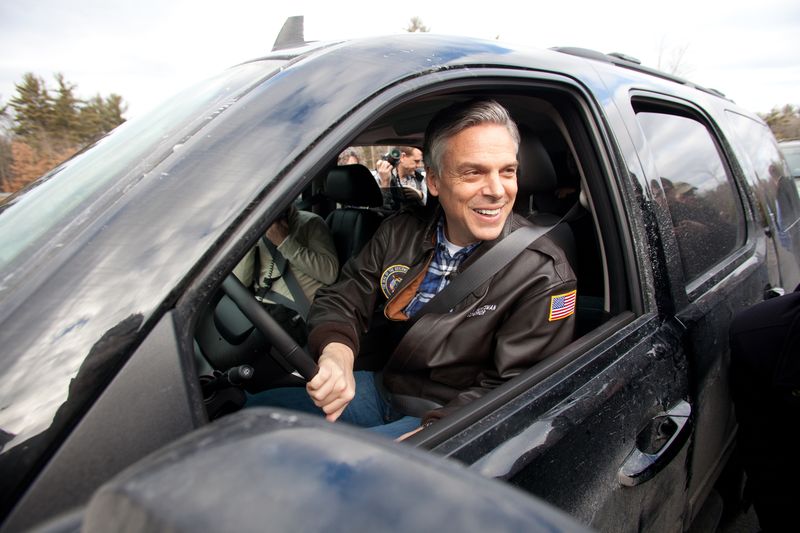
(Photo: Republican presidential candidate and former Utah governor Jon Huntsman smiles as he drives away from a campaign stop at the Bean Towne Coffee House on January 08, 2012 in Hampstead, New Hampshire. Polls show Huntsman gaining on front runner Mitt Romney ahead of Tuesday's primary. By Matthew Cavanaugh/Getty Images)

Face Of The Day

136695691

A supporter of U.S. Congressman Ron Paul (R-TX) waits outside Webster Elementary School for Paul's arrival on January 10, 2012 in Manchester, New Hampshire. According to recent state-wide polls, Paul is in second place in a field of six hopefuls but still lags behind former Massachusetts governor Mitt Romney by more than 20 percentage points in this New England state. By Andrew Burton/Getty Images.

Romney Paints Self Into Corner On Bain Numbers

Ezra Klein says Mitt has made two major mistakes:

First. he’s committed himself to generating a figure he can’t prove through honest, rigorous means — Glenn Kessler gives his jobs claims so far three pinocchios – and that’s making him look slick and untrustworthy.

Second, he’s framed the success of his tenure at Bain around job creation rather than wealth creation — and Bain, as many of its actions and former employees will testify, was not in the job creation business. As Kessler notes, the Bain prospectus says "The objective of the fund is to achieve an annual rate of return on invested capital in excess of the returns generated by conventional investments in the public equity market and the private equity market.” It never mentions "jobs," "job," or "employees." Those simply aren’t the objective. Sometimes, in fact, they’re collateral damage.

Will Romney Beat His Personal Best Today?

John Heilemann reminds us that Romney won 31.6% of the vote in New Hampshire in 2008. He thinks Romney must exceed this percentage to get a decent bump going into South Carolina:

The expectations game no doubt drives some readers crazy, but there is no getting around it. And while the expectations in question are set unscientifically, they are neither wholly subjective nor wildly irrational.

What the press and the rest of the political class are focusing on are a pair of related metrics: the percentage of the vote and the margin of the victory that Romney claims compared to his performance in 2008. In the aftermath of the caucuses in the Hawkeye State, please recall, the credit given to Romney for his victory was tempered slightly (and fairly, I think) because of its astonishing eight-vote narrowness and the fact that he won no higher a percentage than he did four years ago — despite being the national front-runner and a thoroughly known commodity this time around. If something similar (or worse) occurs in New Hampshire, the nagging questions about Romney's strength as a presumptive standard-bearer will persist and might even be exacerbated.

Nate Silver's final projections look good for Romney.

Campaign Signs Might Actually Help?

136683768

Sasha Issenberg assembles evidence:

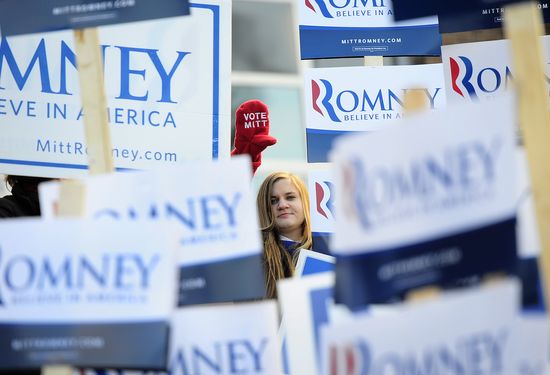
Under some circumstances, they can motivate people to vote. Before New York City’s  2005 mayoral election, Fordham University professor Costas Panagopoulos decided to take his curiosity about the effectiveness of signs to the streets. In the only known randomized academic experiment on the subject, Panagopoulos matched 14 pairs of Manhattan voting locations with similar turnout levels in previous elections. In each pair, he randomly designated one location as a control and the other as an experimental treatment: a small group of volunteers were dispatched to a nearby intersection, where they stood for 11 hours on election eve with white 2-foot -by-3-foot signs with "VOTE TOMORROW" written in blue. Once the polls had closed, Panagopoulos checked the numbers of votes cast in each of the 28 districts, and found that the ones visited by his sign-wavers had 37 percent turnout, nearly four points higher than those that didn’t. 

Panagopoulos attributed that boost to the value of a quick reminder and speculated that seeing one’s neighbors publicly promoting the cause might instill a sense of social pressure to vote. That’s why Panagopoulos designed his experiment to measure if signs could change behavior on the boulevard, rather than just inspiring an already convivial small-town Main Street. “Detecting environmental effects in New York City, the epitome of urban anomie, would produce more convincing evidence,” Panagopoulos wrote.

(A Republican presidential hopeful Mitt Romney supporter expresses her opinion outside a polling station at Webster School in Manchester, New Hampshire, on January 10, 2012. By Emmanuel Dunand/AFP/Getty Images)

Defending Romney’s Role At Bain, Ctd

Like several Dish readers, Avik Roy praises Romney's business record:

It is true that the money that [leveraged-buyout (LBO)] firms draw out of an acquired company — in the form of dividends and management fees — will always look bad in a situation where the turnaround fails. It will be up to Romney to defend this practice. But it’s important to remember that LBO firms have every incentive to avoid letting their investments fail: After all, they stand to make far more money if their turnarounds succeed.

Similarly, Bainbridge defends Romney's firing people while working at Bain. Frum seconds him:

The fact is, presidents (being politicians) get into much more trouble because they hesitate to fire than because they overenjoy it. Donald Rumsfeld lasted for years after it became apparent that his management of the Iraq War was failing. President Obama won't take action against Eric Holder, not after he bollixed the trial of Khalid Sheikh Muhammed, who has to date faced neither the promised civilian trial nor the substituted military commission. It was son George W. who had to carry the message to White House Chief of Staff John Sununu that he must go, because President George H.W. Bush could not bear to do it. For 13 miserable years, Franklin Roosevelt flinched from firing an incompetent and obnoxious White House cook.

Electability: How Romney Dispatched Gingrich

Romney_Intrade

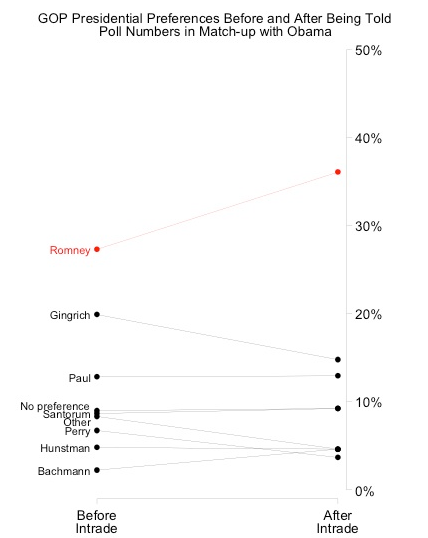
John Sides and Alex Lundry summarize a recent experiment where they showed GOP voters the candidates' chances, according to Intrade, of winning the nomination and beating Obama:

[Romney's] projected performance against Obama is the best of any candidate (49%) and he is the only one who benefits from providing respondents this poll number.  His vote share increases from 27% to 36%.  Interestingly, however, the 36% figure is actually lower than was his support among respondents shown only his chance of winning the primary …  This could be because the polling numbers were somewhat more equivocal: only 5 points separated Romney from the Republican who is predicted to perform the worst against Obama (Bachmann, at 44%). 

In a follow-up, Sides argues that the research shows "[c]ommentators have consistently underestimated Romney’s appeal within the party."

The World’s Greatest Abusers Of Executive Power Decry Abuses Of Executive Power

John Yoo and David Addington, among the main legal architects of Bush's executive power grab, think Obama's recent appointments are an abuse of power. Adam Serwer is flabbergasted:

Watching two men who argued for years that the president could pick and choose which laws to follow wring their hands over Obama's recess appointments as an abuse of power is so absurd that one practically has to reach into fiction to find parallel analogies. If we could only get Lex Luthor's feelings on financial regulation or Emperor Palpatine's thoughts on the importance of checks and balances.

My flabber was gasted a long time back with these shameless criminals – and the Washington that salutes, reveres and rehabilitates them.