Why Are White Men Singing Less?

Pivoting off the above video, Doctor Science finds data suggesting that white males are singing an increasingly small percentage of chart-topping songs. She wonders why this is:

There's a paradox here, it seems to me. The majority of top-25 hits in recent years are one variety or another of hip-hop, very broadly speaking. I assume that young white males are still a huge segment of the music market, though I can't find specific figures. Logically, then, I'd expect white guys to be buying a lot of hip-hop, as everyone else does. So why aren't they *singing* it? Why would white guys prefer not to hear white male voices? Or is it a supply problem, such that white guys who try to make a career of music have fundamentally different tastes than the much larger group of white males who *buy* music? Or has music become something that isn't considered cool or worthwhile for white boys to do for a career? That's really hard for me to believe, frankly.
The Spooks Plead Not Guilty

Paul Pillar, who served in the CIA for decades, blames its failures on bad leadership rather than bad intelligence:

Had Bush read the intelligence community's report, he would have seen his administration's case for invasion stood on its head. The intelligence officials concluded that Saddam was unlikely to use any weapons of mass destruction against the United States or give them to terrorists — unless the United States invaded Iraq and tried to overthrow his regime. The intelligence community did not believe, as the president claimed, that the Iraqi regime was an ally of al Qaeda, and it correctly foresaw any attempt to establish democracy in a post-Saddam Iraq as a hard, messy slog.

Where Does Consciousness End?

76396287_9f182eac94_b

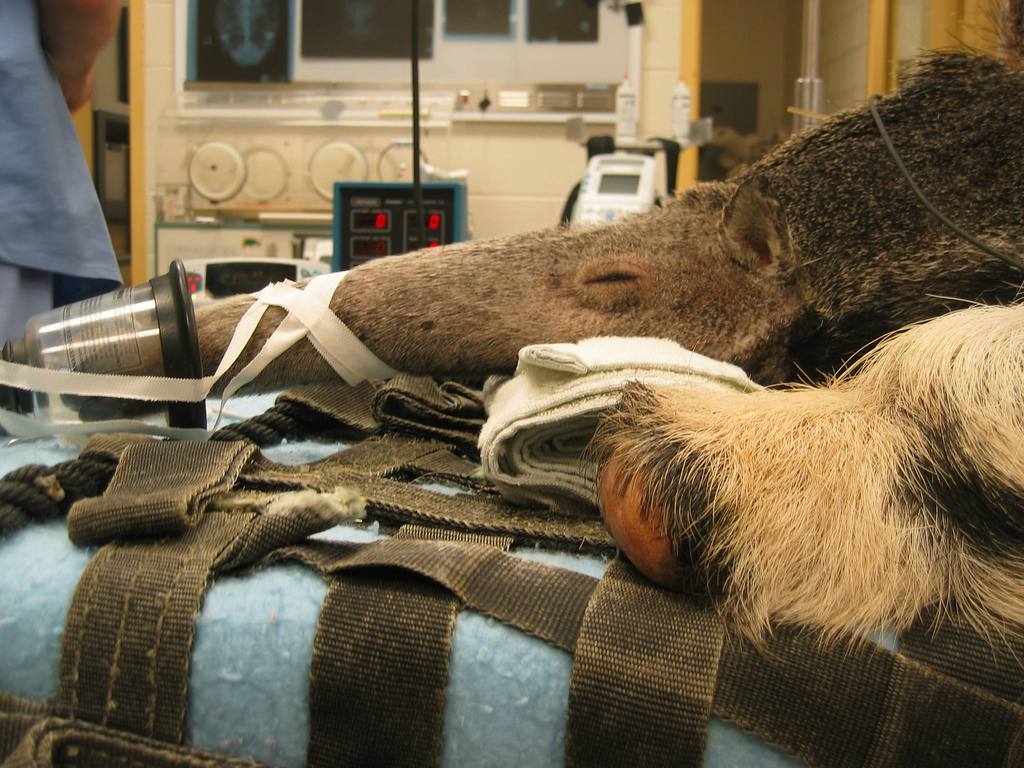
Vaughan Bell explores what anesthesia can tell us about our minds:

Doctors don’t want people to regain awareness during surgery because the experiences may be frightening and even traumatic. But on a purely scientific level, these fine-grained alterations in our awareness may help us understand the neural basis of consciousness. If we could understand how these drugs alter the brain and could see when people flicker into consciousness, we could perhaps understand what circuits are important for consciousness itself. 

Courtney Humpries delves deeper.

(Photo by Flickr user lhooq38)

Who Is Mitt Romney?

A profile by Michael Kranish and Scott Helman is well worth reading in full. An excerpt that undermines Romney's claim that he created 100,000 jobs:

Assessing claims about job creation is hard. Staples grew hugely, but the gains were offset, at least partially, by losses elsewhere: smaller, mom-and-pop stationery stores and suppliers were being squeezed, and some went out of business entirely. Ultimately, Romney would approvingly call Staples "a classic ‘category killer,’ like Toys R Us." Staples steamrolled the competition, undercutting prices and selling in large quantities. When asked about his job-creation claim during the 1994 Senate campaign—that he had helped create 10,000 jobs at various companies (a claim he expanded during his 2012 presidential campaign to having "helped to create tens of thousands" of jobs)—Romney responded with a careful hedge. He emphasized that he always used the word "helped" and didn’t take full credit for the jobs. "That’s why I’m always very careful to use the words ‘help create,' " he acknowledged. "Bain Capital, or Mitt Romney, ‘helped create’ over 10,000 jobs. I don’t take credit for the jobs at Staples. I helped create the jobs at Staples."

Howard Anderson, a professor at M.I.T.’s Sloan School of Management and a former entrepreneur who has invested with Bain, put it more plainly: "What you really cannot do is claim every job was because of your good judgment," he said. "You’re not really running those organizations. You’re financing it; you’re offering your judgment and your advice. I think you can only really claim credit for the jobs of the company that you ran."

The Origins Of Epidemics

Karl Smith believes that "overwhelmingly the presumption should be that epidemics have a single precipitating factor." He applies "epidemic" broadly:

People are sometimes confused by the fact that complex conditions have a long list of necessary factors. However, the odds against more than one necessary factor pushing the phenomenon across the line into epidemic at the exact same time are astronomical. Not to go to far astray but this is why recessions likely have a single precipitating factor. They spread too fast and burn out too quickly to be multi-casual. A fifty year period of off and on stagnation, that might be multi-causal. An 18% collapse in industrial production over 18 months? That has a vector.

Will Amtrak Always Be Broke? Ctd

A reader writes:

There is no passenger train system in the developed world that makes a profit.  All are government-subsidized because they are a public service, like roads or airports or sewers.  But in America, generations of Republicans saying that passenger rail, like the Post Office, must somehow be profitable or be eliminated has conned people into expecting Amtrak to make money. It can’t; it won’t; it never will.  But it shouldn’t have to, no more than the Interstate Highway system should.

Another writes:

Public transit everywhere requires public subsidy – and as a fiscal conservative I would hope funds are spent efficiently and effectively.  And while automakers, oil companies, the AAA and others lobby for more and improved highways, the lobby for rail is nonexistent – as the gains are delivered primarily to public rather than private interests.

Another:

Contra Stephen Smith, privatizing the Northeast Corridor would simply be a long-term path to putting it out of service.

Private owners would insist on a constantly increasing profit, wanting 10% this quarter, 12% the next, ad infinitum. Wall Street would report each failure to achieve these goals and investors would shun the company … leading the management to cut service and raise fares in an attempt to generate profits. This would lead to reduction in ridership and a further decline in profits, leading to another round of cuts in service and fare hikes. It could create exactly the set of circumstances that some 50 years ago led the previous operators of the NE Corridor – NY Central and Pennsylvania RR – first to merge and then get out of the passenger rail business entirely, selling the kit and kaboodle to the government to operate as part of Amtrak. As long as mass transit in this country – both inter- and intra-city – is viewed as a business and not a public service, this is the situation we will face.

The Daily Wrap

Today on the Dish, Andrew watched the above video and teased out what one can (fairly) conclude from it. He also noted Bill Kristol's enlistment of Gary Bauer as spokesman for the neoconservative cause, chuckled at Vatican insanity over gays, set expectations for Romney in New Hampshire, and got some backup on Mitt's viability in the general from Arah-say Alin-Pay. We discovered some nasty details from Romney's Bain days, questioned his claims about creating jobs, tracked a debate over the qualit of the Republican field, blamed Bush for the state of the GOP, and examined whether the non-Romneys were a circular firing squad. Santorum was popular in the South, was understood as the political Tebow, and was peddling nonsense about polygamy. Huntsman had a modicum of momentum (possibly enough to get money from his pops), he and Paul benefitted from a Romney decline, Ron enabled both the mass imprisonment of Americans and his son's ambitions, and James Joyner timed out the inevitable GOP revolution.

The international response to brutality in Syria was muddled, Iran sanctions had bite, and the defense budget may not have contributed to innovation. Lobbying paid off, Thatcher hated lazy crony capitalism, and women didn't need their own blog to talk about politics. Marriage equality faced a test in New Jersey, Salt Lake City won the crown for "gayest city" (Orlando came in #2), nasty zealots acted like hipsters, and the best way to rebel was in secret.

Crime declined, weather made men work, arguing with the fam helped kids, calling your mam calmed you, television shows sneakily manipulated contagious laughter, Amtrak's future wasn't clear, people were afraid to say they were sick, and Paypal went nutzo with respect to counterfeit policies. Faces of the Day here, Yglesias nominee here, VFYW here, AAA here, Quotes for the Day here and here, and MHB here.

Z.B.

Why Are The GOP Candidates So Weak?

New polling from Pew and CBS confirm how unexcited Republicans are about their candidates. Ryan Lizza blames Bush more than anyone else:

A successful Presidency can produce a new crop of future Presidential candidates for the party that controls the White House. The vice president and cabinet officials, as well as governors and senators elected over the course of the administration, are historically major sources for a party’s next round of candidates. The Bush years had the opposite effect. It was unthinkable that his vice president would run for higher office and much of his cabinet left Washington tainted by the President’s unpopularity. Moreover, Bush helped sink his party in the 2006 and 2008 elections, thus depleting the ranks of potential Republican candidates for 2012.

The Libertarian Kennedys?

GT_RANDRON_120109

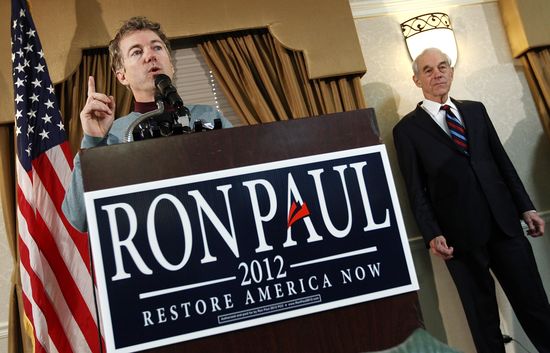
Steve Kornacki expects Ron Paul won't run as a third party candidate because it would damage the presidential aspirations of his son:

[I]f there’s an open presidential nomination in 2016, Rand Paul could be a major factor — starting with the base that his father now enjoys and expanding it in ways he never could. Or maybe he’d have to wait until 2020. Either way, though, it’s not inconceivable that Rand Paul could ultimately mount a successful campaign for the Republican nod. But if the Paul name were to turn into the Republican equivalent of Nader, the fallout could threaten the inroads that Rand has made and his otherwise bright future in the party. 

Robert Farley has similar thoughts:

Best case scenario for Rand is that Obama beats Mitt, letting the GOP get even more enraged over the next four years.  A Mitt defeat will be blamed on the "moderate," "establishment," elements of the GOP, likely increasing the appeal of a radical outsider.  It will depend on the other candidates, but I wouldn’t say he’s guaranteed to lose the nomination in the same sense as his father. I think that he’d be an extremely weak general election candidate, but of course the result of the election will turn mainly on factors that will develop closer to 2016.

(Photo: Senator Rand Paul (R-KY) introduces his father, Republican presidential candidate U.S. Rep Ron Paul (R-TX), at a campaign event during his 'Whistle-stop' tour with at the Steeple Gate inn in January 2, 2012 in Davenport, Iowa. By Win McNamee/Getty Images.)