Does Huntsman Have Momentum?

His most recent ad:

Nate Silver thinks Huntsman is gaining in the polls but that it won't be enough:

Our model puts Mr. Huntsman’s odds at about 250-1 against an outright win. It would very probably be the biggest last-minute upset ever in a caucus or primary.

 Patricia Murphy talks to voters:

"The guy is very impressive, he’s got ideas that are bang on, but it’s the way he presents it," says Gregory Slayton, a venture capitalist from Hanover. "He makes jokes people don’t get, his timing isn’t right. On paper, the guy is strong, but it may be too little, too late."

Alex Altman makes my point about Huntsman's tone-deaf delivery:

Part of the reason Huntsman has struggled to catch fire is his mixed messaging. Huntsman was tagged as a moderate early on because of his deviation from conservative dogma on issues like global warming. But he is a moderate in temperament only; his record and proposals on fiscal issues are among the most conservative in the field. Huntsman’s problem — one of them, anyway — is that he hasn’t made that clear.

Along the same lines, Larison continues to insist that Huntsman isn't moderate. Joe Coscarelli notes that every candidate has gotten a surge, which makes Huntsman's polling improvement less remarkable:

[I]f Huntsman's New Hampshire bump isn't proof enough that every Republican in this race gets their own little surge at some point, consider this: In the Granite State, Buddy Roemer is now polling above Rick Perry, who's alone in last place.
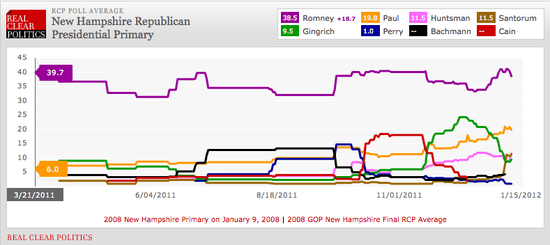
Romney Still Sinking In Tracking Poll

Screen shot 2012-01-09 at 11.43.57 AM

He dropped another two points today in the Suffolk University tracking poll … to 33 percent, a ten point drop in less than a week, but still more than ten points ahead of Paul. Some details:

Romney showed weakness among younger voters and in the north/west region of the state which includes the counties of Carroll, Cheshire, Coos, Grafton, and Sullivan. Among younger voters ages 18-34 years, Romney now trails Paul, who leads 36 percent to 22 percent. In the north/west region, Paul led Romney 25 percent to 21 percent.

But Paul remains stuck at 20, with Huntsman catching up. Around a quarter of the respondents say they could yet change their mind. I’m always open to the idea that New Hampshire can surprise.

Will Romney Win New Hampshire?

Almost certainly:

Although Hillary Rodham Clinton’s defeat of Barack Obama in the 2008 New Hampshire primary was an incredible story … it would not be in the same ballpark as Ron Paul or another candidate upsetting Mr. Romney. Had we run our forecast model on Saturday, Jan. 5, 2008, it would have put Mrs. Clinton 8.7 points behind Mr. Obama based on the polling at that time and given her a 10 percent chance of defeating him.

By contrast, Mr. Romney’s lead over his nearest competitor, Ron Paul, is 22.6 percentage points based on polling through Saturday morning — more than twice as large as Mr. Obama’s. That’s why our forecast model gives Mr. Romney just a 1 percent chance of losing.

But winning New Hampshire by an underwhelming margin would be perceived as a defeat. My test will be 30 percent. If he gets that, it's a win. But if either Huntsman or Paul get into the 20s, not a very convincing one.

Why Are We Scared To Announce Our Illnesses?

Jeff Jarvis asks:

With openness about health, we could do a better job connecting people who share conditions to get information and support and each other. I am on the board of Learning Ally, formerly Recording for the Blind and Dyslexic, and at our last meeting, I was struck by the barriers that stigmas put in the way of young people getting the organization's help. I heard how getting our software on iPods has helped more kids use the service because they no longer have to carry around a special device that marks them as different …

Will Amtrak Always Be Broke?

5133111417_fdc1a98acc_b

Freakonomics posed the question to a panel of experts:

Amtrak’s ridership and revenue has been steadily increasing over the last 10 years, and 2011 set a new ridership record with 30.2 million passengers, and $1.9 billion in ticket revenue. But, even though it took in $1.42 billion from Congress last year, it still manages to lose $1 billion annually.

Stephen Smith's conclusion on the privatization front:

The Northeast Corridor is an obvious candidate for splitting off and selling, because it’s both the most profitable route, and the only one whose tracks Amtrak actually owns. The rest of the network will almost certainly need subsidies to survive, although popular routes like those in California should be further separated from inland services, so that in case they are seen as profitable in the future, they won’t be held back by the morbid routes away from the coasts and major cities.

Yglesias thinks profitability needs to be defined:

Is the idea that Amtrak ought to operate the way a for-profit company would and not operate any services that don't earn positive cash flow? Or is the idea simply that Amtrak should earn a sufficient operating surplus from some lines to generate the necessary subsidy to discharge its public service obligations? Or is the question whether Amtrak can be turned into something that earns a reasonable rate of return on its capital investments? Or something in between? 

(Photo by Flickr user pheanix)

Call Your Mother

It will calm you down:

When girls stressed by a test talked with their moms, stress hormones dropped and comfort hormones rose. When they used IM, nothing happened. By the study’s neurophysiological measures, IM was barely different than not communicating at all. "IM isn’t really a substitute for in-person or over-the-phone interaction in terms of the hormones released," said psychologist Leslie Seltzer of the University of Wisconsin, a co-author of the new study. "People still need to interact the way we evolved to interact."