
Seattle, Washington, 10.52 am
Seattle, Washington, 10.52 am
Robin Hanson encourages it:
I’ve known some very successful people with quite weird ideas. But these folks mostly keep regular schedules of sleep and bathing. Their dress and hairstyles are modest, they show up on time for meetings, and they finish assignments by deadline. … Think of it this way. When some folks go out of their way to show off their defiance and rebellion, others go out of their way to publicly squash such rebellion, to assert their dominance. But if you are not overtly rebellious, you can get away with a lot of abstract idea rebellion — few folks will even notice such deviations, and fewer still will care. So, ask yourself, do you want to look like a rebel, or do you want to be a rebel?
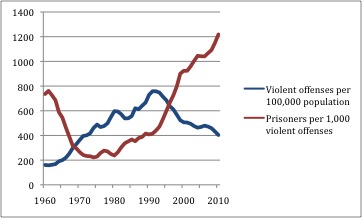
Charles Murray points to a higher rate of incarceration as the reason we've seen such a big drop in crime over the past two decades:
Suppose we had maintained imprisonment for violent crime at the rate that applied in 1974. In that case, we would have had 276,769 state and federal prisoners in 2010 instead of the 1,518,104 we actually had. Suppose tomorrow we freed 1.2 million inmates from state and federal prisons. Do we really think violent crime would continue to drop at a somewhat slower pace?
Pete Wehner thinks the answer is far more complicated:
I tend to be skeptical of mono-causal explanations when it comes to social phenomena and behavioral trends. These tend to be the result of a complex, and sometimes mysterious, interplay of events. For examples, since the early-to-mid-1990s, out-of-wedlock births have increased from less than 30 percent of all births to more than 40 percent of all births today. Yet during that period almost every other social indicator — including crime, drug use, welfare, education test scores, teen suicides, divorce, and abortion –improved. In some areas, like crime and welfare, the progress has the dimensions of a sea change. This is a remarkable, unexpected and encouraging development. It also reaffirms the conservative belief that modesty and caveats are in order when it comes to our ability to understand, let alone predict, social trends and human behavior.
Joel Warner reports that "live-audience sitcoms are turning to laughter ringers, folks so good at guffawing they're planted the audience and get everyone else cackling at the right moment." He profiles Lisette St. Claire, the woman who pioneered the business:
To prove her folks are right for the job, St. Claire picks up her phone and dials one of her go-to laughers, one of the Group A hotshots. "Give me a laugh," she says, and puts him on speakerphone. Never mind it's 7:30 in the morning, that the man on the other end has just been woken up. A dramatic, spontaneous cackling erupts from the phone, causing the early-bird crew working around us in the casting office to look up and smile, and a few chuckle themselves.

An antique violin seller recounts what happens when a buyer disputes the authenticity of a purchase:
I sold an old French violin to a buyer in Canada, and the buyer disputed the label. This is not uncommon. In the violin market, labels often mean little and there is often disagreement over them. Some of the most expensive violins in the world have disputed labels, but they are works of art nonetheless. Rather than have the violin returned to me, PayPal made the buyer DESTROY the violin in order to get his money back. They somehow deemed the violin as "counterfeit" even though there is no such thing in the violin world. The buyer was proud of himself, so he sent me a photo of the destroyed violin. I am now out a violin that made it through WWII as well as $2500. This is of course, upsetting. But my main goal in writing to you is to prevent PayPal from ordering the destruction of violins and other antiquities that they know nothing about.
Chris Morran pinpoints the problem:
It is certainly not uncommon for people in the antique musical instrument field to argue over whether or not a particular item is the real deal, and it makes sense to notify PayPal that you are disputing the purchase. But the decision as to whether or not the violin is the real deal or an impersonator is not usually left up to the company that promises the payment.
PayPal's official statement:
While we cannot talk about this particular case due to PayPal's privacy policy, we carefully review each case, and in general we may ask a buyer to destroy counterfeit goods if they supply signed evidence from a knowledgeable third party that the goods are indeed counterfeit. The reason why we reserve the option to ask the buyer to destroy the goods is that in many countries, including the US, it is a criminal offense to mail counterfeit goods back to a seller.
How arguing with your parents can be constructive:
Effective arguing acted as something of an inoculation against negative peer pressure. Kids who felt confident to express themselves to their parents also felt confident being honest with their friends. So, ironically the best thing parents can do is help their teenager argue more effectively. For this, [Joseph] Allen offers one word: listen. In the study, when parents listened to their kids, their kids listened back. They didn't necessarily always agree, he says. But if one or the other made a good point, they would acknowledge that point. "They weren't just trying to fight each other at every step and wear each other down. They were really trying to persuade the other person."

Mamaroneck, New York, 7.03 am
Seriously, the funniest Mental Health Break I've heard in yonks.
For Vanity Fair, on Dickens and his attempt at redemption after a career of insulting Americans. Money quote:
[F]rom a deep boiling layer of anxiety and rage that goes well beyond anything Dostoyevsky might or might not have been told about, we have the Dickens who wrote to his best female friend, Angela Burdett-Coutts, in 1857, telling her of his yearnings to “exterminate” the Indian rebels against British rule. We have the Dickens who joined his friends Thomas Carlyle and Ruskin against Darwin, T. H. Huxley, J. S. Mill, and the other Victorian humanitarians, to support Governor Eyre of Jamaica in his war of torture and execution and reprisal against the rebels of that country.
We have—this is in some ways the most depressing of all—Dickens’s surreptitious hatred for Americans, even as he was making his way from one scene of their immense hospitality to the next in the 1840s. Admittedly, he had a qualified beef with those Yankee publishers who wouldn’t part with royalties, but this hardly licences what he wrote in private to his friend the actor William Macready about America’s being “a low, coarse and mean nation” that was “driven by a herd of rascals Pah! I never knew what it was to feel disgust and contempt, ’till I travelled in America.” The Dickens mean streak is quite something when you strike it.
The use of that word "strike" is pure Hitch.
 The Dish