Face Of The Day

Sand-2

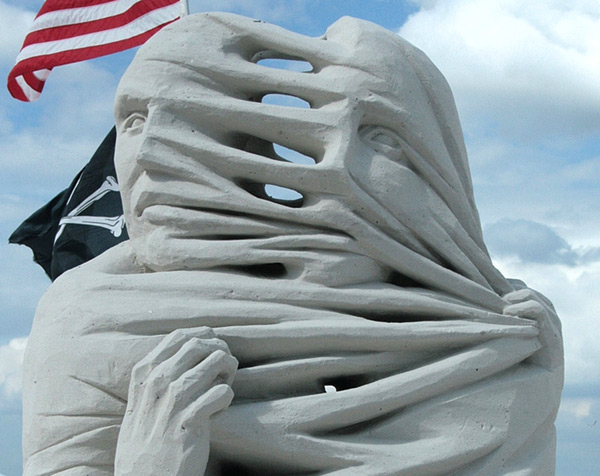
Christopher Jobson marvels at the sand sculptures of Carl Jara:

Call me old fashioned, but when I think of a sand castle competitions my mind is filled with images of giant structures adorned with mermaids, pirates, and sand dollars, enormous boat-devouring sharks, and faithful replicas of Mount Rushmore or the Leaning Tower of Pisa. How pleasantly surprised I was to find these striking figurative sculptural works by Cleveland-based sand sculptor and woodworker Carl Jara, who says his intention is to sculpt things with sand you would never expect to see at a sand castle competition. His work is so accomplished you almost forget the medium you’re looking at, the pieces appearing as if carved from marble or wood.

Jara has won nine World Championship medals. Follow more of his work here.

The Joys Of A Yenta

Marina Adshade explores why we love to set people up:

Matchmaking has essentially gone out of favour because people presume that others don’t want their help in finding love. That may be true, but there is new evidence that suggests we should do it anyway, if for no reason but to increase our own happiness. In a laboratory experiment and an online survey, the research finds that people who work at bringing others together are over-all happier than those who do not.

What is interesting about this research is that an increase in happiness isn’t even dependent on a personal connection to the people being matched – happiness can be found in matching complete strangers. It seems as well that the less likely it is that the two people would have matched without help, the more satisfying the match is to the matchmaker. People are made happiest by matching people who bring together different qualities. For example, in the experiment participants were happier when they made inter-racial matches than when they made same race matches. 

The Season For Reading

85752623_4f15c9fb74_o

Nika Knight compiles her favorite quotes about winter. A gem from David McCullough:

Once upon a time in the dead of winter in the Dakota Territory, Theodore Roosevelt took off in a makeshift boat down the Little Missouri River in pursuit of a couple of thieves who had stolen his prized rowboat. After several days on the river, he caught up and got the draw on them with his trusty Winchester, at which point they surrendered. Then Roosevelt set off in a borrowed wagon to haul the thieves cross-country to justice. They headed across the snow-covered wastes of the Badlands to the railhead at Dickinson, and Roosevelt walked the whole way, the entire 40 miles. It was an astonishing feat, what might be called a defining moment in Roosevelt’s eventful life. But what makes it especially memorable is that during that time, he managed to read all of Anna Karenina. I often think of that when I hear people say they haven’t time to read.

(Photo by Michael Glasgow)

Literary Darwinism

R. Salvador Reyes theorizes as to why we love to hear and tell stories:

There is a deep part of our brain that is a pattern junkie; it feeds on them, needs them, wants to find them everywhere. And it doesn’t do this without reward. … When you think about the kinds of patterns that are useful for prediction—patterns that are defined by a certain string of actions and reactions that occur within a specific set of conditions—it is easy to see that these types of patterns are, in essence, stories. Most predictive patterns are ultimately a type of narrative. Think again about how we just defined a pattern that’s useful for prediction: a certain string of actions and reactions that occur within a specific set of conditions. Aren’t those also descriptions of plot and setting? …

In fact, we’re so addicted to ferreting out a useful pattern from consumed data that we’ll often see narratives when they aren’t really there: conspiracies, astrology, the man who ends up on “Dateline” after being wrongly accused of killing a wife who actually slipped in the tub. Randomness, events that seem to have happened without just, plausible cause or didn’t lead to a logical, believable result—this is data that our brain has no use for. Much better for us to find a narrative in the nonsense, because a narrative is what we seek, what brings us that pattern pleasure, what satisfies our need to turn the chaos at the center of our Times Square-ish universe into something we can contemplate and navigate.

Killing Pub Culture In The UK?

201083495_0bd4189ede_z

Victoria Henshaw worries:

Now that tobacco legislation has moved all the smokers outside, pubs have started to smell of body odour, urine, stale beer — all those sorts of things, instead. A lot of people on my smell walks really mourned the smell of the traditional English pub. Smoke was a large part of it, but really all those odours combined together to create this unique mix — the smell of the English pub — which people perceived as a comforting odour. And now it’s gone. It’s not that people don’t perceive the health benefits, but they do miss that smell.

What was interesting was that a lot of my smell walkers talked to me about how they are actually more annoyed now by experiencing cigarette smoke in the street than they were by it in the pubs, because in the pubs it was expected to be in there and it belonged, and they don’t think it belongs in the street in the same way. That seems to be part of the current mindset: we’ve sanitized our urban environments to such a degree that any experience that’s out of our control, we automatically react negatively to it.

William Murphy explains the above scene:

One of the results of the smoking ban in Ireland is that many people now go outside to smoke and during good weather they bring their drinks with them. This photograph was taken outside a Dublin Pub at mid day on a Saturday. Dublin is dirty enough without having glasses and beer bottles on the streets.

The Inventor of “Effortless Abundance”

Alexis Madrigal gives thanks to Kodak, which is on the verge of bankruptcy:

[B]efore Kodak, photographs of death and other somber themes were far more common than in the snapshot era that followed. Kodak pitched its cameras, through a series of different ad campaigns, as vehicles for capturing good times, good memories, good stories. Not war, but the letter a soldier would read to comfort himself while in the trenches. Kodak's themes resonated with a newly wealthy, pre-Depression American population that liked to go on vacation and camping. It said to them: you can capture the good life with the press of a button.

John Paul Titlow blames the smartphone for killing the company.

How Lego Cities Are Like Real Cities

Legos

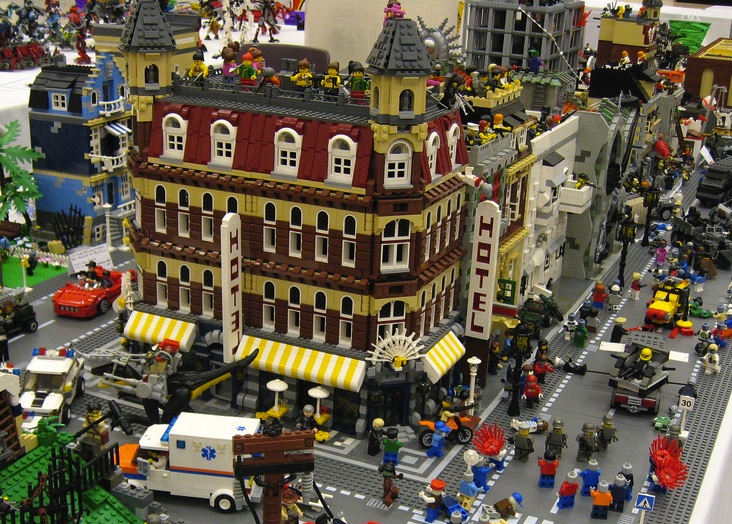
They both follow a power law, meaning " as the number of pieces in a set grows, so do the number of piece types":

However, the number of piece types grows sublinearly: while a larger set uses more piece types, as sets becomes larger, they use progressively fewer additional piece types (so larger sets actually use fewer types per piece). This is similar to other sublinear curves, where larger animals use less energy per cell for metabolism or larger cities actually need fewer gas stations per capita. Essentially, larger sets become more efficient, using the same pieces that smaller sets do, but in a more complex and diverse way.

(Photo by Flickr user Dunechaser)

Is Reading Anti-Social?

Nicholas Carr doesn't think so:

In our day-to-day lives, we are always trying to manipulate or otherwise act on our surroundings, whether it’s by turning a car’s steering wheel or frying an egg or clicking on a link at a website. But when we open a book, our expectations and our attitudes change drastically. Because we understand that "we cannot or will not change the work of art by our actions," we are relieved of our desire to exert an influence over objects and people and hence are able to "disengage our [cognitive] systems for initiating actions." … It is only when we leave behind the incessant busyness of our lives in society that we open ourselves to literature’s transformative emotional power.

That doesn’t mean that reading is anti-social. The central subject of literature is society, and when we lose ourselves in a book we often receive an education in the subtleties and vagaries of human relations. Several studies have shown that reading tends to make us more empathetic, more alert to the inner lives of others. The reader withdraws in order to connect more deeply.