The reader response to this post (at least from atheists) has been overwhelming, for which I'm extremely grateful. Most of my fellow atheists appear pretty willing to accept my characterization of their beliefs. A representative email on that front:
I'd say that you and Kenan Malik have more or less captured what I, as an atheist, believe about the question of God's existence. In fact, I'd go a step further – I think you have more or less captured the view of virtually every atheist I have known and talked to about the subject. Obviously, that's a small sample size with a considerable demographic skew, but I think it captures something that gets repeatedly lost in discussions of "new atheism:" plenty of people are atheists for the simple reason that they try not to believe in things without good reason, and they see no good reason to believe God exists.
Another:
In general, we can expect atheists and theists to agree on the usefulness of empirical evidence, but theists seem much more sympathetic to broadening the sorts of beliefs that we can count as justified or warranted. So I think that indeed, much of the divide here is on a sort of "meta" level: What sorts of evidence actually count as evidence and actually justify beliefs?
A third can't understand why anything other than logic or science could ever give a good reason to believe in something:
Jack says that two plus two is four, while John says that two plus two is five (or any number other than four). No problem. We have a mechanism, arithmetic, that allows us to determine which one of them is telling the truth. We also have a way of detecting whether, possibly, they are both wrong.
Now try this in religion.
Jack says that Jesus Christ is the Son of God, while Mohammed is a false prophet. John says that Mohammed is the Prophet, while Jesus is NOT the Son of God. Both of them can claim to have "religious evidence" for their claims – personal experience, feeling of revelation, whatever.
There is no way – no way at all – to tell who is telling the truth (or to tell whether either one is). The choice is simple: we have to either completely give up the notion of truth, or we have to set *some* standard which allows us to tell true statements from false ones. Outside of pure abstract theism ("I believe that somehow somewhere there is something big and important, which I will refer to as God"), no religious thought can meet even the simplest standard possible. Atheists aren't setting unreasonably high standards for believers. Our argument holds if we set *any* objective standard whatsoever.
That's probably what motivated another to write that atheists "want proof of God using the same standards the FDA uses to approve cough syrup as safe and effective." Another reader thinks the view I described is better characterized as agnosticisim:
I am willing to accept your characterization of my position, but it is exactly because I hold this view that I do not call myself an atheist (which seems to be popularly identified as someone who actively asserts that there is no God) but rather a doubting agnostic. Putting a little extra spin on your characterization, I would say that science can neither prove nor disprove God at this stage; additionally, I think that there are serious logical flaws with many of the religious depictions of God that I'm familiar with. But I find it equally illogical to state definitively that there is no God; proving a negative on that order is almost impossible. Thus, I'm a doubting agnostic.
Frankly, I don't spend a lot of time worrying about the existence of God. Something about my mind tends to shut down questions that I'm confident are unanswerable to my satisfaction. Maybe that's the difference between agnostics and true believers of one sort or another.
But this is precisely why I don't think agnosticisim is meaningfully different from atheism. Most atheists don't claim to have definitively disproven God any more than they claim to have definitively disproven leprechauns, but they're comfortable in saying they don't believe either exist. Are agnostics agnostic about leprechauns as well? A final reader thinks the whole debate is missing the point:
The main issue isn't whether some sort of god exists. The main issue is whether we change how we live our lives – whether we subvert our will to the authority of such a supreme being. We can talk on and on about whether some omnipotent consciousness conceived the universe we perceive, but even if you can provide an ironclad argument demonstrating beyond doubt that it did, you're still a long way from convincing me that I should be a Christian, or a Muslim, or a Jew. Even if "the creator" exists, it doesn't automatically follow that s/he/it doesn't like gay people, or wants me not to use a condom, or have premarital sex, or even, for that matter, murder my neighbors and steal their shit.
Because the term "atheist" is understood to mean "doesn't believe god exists", that's often where the discourse is focused. And so you end up with a lot of talk about the inability of atheists to explain all observable phenomena, or the origin of the universe, or the quantum leap that generated the first self-replicating molecules on earth. I do think most atheists would, failing evidence, tend to suppose that there is an explanation for all these things that doesn't require divine consciousness. But I also think that what atheists are really against is the idea that the answer to this question ought to influence how we live our lives.
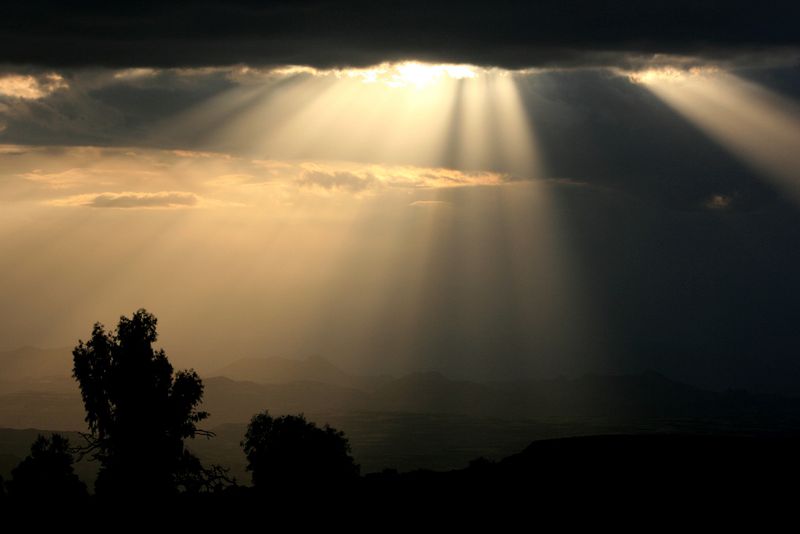
(Image by Flickr user DamienHR, who captions, "I saw these sunrays, and took this picture, just after visiting the mysterious Churches of Lalibela [Ethiopia], as the night was showing up. Somehow I got the impression that God was speaking.")
 The Dish