by Patrick Appel
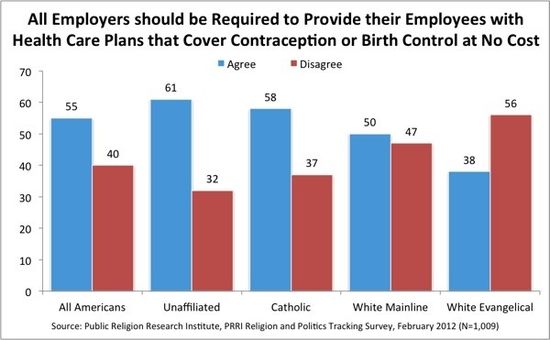
Chart above from Sarah Kliff. TNC captions:
The difference numbers for Catholics and White evangelicals are really interesting. It's almost as if the issue for Republicans, isn't so much a hard pitch to Catholics, as it is a hard pitch to white Evangelicals, with the hope of clipping off some conservative Catholics along the way.
Eleanor Clift wonders whether the Obama administration provoked the controversy intentionally:
The election won’t turn on these kinds of cultural issues, but they can generate emotion and passion. Obama’s job approval is just above 50 percent among younger voters, a group that gave him 66 percent of their vote in 2008. “They’ve got to get young people jazzed up, and there are very few issues that get young women more jazzed up than contraception,” says Cook. Indeed, the Obama campaign website highlights the issue of contraception, along with the fact that it will be free once the Affordable Care Act is implemented.
David Link points out that the vast majority of Catholics use birth control:
Here, there is nothing at stake but the power of the bishops to demand in the civil world a rule they cannot enforce in their own domain.
Douthat counters this argument:
Yes, sometimes state interests are compelling enough to trump religious liberties, and defenders of this mandate have every right to make that case. But the argument that the state’s interests can trump religious liberties so long as the group of people being asked to violate their consciences is small enough is not an argument at all. It’s just a raw appeal to power.
Amanda Marcotte claims that many Catholic institutions are indistinguishable from secular ones:
The notion that the culture of Catholic-affiliated universities and hospitals is substantively different than secular or Protestant ones, and thus deserves some kind of special dispensation from having to obey the law, is something that direct experience with these institutions should immediately disprove. I personally went to a Catholic-affiliated university, and the reason that it was a fine fit for my atheist self was that "Catholic-affiliated" is basically meaningless when it comes to the daily business of a university. Culturally, there was no real difference between my school and a secular school.
Jonathan Rauch, who "thinks the church’s position on contraception is absurd and harmful," nevertheless defends the church:
I think the starting point for discussion should be, “What’s the most—not the least—amount of leeway we can give to religious institutions without undermining important social or governmental ends?” First, because it’s what Madison and the founders intended, and they were smarter than we are. Second, because it’s good social policy to avoid unnecessary conflict. Third, because erring on the side of diversity is a partial brake on the natural but dangerous tendency toward absolutism in the exercise of power.
And Lexington asks why a compromise isn't possible:
It is surely not beyond the wit of man to find a way to make sure that all women have affordable access to contraception without demanding that Catholic institutions do something they find morally repugnant by buying such policies directly. Why not have such institutions help their staff find outside providers who can offer the full range of contraceptive services? Or give employees in these institutions the option of buying insurance through the new Obamacare exchanges designed to help the self-employed?
Zack's defense of the new regulation, from last night, is here.
 The Dish