Peggy Kamuf tracks our primitive instinct for accumulation:
People really couldn’t settle down in one place until they figured out reliable storage methods for the fruits of their labors. Because they don’t store food in any quantity, hunter-gatherers have to keep moving to better hunting and foraging grounds. The anthropologist James Woodburn has made the distinction between “immediate return” and “delayed return” economies, terms he uses to classify foraging societies that consume their food within a day or two, as if there were no tomorrow, as distinct from social organizations that practice some kind of food storage. Most anthropologists agree that immediate-return societies are typically nonhierarchical and egalitarian, more egalitarian at any rate than delayed-return societies. Which suggests that social inequality couldn’t really get a foothold until people developed a storage capacity.
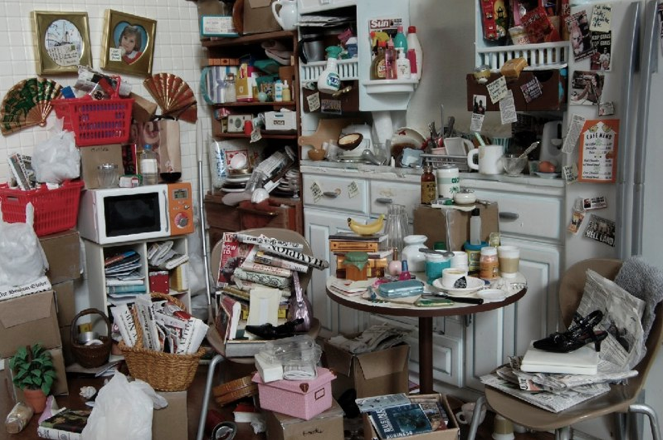
(Image from Barbie Trashes Her Dreamhouse, a 1/6th scale hoarder's house by Carrie M/ Becker.)
 The Dish