Marc Lynch summarizes his new report [pdf] outlining a strategy for toppling Assad without war:
[T]he time for negotiations with the top levels of the Assad regime has passed, and if they refuse to engage immediately then they should be moved towards indictment at the International Criminal Court. A real choice should be given to lower level state officials, who should understand that their window is rapidly closing to defect or be indicted. Targeted sanctions should increase the pressure on the top of the regime. The Friends of Syria group should coordinate international activity, and every possible international forum should be mobilized to isolate and shame the Syrian regime.
But pressure is not enough. Efforts should be stepped up to reach out to the broad base of the regime's remaining political support and to persuade them to take a frightening, risky leap into the unknown of a transition.
Ed Husain and Shadi Hamid debate whether any military steps could make things better there. Jonathan Spyer reports from Syria on the difficulties in engaging with the armed rebels:
[I]t is very clear that there is, in fact, no real leader. Armed resistance against the Assad regime has emerged out of the very basic need to protect the Syrian civilian population from their murderous dictator. A united, countrywide armed resistance movement does not yet exist in Syria. Nor do the rebels possess a single, uniting political idea, beyond bringing down the dictatorship. They seemed to be united by something more fundamental: They have all witnessed suffering caused by the regime. A good number of the fighters I spoke with were asked to carry out the violence themselves.
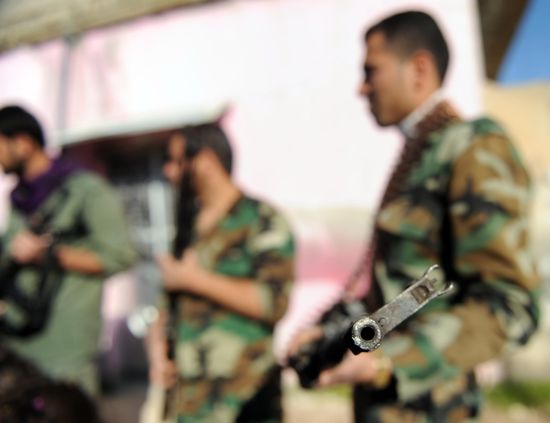
(Photo: A Free Syrian Army fighters stands guard in Idlib, northwestern Syria, near the Turkish border, on February 20, 2012. The Red Cross said it was in talks with the Syrian authorities and rebels to halt the violence so it can deliver aid amid calls to allow women and children out of the besieged city of Homs in central Syria. By Bulent Kilic/AFP/Getty Images.)
 The Dish
