The US is the red dot in this healthcare price comparison chart:
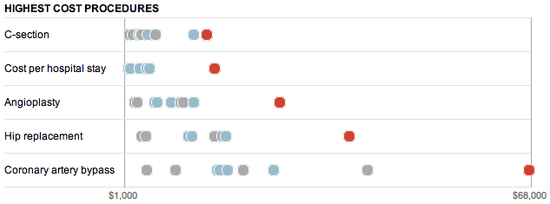
Ezra Klein studies why American procedures are much more expensive. One theory:
“In my view, health is a business in the United States in quite a different way than it is elsewhere,” says Tom Sackville, who served in Margaret Thatcher’s government and now directs the IFHP. “It’s very much something people make money out of. There isn’t too much embarrassment about that compared to Europe and elsewhere.” The result is that, unlike in other countries, sellers of health-care services in America have considerable power to set prices, and so they set them quite high.
Follow-up here. In other health spending news, a new study finds that electronic medical records are associated with more testing and, therefore, more healthcare spending. Drum defends them regardless:
I never bought the notion that electronic records would really restrain costs much anyway. I just think they're a good idea because they'll reduce medical errors and make life more convenient. I've been with Kaiser Permanente for the past few years, and their extensive computerization of everything really does streamline the whole process of dealing with the healthcare system. I'm totally sold, regardless of whether they're saving any money by doing it.
Yglesias bets the healthcare spending will increase no matter what:
Once you're talking about a middle class family in a developed country—a family that's not worried about starving to death or freezing on the streets or being unable to afford shoes—you're talking about a family that's going to plow what resources it has into attempting to address the potentially limitless health care needs of its members.
Relatedly, Aaron Carroll argues that HSAs won't fix runaway spending.
 The Dish