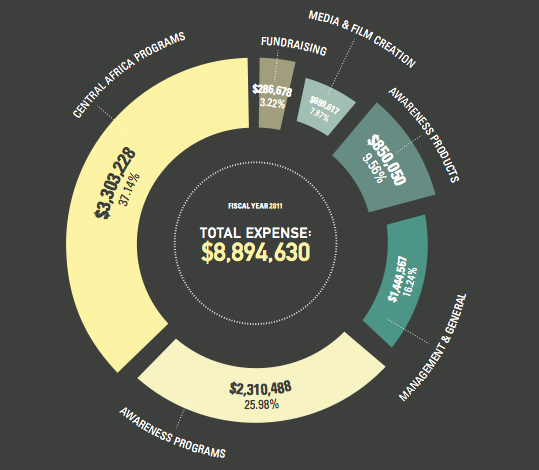
In response to heavy criticism, Invisible Children has posted a defense of their goals and the above chart detailing how they work towards attaining them. Sarah Margon half-nods:
[Invisible Children]'s grassroots mobilization contributed overwhelmingly to the passage of The 2009 LRA Disarmament and Northern Uganda Recovery Act — the most widely cosponsored bill Africa-related piece of legislation in the last 37 years — and more generally to the ongoing prioritization the LRA throughout State and USAID, as well as to the President’s decision to deploy U.S. military advisors to central Africa. Of equal importance is that Invisible Children also supports an innovative radio program in the remote regions of eastern Congo. This program collects information about LRA movements, abductions, and defections and is often better and more up-to-date than the information obtained by the United States government.
So, instead of continuing to debate the strengths and weakness of the Kony2012 video, or attack Invisible Children for their lack of financial transparency, let’s figure out how to turn this momentum into a constructive opportunity that can result in smart policies that will have a positive, real-time impact in the affected areas of central Africa.
Ugandan social media users are less sympathetic. Holden Karnofsky wants "smart policies" that follow from Invisible Children's campaign to be focused on malaria rather than warlords. Dish readers sound off:
Yesterday, my daughter told me she would be speaking today about Joseph Kony in her civics class. His story had not come across my radar screen; but it had come across hers. Told me she had been the one who raised the subject to Mr. Martinez, who encourages his students to discuss current events. Normally, Julia's not informing me of anything other than what the kids on "Glee" are up to. She and I both remarked yesterday that this might be the first time she was ahead of me on something that I eagerly wanted to follow up on and learn more about.
Wherever the story goes from here, I was struck that this was how I learned about it. I try to keep well-informed, and I had whiffed on this one until my socially plugged-in kid caught me up. The power of inter-connectivity and the developing methods of communication still sneaks up and surprises me sometimes.
Another is more blunt:
Who the fuck cares about all this hand-wringing over Invisible Children? The group got millions of apathetic Americans to care about something instead of the fucking Kardashians for a minute. I think this is going to set a new pathway for this type of social activism. Build all the schools you want to in obscurity, but my bet is that getting 35 million YouTubers in a day is going to have a much more significant, long-term effect. Never let the perfect be the enemy of the good.
Another:
The true problem with countries like Uganda and the Congo is that they are full of minerals, notably Coltan – a mineral used in virtually every laptop and cellphone. The governments, rebel tribes and warlords are all fighting for control of these mines, which industrialized nations purchase by the truckload with little to no regard for the collateral damage that comes with the mining. This is a far more complex and a far less sensationalist concept than hunting down Kony, but compared to this larger issue, Kony is almost irrelevant.
Once Kony is killed or found, everyone who got behind #KONY2012 will celebrate, undergo some type of catharsis, and then forget about the whole thing while they type away at their laptops that are fueling the whole thing.
The role of mining in these conflicts isn't so simple either. Nick Sibilla points out that a provision in Dodd-Frank is "a de facto embargo on Congolese mining":
This has been disastrous for that nation's already troubled economy. Some Congolese mines have seen output plummet by 95 percent, while anywhere from tens of thousands to upwards of two million Congolese miners have lost their jobs. Meanwhile, militia leaders have formed smuggling networks and bribed officials to bypass the disclosure requirement. In addition, since American demand has dropped, morally flexible Chinese firms have invested heavily in these mines, obtaining commodities at huge discounts.
 The Dish